The trouble with the universe is that the true numbers don't fit in a human head. "The nearest star is 25 trillion miles away" is not a fact you can feel; it's just a long noise. So let's do the only thing that ever works: shrink everything by the same factor until one piece of it fits in your hands, and then walk outward and see what happens to the rest.
We'll do it twice — once for space, once for time — and both times the punchline is the same. You can make the Earth small. You cannot make the universe small. It will not let you.
Act I · SpaceHold the Earth in your hands
Take the whole Earth and shrink it until it is a Cheerio — half an inch across. That's our one move: every distance and size from here on is shrunk by the exact same factor, and the factor turns out to be almost indecently clean — one billion to one.
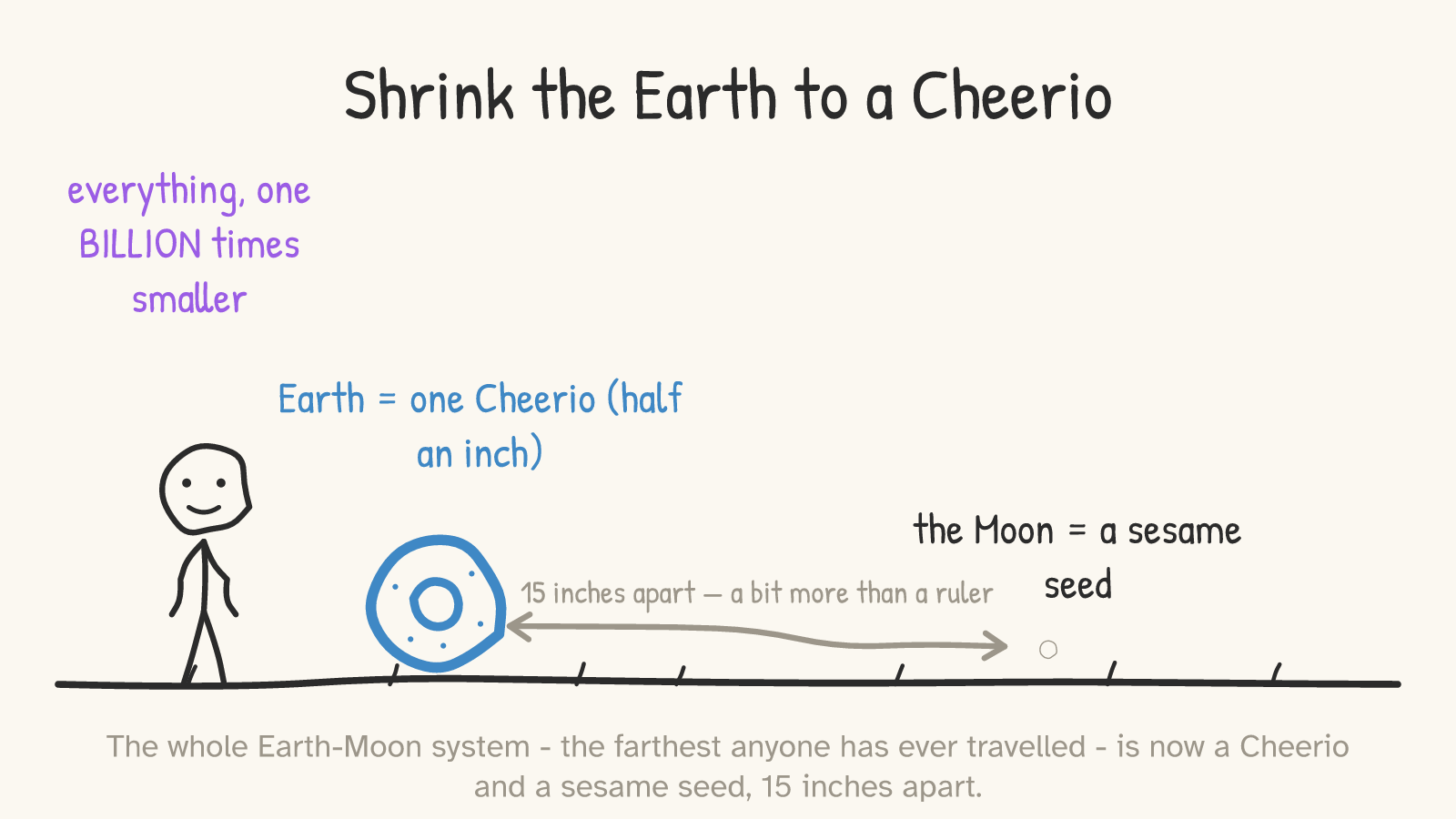
At this scale the Moon is a sesame seed, and it sits about 15 inches away — a bit more than a ruler. That's it. The entire Earth-Moon system — the farthest any human being has ever travelled — is a piece of cereal and a sesame seed on the desk in front of you. Comfortable. Graspable. Enjoy it, because it is the last comfortable thing that will happen.
Then the Sun is chest-high, a block and a half away
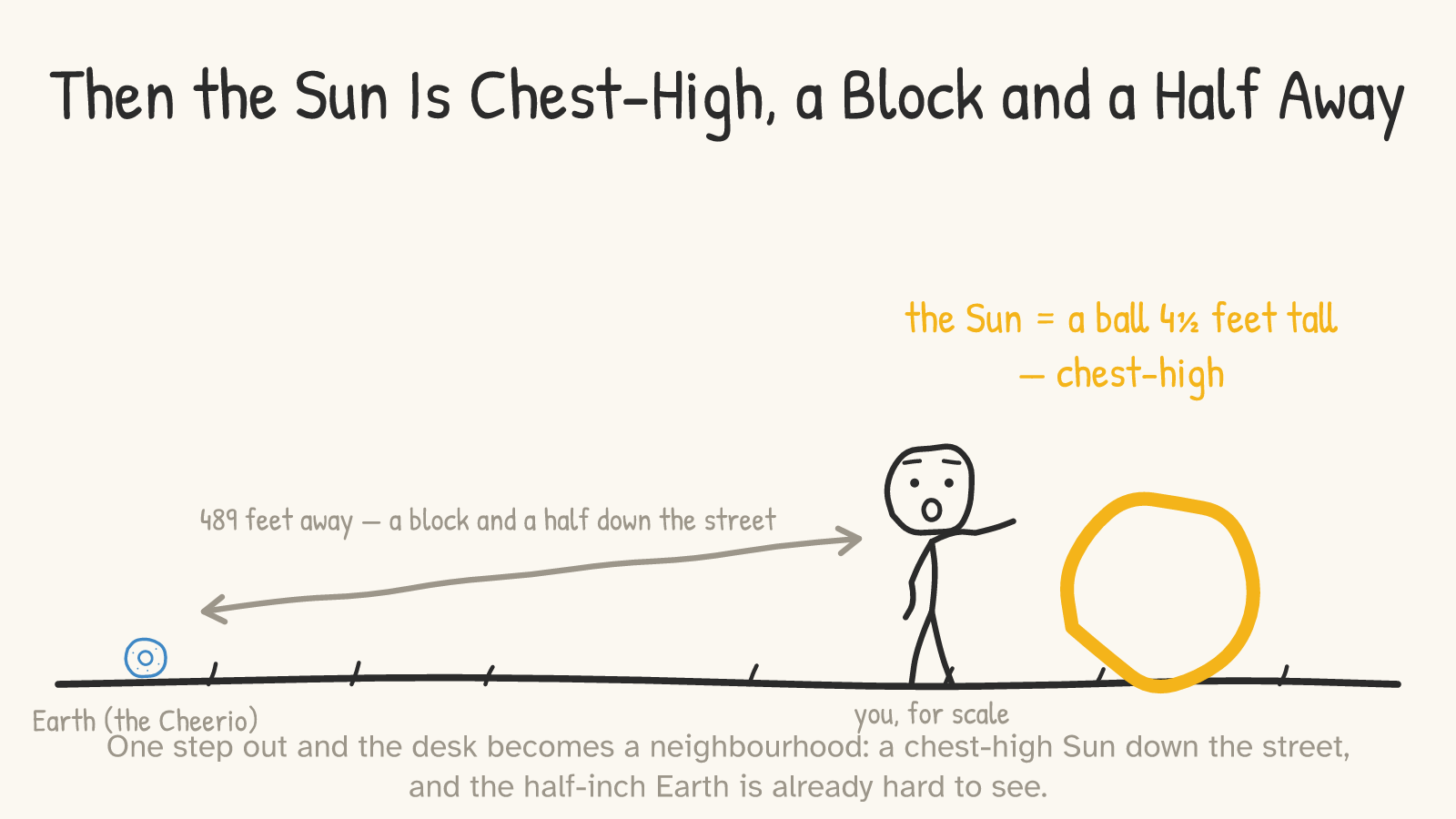
One step out and the desk becomes a neighbourhood. The Sun, on the same scale, is a ball four and a half feet tall — chest-high on an adult — and it stands 489 feet away, a block and a half down the street — a ninety-second walk. Your Cheerio Earth, meanwhile, has become something you'd genuinely struggle to spot from the Sun's corner. We've taken exactly one step out from the Moon and already the model has stopped being cozy and started being a walk into town.
The nearest star breaks the model
Here is where the trick begins to fail, and the failure is the most interesting thing in the essay.
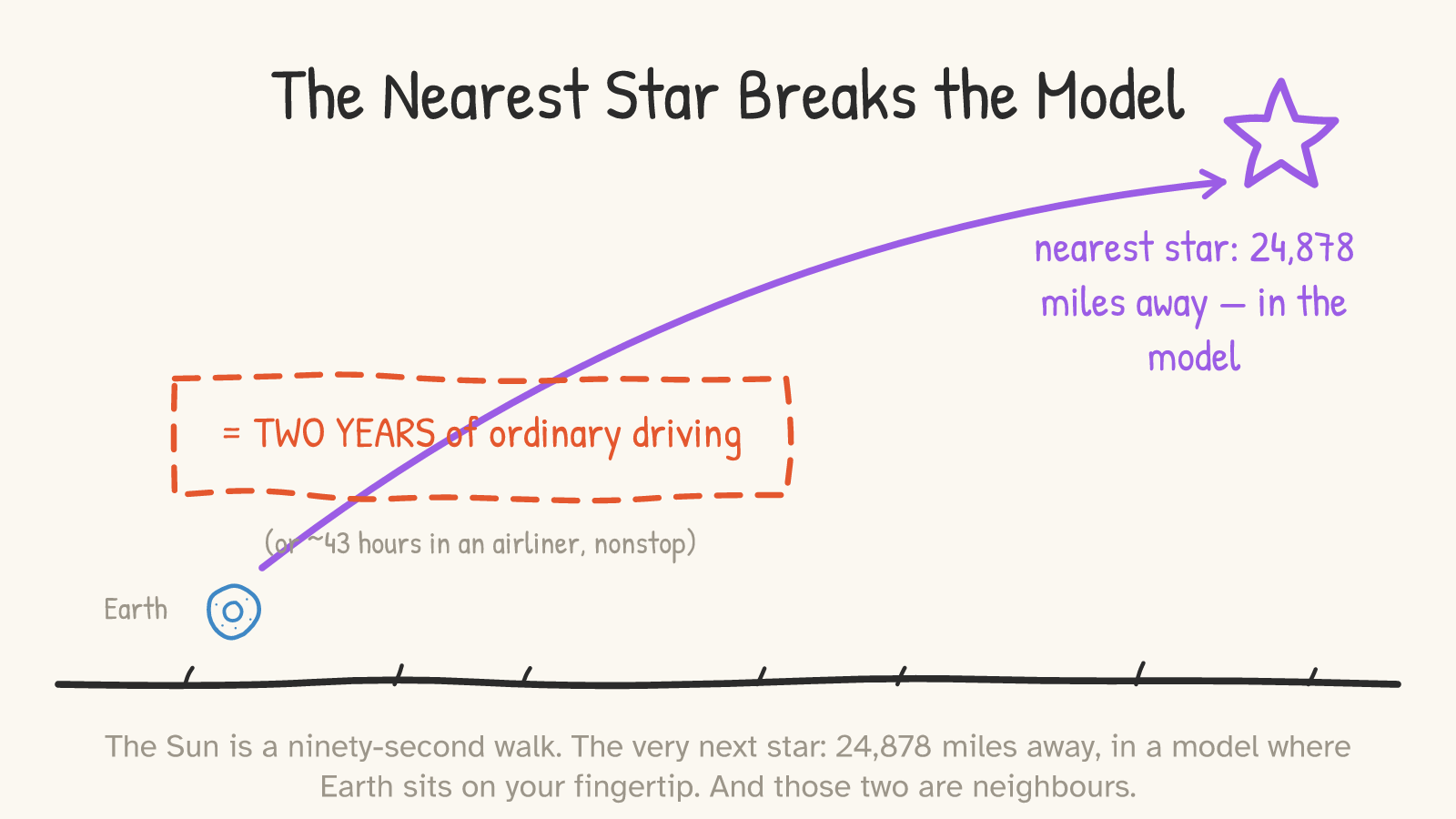
The Sun is a ninety-second walk down the street. The nearest star — Proxima Centauri — is, in our model, about 24,878 miles away. Now, that's a model distance, so it needs a human anchor, and here's the unsettling one: 24,878 miles is two years of ordinary driving. It's forty-three hours in an airliner, nonstop. We shrank the Earth a billion-fold — the planet fits on your fingertip — and getting from our Sun to the very next star still costs every mile your car covers between new-car smell and its first big service. And those two stars are neighbours. The shrink ray is already losing.
(Whenever this essay compares a model distance to a real one, it will say so out loud — "in the model, X is as far as the real Y." That apples-to-oranges move is the whole point: it shows exactly how little the shrinking helped.)
Now the airliner needs a century
And here the model stops paying you in distances at all, and starts charging you in time.
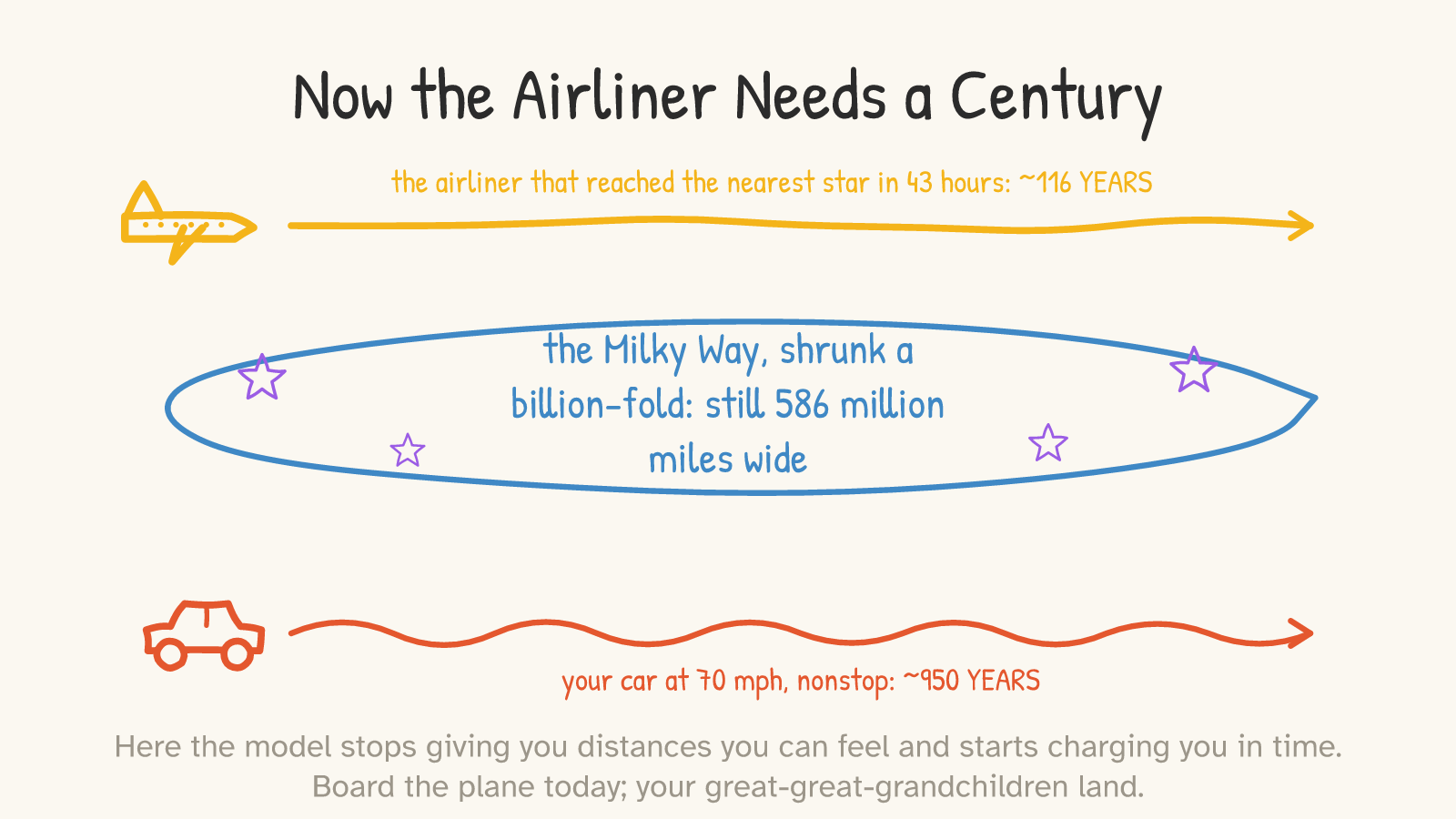
The Milky Way is really about 100,000 light-years across — a number with no hope of meaning anything. Shrunk a billion-fold, the galaxy is still 586 million miles wide — which is no longer a length in any human sense, so the model switches currencies. The airliner that carried you to the nearest star in 43 hours — same plane, same cruise speed, no stops — needs a hundred and sixteen years to cross the toy galaxy: board today, and it's your great-great-grandchildren who land. Your car, at 70 mph, needs about 950 years: pull out of the driveway today and you arrive around the year 2980. That is the shrunken galaxy. The model didn't make it small; it made it measurable in generations instead of in nonsense.
You cannot make the universe small
And then we reach the edge, and the model doesn't just strain — it surrenders.
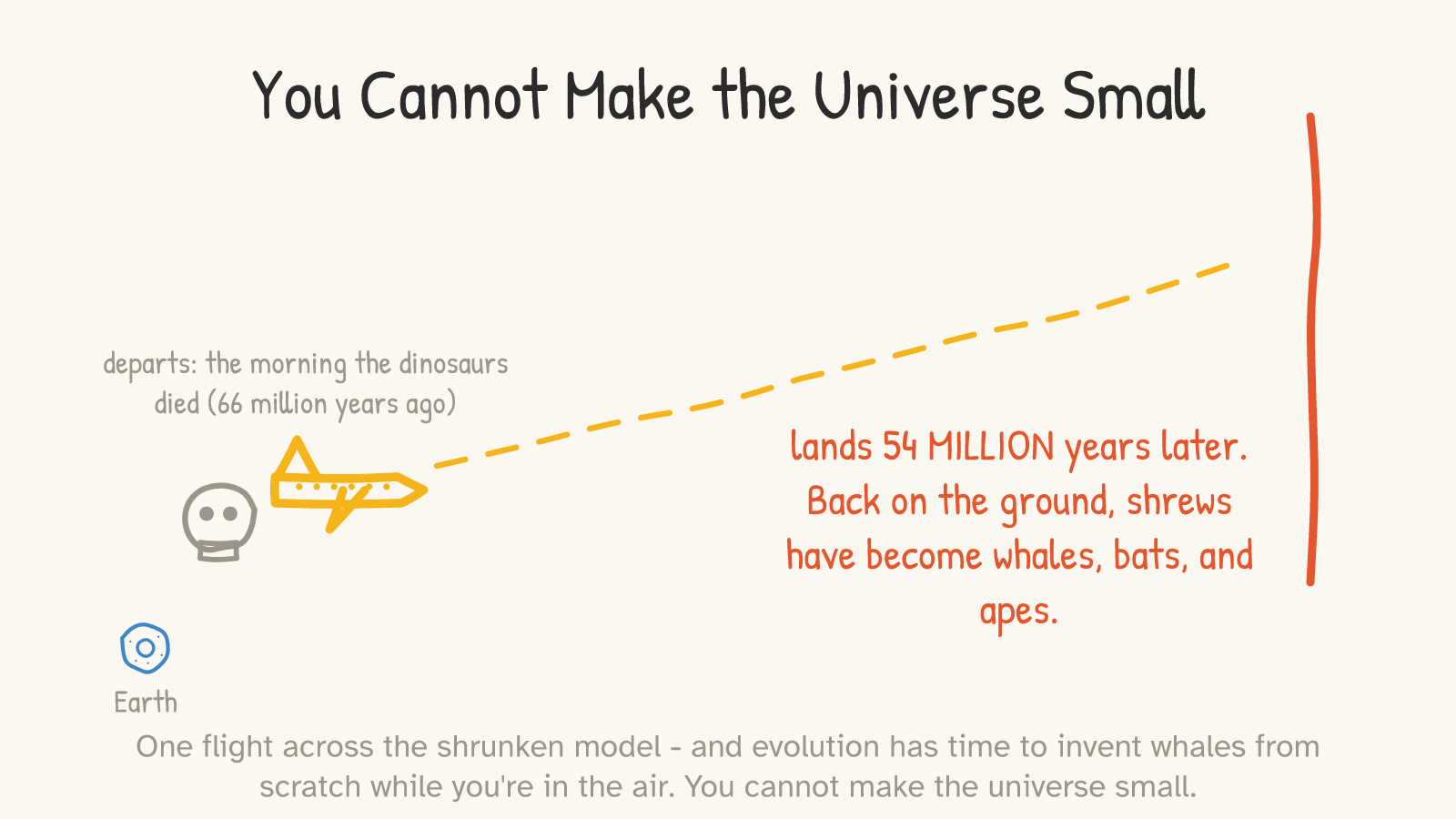
The edge of the observable universe is, in real units, the longest of the long noises — tens of billions of light-years, a number with nothing for your hands to hold. So stay inside the model, and keep paying in the model's own currency. The same airliner — 43 hours to the nearest star, a century across the galaxy — needs fifty-four million years to reach the edge of the model. You can't feel a number like that, but you can feel what it does, so put the plane in the air the morning the dinosaurs die and look out the window. At takeoff, the largest mammal below is the size of a shrew. While you cruise, those shrews become whales. They become bats. They become apes. Evolution invents a planet's worth of new animals from scratch — and the seatbelt sign is still on. One flight, across the toy. (That's to the edge — your distance to it; corner to corner, double it: two whole evolutions.) We shrank the Earth a billion times and the universe barely noticed. That is the thesis, drawn: you cannot make the universe small.
Two honest notes here, because this is exactly where a careful reader gets suspicious:
"Observable" is doing real work. We can only see the part of the universe whose light has had time to reach us — a bubble about 93 billion light-years across. The whole universe is at least vastly larger than that, and might well be infinite. We are not shrinking the universe; we are shrinking the part we can even point a telescope at.
"46.5 billion light-years, but the universe is only 13.8 billion years old — nothing can outrun light, so how is the edge that far?" Good catch, and it's not a mistake. That 46.5 billion is a comoving distance. The most distant light we can detect — the cosmic microwave background, the glow of the hot plasma that filled everything about 380,000 years after the Big Bang — has been travelling for nearly the whole 13.8 billion years. But in that time space itself stretched, carrying the patch that emitted it to a present distance of about 46.5 billion light-years. Nothing outran light: those recession speeds are coordinate velocities — the rate at which the distance between two faraway points grows as space expands — not anything moving locally through space, and so the speed-of-light limit doesn't apply to them. The galaxies didn't sprint; the racetrack grew.
This kind of scale model is an old and honorable trick — Kees Boeke sketched the powers-of-ten zoom in his 1957 book Cosmic View, Charles and Ray Eames brought it to film in Powers of Ten, and museums lay the Solar System out along a hiking trail. Our only twist is to carry one ordinary object — a piece of breakfast cereal — all the way out until it visibly fails, and to make that failure the point.
Act II · TimePour all of history into one year
Space is only half of it. The other axis you don't fit in is time — and the same trick works, with the same gut-punch ending.
Take the entire age of the universe — about 13.8 billion years — and pour it into a single calendar year. January 1st, midnight, is the Big Bang. Right now is the very last minute of December 31st — it's 11:59 PM, and the new year is seconds away.
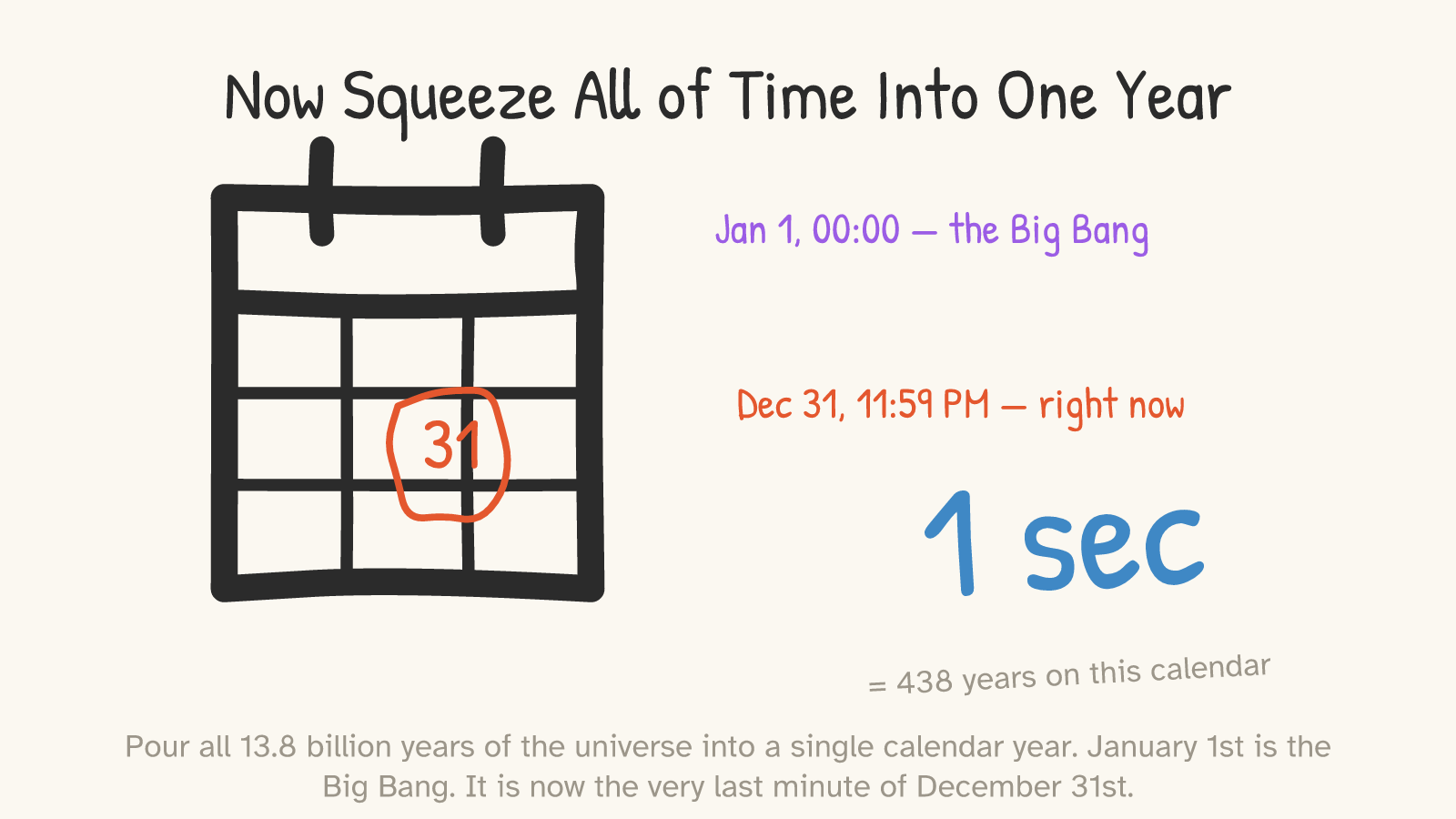
On this calendar, one second equals about 438 years, and one day is about 38 million years. Hold onto the seconds figure, because it's what makes the ending land: the whole written record of humanity is going to turn out to be a matter of seconds before midnight.
Earth shows up in September. You arrive in the last blink.
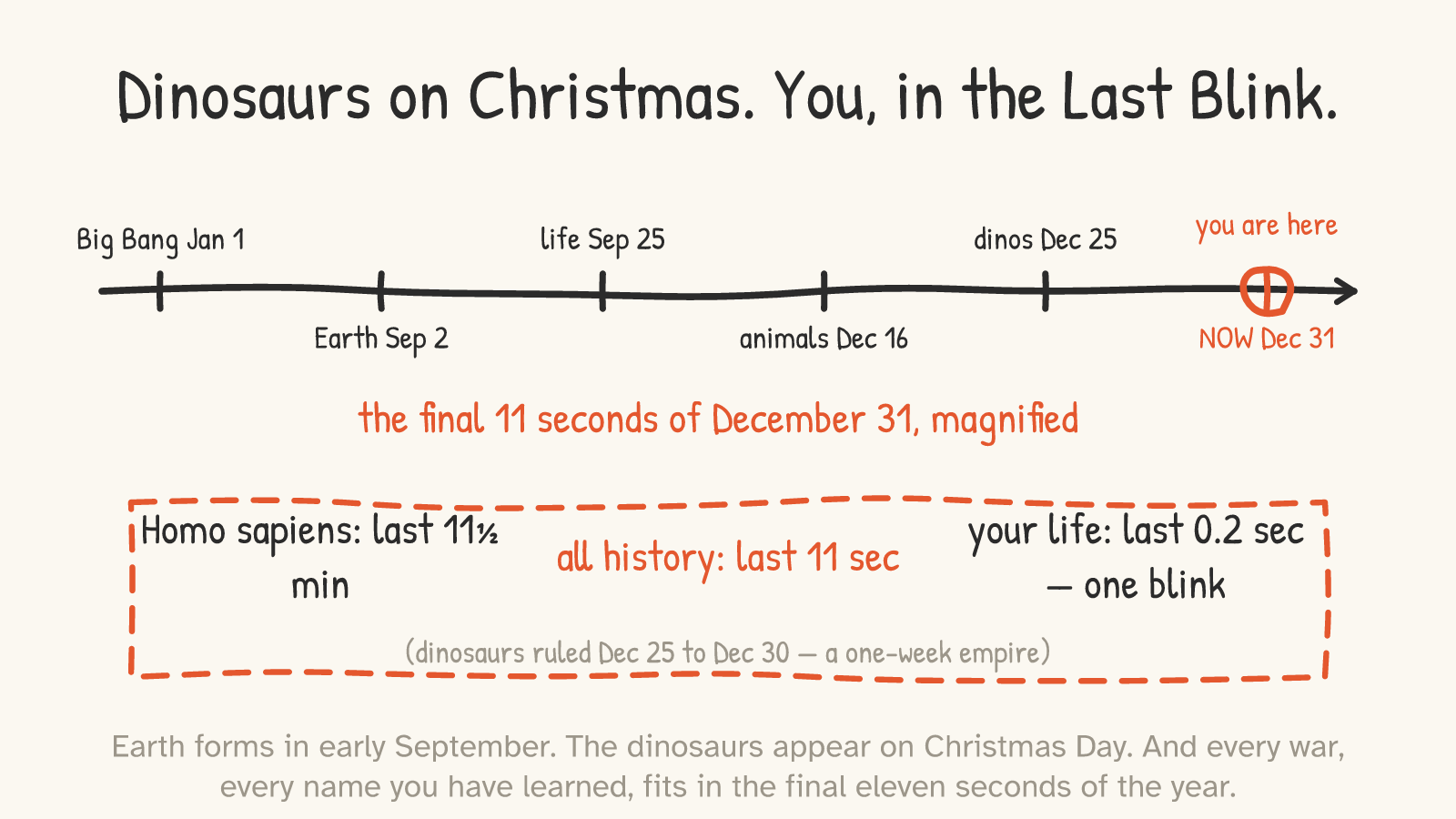
Here is the year, month by month (the deep-time dates are approximate — paleontology argues about the exact figures — but the shape is rock-solid, and nothing you can revise rescues you from the ending):
- January 1st the Big Bang.
- First week of January the first stars light up.
- September 2nd the Sun and Earth finally form. The Earth is a latecomer; two-thirds of the year is already gone before it exists.
- September 25th the first life appears, and then… very little happens, for months. For most of the time life has existed, it was invisible, single-celled pond scum.
- December 16th complex, multicellular life.
- December 25th–30th the dinosaurs. They appear on Christmas Day, rule for the last week of the year, and are wiped out the morning of the 30th.
- Dec 31, 11:48 PM the first humans who look like us. The whole human species fits in the last ~11½ minutes of the year.
- Dec 31, 11:59:48 PM the beginning of all recorded history — the pyramids, every empire, every war, every name you have ever learned. It all fits in the last ~11 seconds.
- Dec 31, 11:59:59.8 PM an entire 80-year human life: about a fifth of a second. Roughly the length of a single blink.
Everything you have ever read about happened in the final breath before the new year. The calendar cannot render your civilization; its smallest meaningful tick is too long.
CodaA rounding error that noticed
So put the two pictures side by side and look at yourself in both.
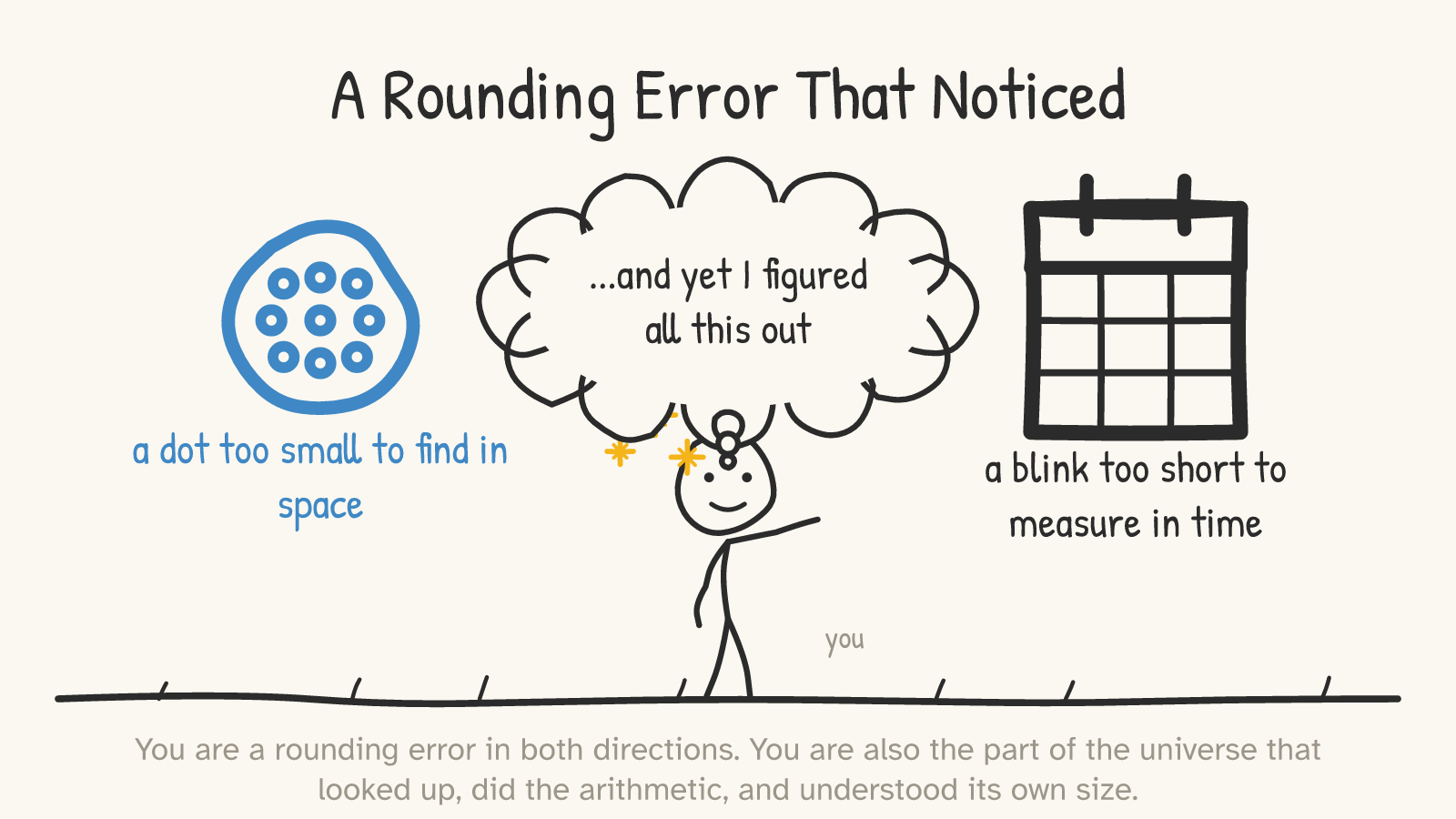
In space, you are a feature on a dot too small to find. In time, you are an event too brief to measure — a single blink before midnight on December 31st. By any honest accounting of the cosmos, you round to zero in both directions at once.
And yet. The same shrink ray that vanished you also reveals the one genuinely staggering thing in either picture: the rounding error worked all of this out. A smear of atoms on a speck, lasting one blink of the cosmic year, looked up, measured the distance to Arcturus, clocked the expansion of space, dated the Big Bang, and drew itself to scale — accurately — inside its own head. The universe is too big and too old to fit in you. It fit anyway, as knowledge, in the one part of it small enough and brief enough to be called you.
You cannot make the universe small. But you can, apparently, make it understood — which may be the more impressive direction.
Notes & receipts
All model figures computed from standard constants (script in the repo). The scale model uses a half-inch (12.7 mm) Cheerio for Earth — a shrink factor of 1.003 billion to one, rounded to a billion to one in the text.
- Scale model — Earth 12,742 km → 0.5 in; Moon → 0.14 in (sesame seed) at 15.1 in; Sun → 4.55 ft at 489 ft; Proxima Centauri (4.246 ly) → 24,878 miles in the model (≈ 43 h nonstop at a 575 mph airliner cruise); Milky Way (~100,000 ly) → 586 million miles — ~116 years by that same airliner, ~950 years at 70 mph; Andromeda (2.54 Mly) → ~14.9 billion miles — ~3,000 years by airliner (a plane airborne since the early Iron Age); observable-universe radius (46.5 Gly) → ~54 million airliner-years to the model's edge: lift off at the dinosaur extinction (66 Mya), arrive ~12 Mya — the first hominins appear ~7 Mya. Corner to corner, double everything.
- Observable vs. whole universe — the observable universe is ~93 Gly in diameter; the full universe is larger by an unknown factor and may be spatially infinite. The model visualizes only the observable part.
- The 46.5 Gly "paradox" — comoving distance. Light-travel time to the edge is ~13.8 Gyr; the present (comoving) distance is ~46.5 Gly because space expanded during transit. Metric expansion is not motion through space and is not bounded by c.
- Cosmic calendar — age 13.8 Gyr (Planck ΛCDM, formal uncertainty under 0.2%; the separate Hubble-tension debate concerns the expansion rate, and if the higher local H₀ ≈ 73 km/s/Mpc is right the age could fall to ~13.0–13.3 Gyr — a few percent, invisible on a calendar) compressed to one 365-day year, so 1 second ≈ 438 years and 1 day ≈ 37.8 million years. Sun & Earth: canonical age ~4.54 Gya → Sep 2 (commonly cited 4.6 Gya → ~Sep 1). First life ~3.7 Gya → Sep 25. Multicellular ~600 Mya → Dec 16. Dinosaurs ~230–66 Mya → Dec 25–30. Homo sapiens ~300,000 yr → last ~11½ min. Recorded history ~5,000 yr → last ~11 s. An 80-yr life → last ~0.18 s. Deep-time biological dates carry real uncertainty; the order-of-magnitude conclusions do not.
- Lineage — the year-long "Cosmic Calendar" was introduced by Carl Sagan in The Dragons of Eden (1977) and popularized in the Cosmos TV series (1980); the powers-of-ten zoom goes back to Kees Boeke's Cosmic View (1957), filmed by Charles & Ray Eames as Powers of Ten (1977). Our contribution: carrying one consumer object to its breaking point and fusing the space and time pictures into one self-portrait.
- Sizes and distances use averages; orbits are elliptical. Panel 5's flight arithmetic: 46.35 ly of model distance ÷ 575 mph ≈ 54.1 million years; depart at the dinosaur extinction (66 Mya), land ≈ 11.9 Mya. The in-flight evolution is literal: within that window Earth's mammals radiated from small post-asteroid survivors into whales (Pakicetus lineage, ~50 Mya), bats (~52 Mya), and apes (~25 Mya).