Be honest about the feeling, because everyone has some version of it. You're not an athlete, exactly, but you're not nothing. You move okay. You'd hold your own. Put you on a start line next to a stranger and you'd back yourself more often than not.
I had that feeling too, right up until I started looking at the numbers. This essay is the result, and it is going to introduce you to a series of people who would beat you — comprehensively, not narrowly — at things you quietly assume you're fine at. Some of them are children. Some of them qualify for a senior discount. Some of them would fit inside your shirt. None of it is because you're unfit. It's because you have never, not once, been measured.
First, the concession — because you're already objecting
You're already winding up the obvious rebuttal, so let me hand it to you fully formed, because it's a good one: "Sure, the single best nine-year-old table-tennis prodigy beats me. So does some freak 80-year-old who runs marathons. But those are one-in-a-million outliers who train twenty hours a week. The average kid and the average retiree lose to me. You're cherry-picking the tails and calling it humbling."
Yes. All true. Concede it completely: when this essay says a kid or a 70-year-old beats you, it means the trained ones — not the average. The average twelve-year-old and the average retiree really are behind you. You might even sit a hair to the better side of average yourself. Hold that thought, and watch it fail to save you.
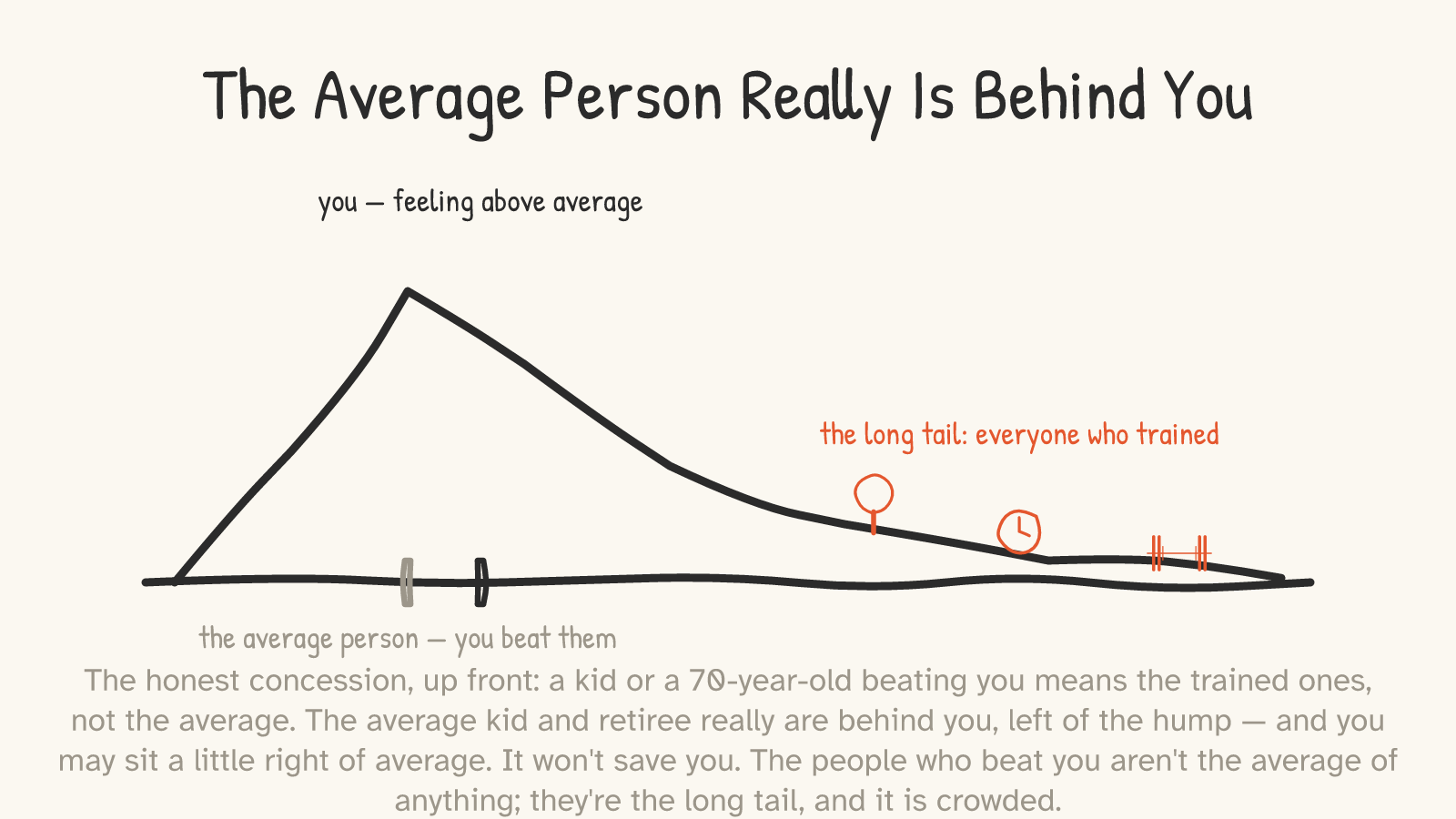
Here's why the concession costs me nothing. Human ability isn't spread out evenly; it's lopsided, with most people bunched together and a long tail of trained performers stretching far out to one side.1 The people who beat you don't live at the average of anything — they live in that tail. And the tail is not one freak. It is crowded. It's every committed fourteen-year-old at the table-tennis club, every sixty-year-old who runs a weekly 5K, every bantamweight at the lifting gym. You're not losing to the single best twelve-year-old on Earth. You're losing to the four-thousandth-best, and the next four thousand behind her. Being "a little above average" is true and completely beside the point, because the gap between you and trained opens up to your right and never closes.
So everywhere below, I'll tell you exactly who you're losing to — world-record holder, national-level competitor, or just a dedicated regular — and I'll keep real, honest times and weights separate from any kind of math. Let's go meet them.
The twelve-year-old
Start with the one that stings on a family vacation: a kid beats you at ping pong. Not a rally — a score, and it isn't close.
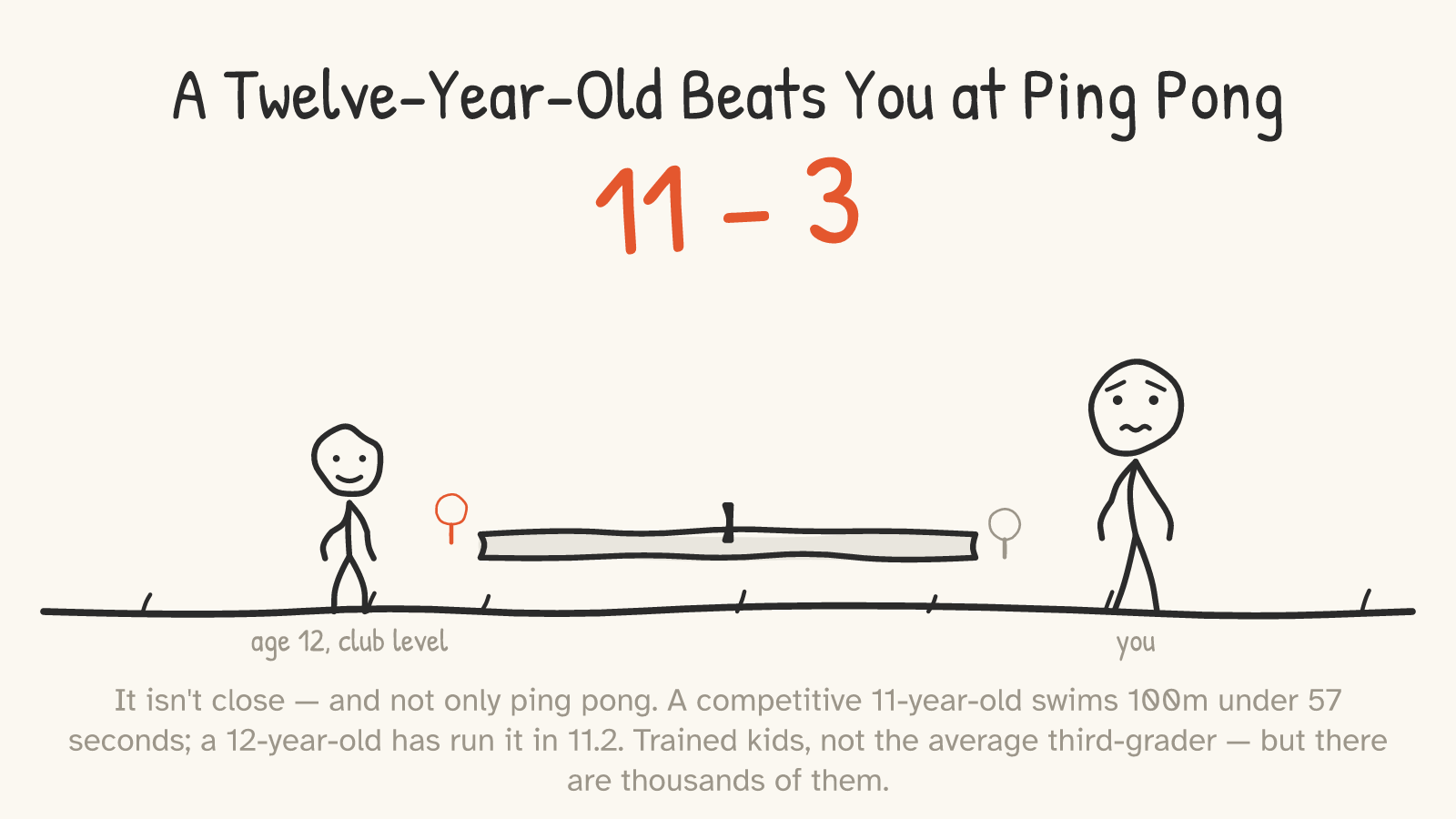
Table tennis is the relatable version, and I'll be upfront that I couldn't find a clean dataset for "trained twelve-year-old versus recreational adult" — it rests on the obvious principle that a few years of coached, deliberate practice buries casual play.2 But where the records are clean, they're brutal. A nationally competitive eleven-to-twelve-year-old swims 100 meters of freestyle in under 57 seconds;3 a recreational adult lap-swimmer is somewhere around a minute and a half to two minutes for the same distance — the child is nearly twice as fast. The best twelve-year-old boys have run the 100-meter dash in about 11.2 seconds; the best fourteen-year-old girls in about 11.34 — times a fit adult man (more like 15–16 seconds5) cannot come close to.
And remember the concession: these are the trained kids, not your average third-grader. But "trained kids" is not a small group. Something like 37 million American children play organized sports;6 the few percent who are genuinely good still number in the hundreds of thousands. There are more children who would beat you than there are people in most cities.
The seventy-three-year-old
Now age, where I have to be the most careful — because this is exactly where the humbling genre starts lying to you.
You may have heard that a 90-something can still out-sprint you. For our recreationally-active reader, that's false, and it's worth saying so plainly. The verified records by people past 100 — a man who ran the 100 meters in 42 seconds at age 105, another who ran it in 27 seconds at 1007 — are genuine marvels of longevity, but they're slower than essentially any adult who can still run at all. Don't let anyone sell you an "age-graded" time, either: that's a calculation that multiplies a real time by an age factor to produce an "open-age equivalent."8 It's a useful tool, but it is not a clock time, and nobody actually ran it.
The honest version doesn't need the trick, because the real damage is in endurance. At seventy-three, Ed Whitlock ran a 2:54 marathon.9 Actual clock time. He would have finished, showered, and been within sight of home before a typical recreational marathoner — who averages somewhere in the 4:30–5:00 range10 — came up the final straight. At eighty-five he ran 3:56, still faster than most people a third his age will ever manage.
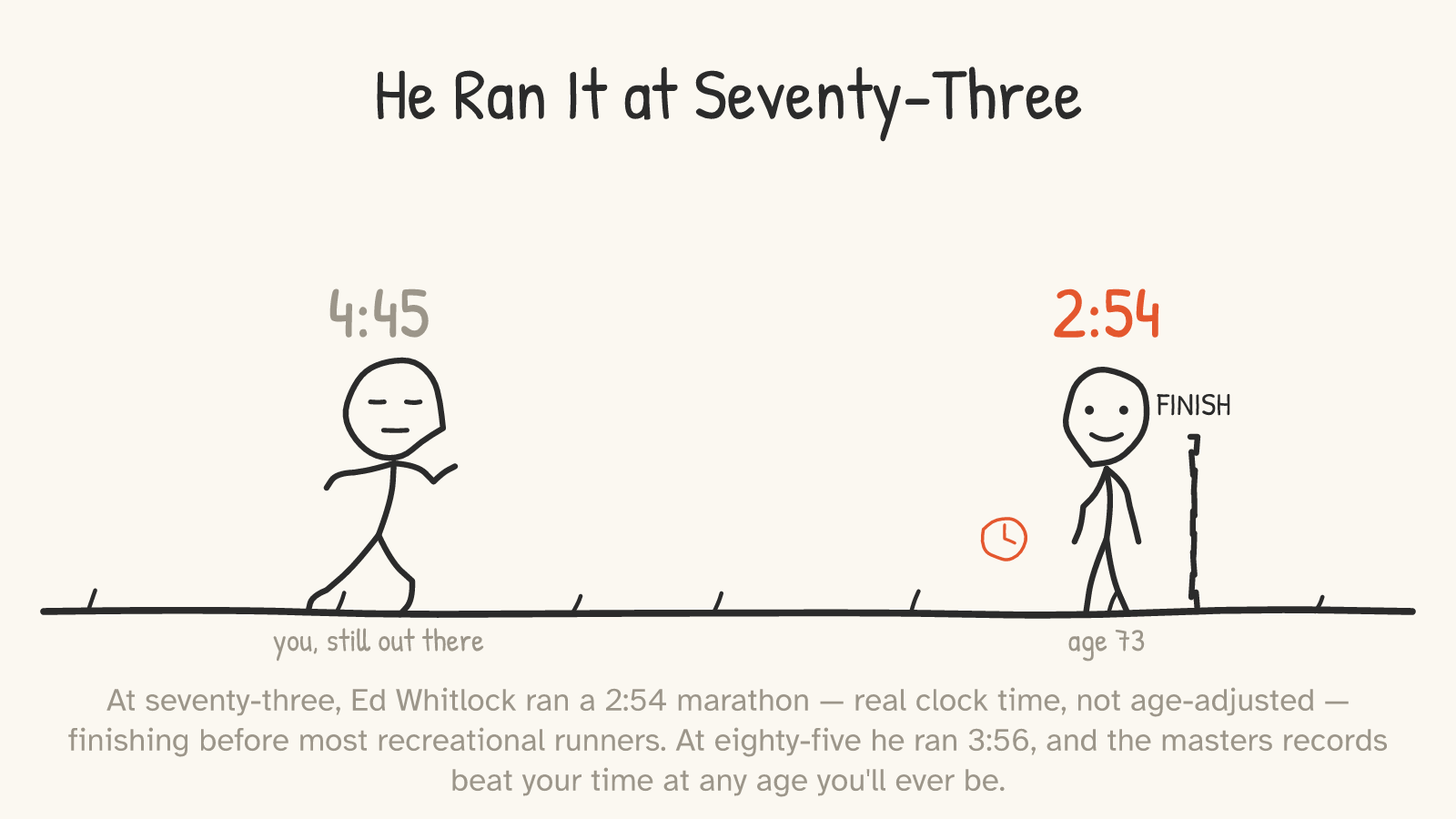
And — this is the part that closes the "lone freak" escape — it isn't one man. The masters marathon world records run 2:36 at 60, 2:42 at 65, 2:54 at 70.11 Below the records, the London Marathon's "Good For Age" standards — the qualifying times that thousands of older runners actually hit every year — ask a 60-to-64-year-old man for a sub-3:34 and a 70-to-74-year-old for a sub-4:52.12 A recreational 4:30 marathoner is too slow to qualify for any men's age group above about fifty. There is a large, specific population of people in their sixties and seventies whose real finishing times you cannot touch at any age you will ever be.
The featherweight
Strength feels like the one place size should save you. It's where the humbling is most absolute — literally.
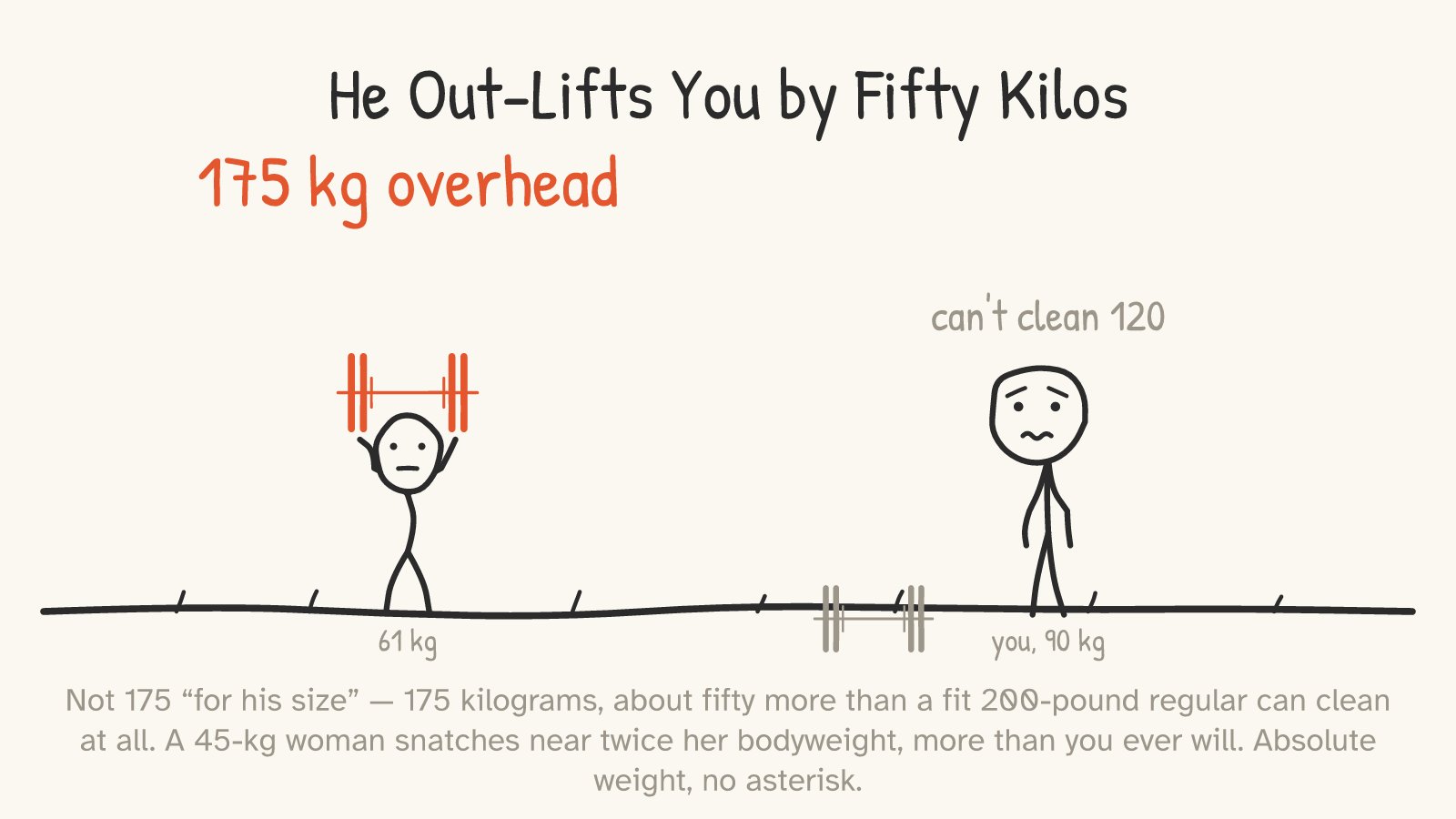
A man in the 61-kilogram weight class — that's about 135 pounds — clean-and-jerks 175 kilograms, the world record.13 Read that again: not 175 "for his size," not pound-for-pound, not adjusted. One hundred seventy-five kilograms hoisted overhead, which is roughly fifty kilos more than a fit, 200-pound recreational gym regular can clean at all.14 A woman in the 45-kilogram class snatches about 87 kilograms — nearly twice her bodyweight, and more than most men who lift casually will ever put overhead.15 Powerlifting tells the same story in the squat and the deadlift: the best featherweight men, all of them under 150 pounds, move far more weight than a 200-pound recreational lifter ever will — and a woman in the sub-52-kilogram class has deadlifted nearly 200 kilograms.16
This is the least arguable humbling there is, because there's no asterisk to hide behind. "I'm bigger, so I'm stronger" isn't merely beaten on a per-kilo technicality — it's beaten on the only scoreboard that feels fair to you, total weight on the bar.
The person who weighs less than you and beats you up
Which brings us to the steelman you've been holding in reserve: fine, a kid out-rallies me and a featherweight out-lifts me — but in a real physical confrontation, my size wins. Sometimes. Within limits that are smaller than you think.
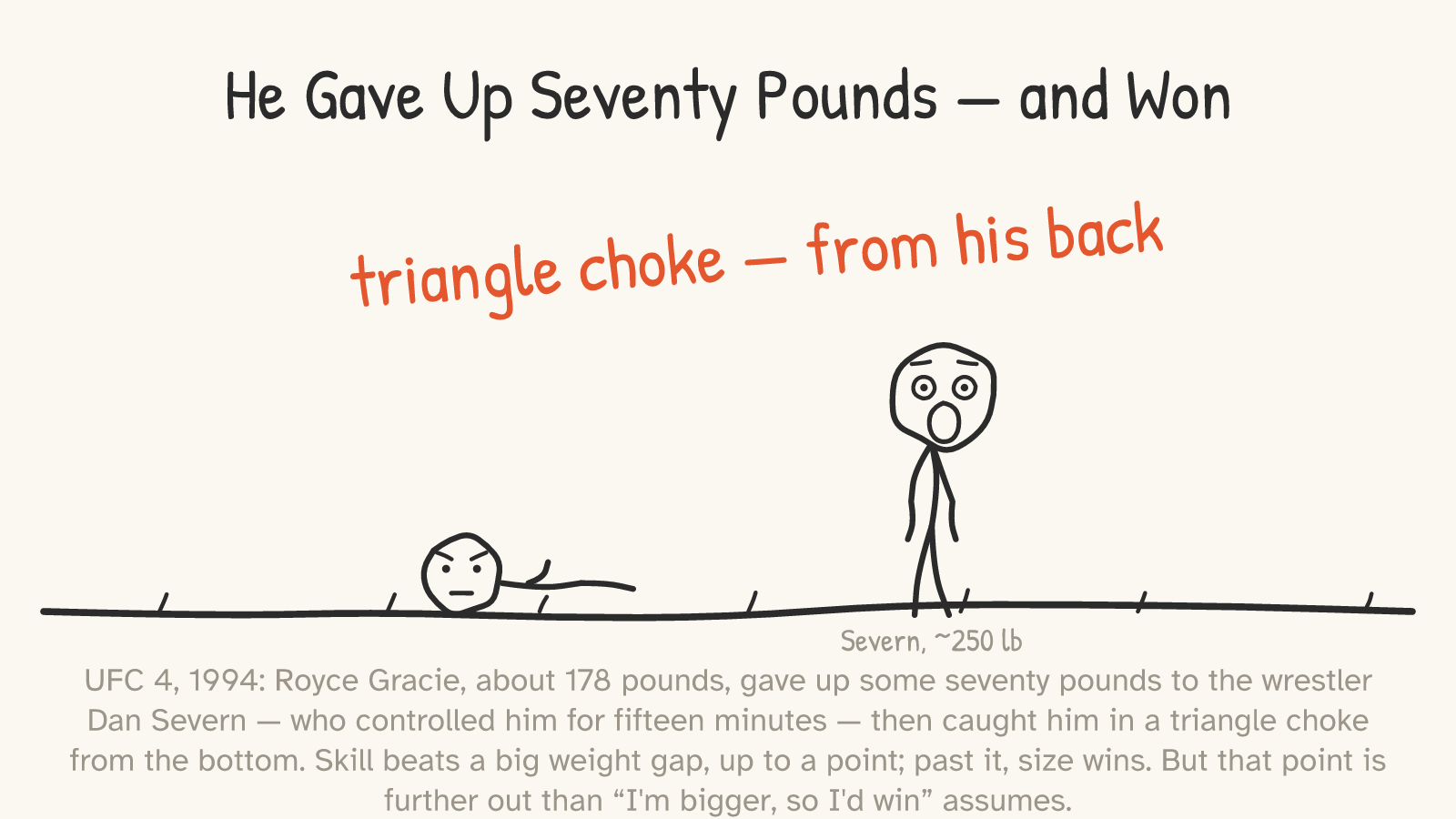
In the early UFCs, Royce Gracie weighed about 178 pounds and made a habit of beating much larger men. At the first event, in 1993, he choked out Ken Shamrock — some thirty pounds heavier — in fifty-seven seconds. A year later he gave up roughly seventy pounds to the wrestler Dan Severn, got controlled on the ground for fifteen straight minutes, and still won, catching Severn in a triangle choke from his back.17 The everyday version plays out in any martial-arts gym, where a lighter, higher-ranked grappler routinely controls a bigger, stronger novice who can't do a thing about it.18
Here's the honest scope, because the enemy is right that size matters somewhere: technique reliably overcomes a real weight difference — often two or three weight classes — but not an infinite one. Past roughly double bodyweight, even excellent technique meets diminishing returns, and Royce was a world-elite practitioner, not a hobbyist.19 But notice where that leaves your intuition. The range in which "I'm just bigger, so I'd win" actually holds is narrow — and most of the people you'd never bet on are comfortably inside the range where skill wins anyway.
Why you couldn't see any of this coming
Step back from the parade of people beating you and ask the real question: why was the feeling so confident, and so wrong?
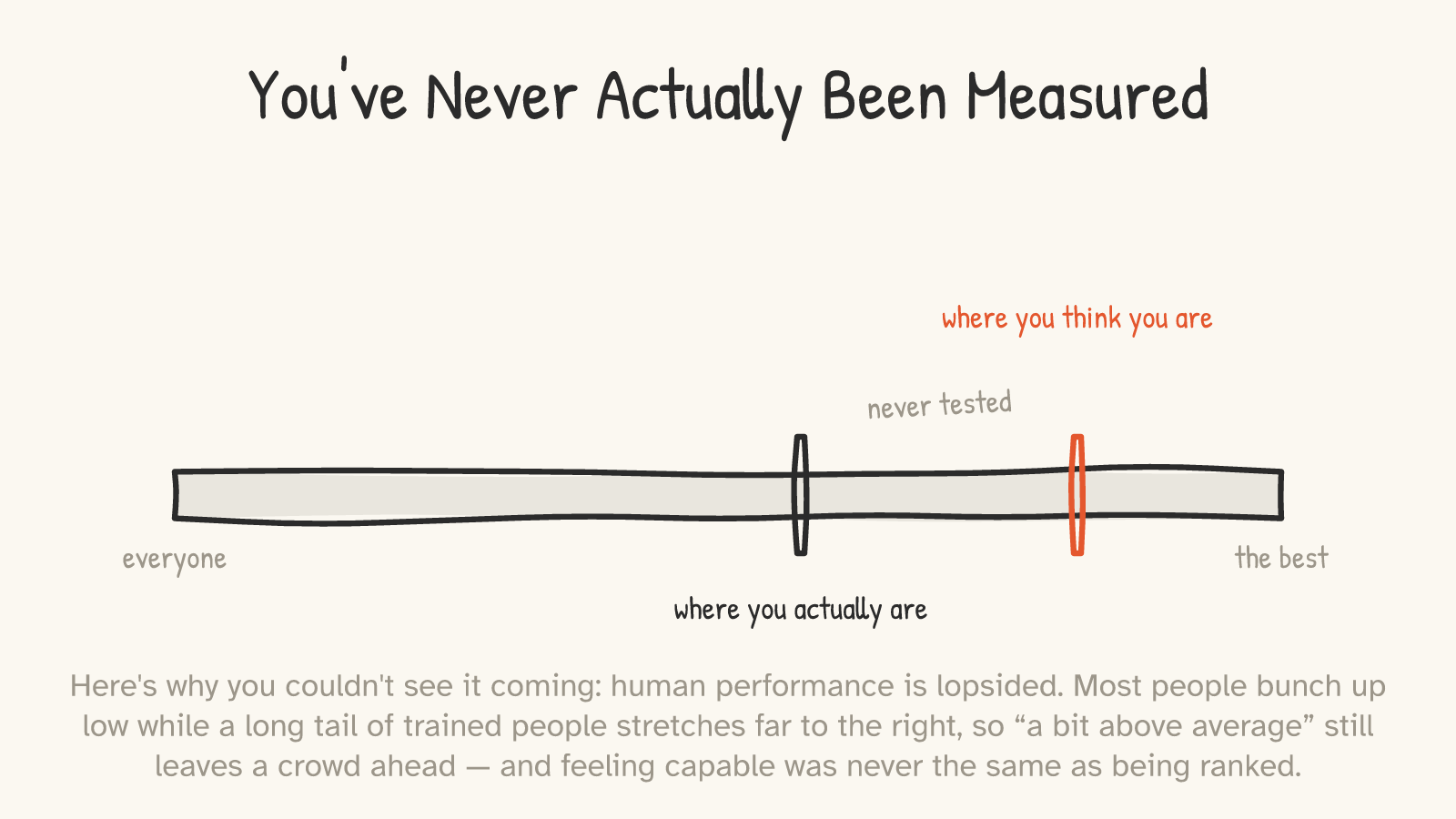
Two things. First, that lopsided distribution again: because the trained tail stretches so far to the right, being genuinely "a bit above average" still leaves an enormous crowd ahead of you, and your brain reads "above average" as "near the top." Second — and this is the cleaner finding — people are simply, measurably bad at rating their own physical performance. In studies of amateur runners, competitors reliably predict finish times faster than they actually run, and the harder the task, the worse the overconfidence gets.20
You might expect me to call this the Dunning-Kruger effect, and a lot of writers would. I'll resist, because the pop version — "the worst are the most deluded" — is substantially a statistical artifact, and serious researchers have spent two decades poking holes in it.21 The honest, defensible claim is smaller and quite enough: most of us rate ourselves above the median, that's mathematically impossible for most of us, and "feeling capable" turns out to be nearly unrelated to where you'd actually rank.22 You can't see your spot on the ruler because you have never been put on the ruler.
You also can't escape into "well, if I trained, I'd be up there." Maybe — but that's a claim about your ceiling, and the humbling is about your floor: where you stand right now, untested. "I could if I tried" is not a rebuttal to "you haven't." It's the bias itself, talking.
So before the closing pep talk, here is the part where you stop reading about a hypothetical reader and find out about you. Pick something you think you're decent at and put a real number in.
The gap is the good news
If you ran that and felt the floor tilt, stay with me, because the ending is genuinely kind.
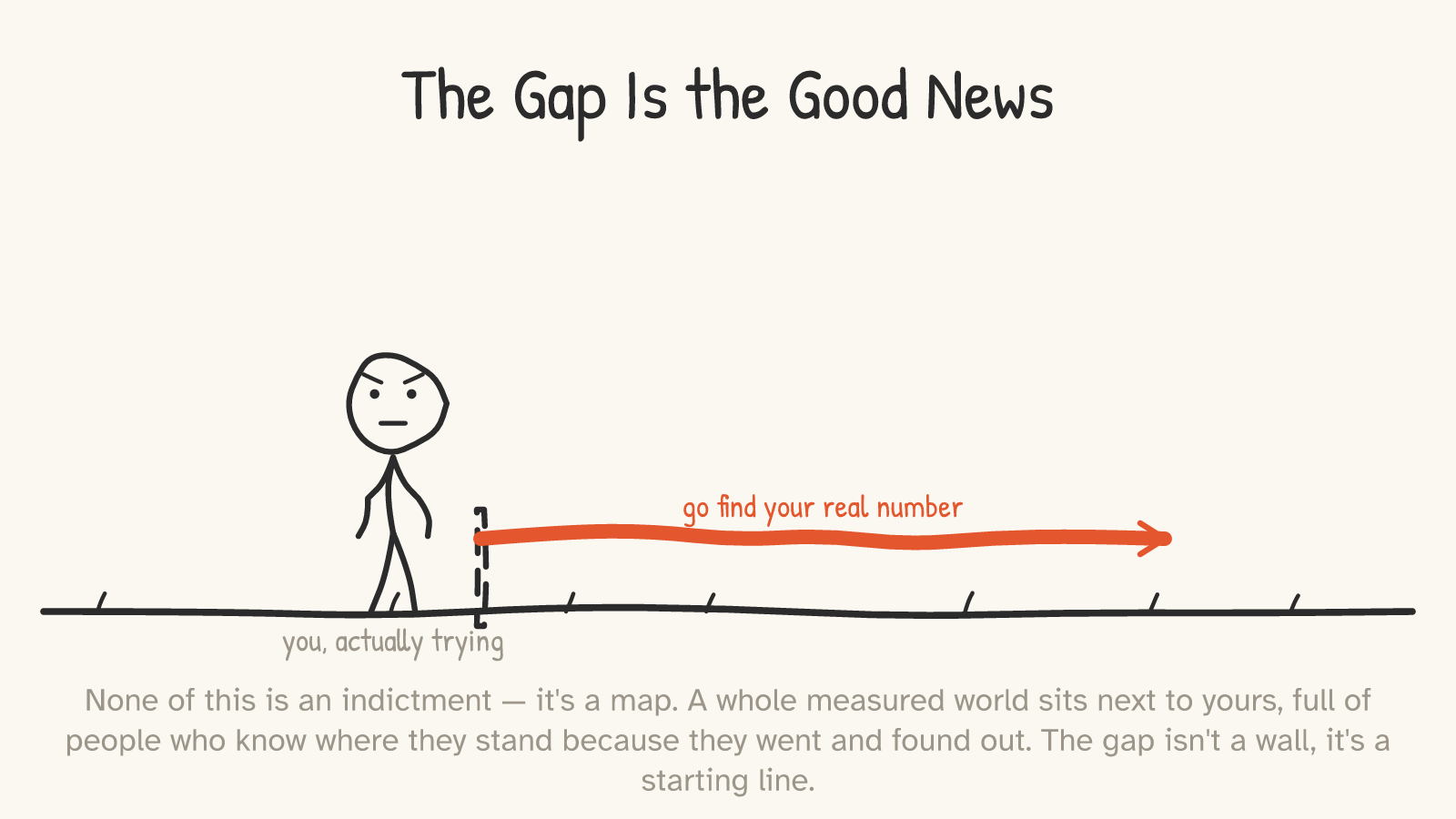
Everything above sounds like an indictment, but it's actually a map. There is an enormous, measured world sitting directly next to the one you live in — full of kids and seventy-year-olds and featherweights who are all in on the same secret: they know exactly where they stand, because at some point they went and found out, and then they started climbing. The twelve-year-old who beats you wasn't born with that paddle; she lost, badly, a few thousand times first. The gap between you and any of them isn't a verdict on you. It's a starting line you didn't know you were standing on.
The only humbling that actually stings is the one you never test. Go find your real number. It will almost certainly be worse than you think — and that's the most interesting thing that's happened to your sense of yourself in years.
Footnotes & receipts
- Performance is right-skewed. Human athletic performance metrics (sprint times, jumps) are typically right-skewed: most people cluster at lower performance with a long tail of high performers, so the median sits far from the elite and the gap grows non-linearly. Peer-reviewed: PMC10645065 (analysis of athletic performance distributions). ↩
- Trained youth vs. recreational adults (table tennis). No authoritative quantitative dataset was found comparing trained-youth to recreational-adult table tennis; the claim rests on the general principle that years of coached deliberate practice dominate casual play. Treated here as principle, not cited measurement — flagged in the text. ↩
- Youth swimming. USA Swimming National Age Group records (long course), 11–12 age group: boys 100m freestyle ≈ 54.91s, girls ≈ 56.87s. A recreational adult lap-swimmer covers 100m in roughly 1:30–2:00. Source: USA Swimming (usaswimming.org), national age-group records. ↩
- Youth sprinting. Age-best 100m times: boys ~11.16s at age 12, ~10.82 at 13, ~10.51 at 14; girls ~11.27 at 14. These are world-level age bests; a merely club-level 12-year-old (~12–14s) still matches or beats a recreational adult. Source: youth athletics ranking compilations [WORLD/AGE BEST]. ↩
- Recreational adult sprint baseline. A fit-but-untrained adult man runs the 100m in roughly 15–16s, a woman ~17–18s. These are aggregated from run-coaching sources (RunRegimen), not a controlled study, so they're approximate — phrased as "around 15–16 seconds." [RECREATIONAL BASELINE, SOFT] ↩
- Youth sports participation. ~54% of U.S. children ages 6–17 (~37 million) participated in organized sports (2020). Source: CDC NCHS Data Brief No. 441. ↩
- Centenarian sprinters — NOT a "beats you" fact. Hidekichi Miyazaki ran 100m in 42.22s at age 105; Donald Pellmann ran 26.99s at age 100 (M100 world record, 2015). Both are real and astonishing but slower than any recreational adult sprint — included here only to mark the honest limit of the age claim. Sources: Guinness World Records / ABC News (Miyazaki); Times of San Diego (Pellmann). ↩
- Age-grading is a calculation, not a time. World Masters Athletics age-grading factors (e.g., ~0.87 for an M70 100m, ~0.74 for M80) convert a real time into an "open-age equivalent." Useful as a tool; it is not a clock time and no one ran it. Source: World Masters Athletics age-grading tables. ↩
- Ed Whitlock marathons. Age 72: 2:59:10 (Toronto 2003, first person 70+ under 3:00). Age 73: 2:54:48 (Toronto 2004; the M70–74 world record at the time, since bettered by Gene Dykes' 2:54:23 in 2018). Age 85: 3:56:33 (Toronto 2016, M85 world best). Real clock times. Sources: Toronto Waterfront Marathon; Runner's World; World Masters Athletics. [WORLD RECORD] [REAL] ↩
- Recreational marathon baseline. Across 485,000+ results, mean finish ~4:37 (men) / ~4:48 (women), with the median slower; a 4:30 is roughly the top 30–35%. Source: RunBundle marathon statistics aggregate. [RECREATIONAL BASELINE] ↩
- Masters marathon world records. M60 ≈ 2:36:30, M65 ≈ 2:41:57, M70 ≈ 2:54:23 (Gene Dykes, 2018). All decisively beat a recreational 4:30. Source: Association of Road Racing Statisticians (ARRS) / masters road-running record lists. [WORLD RECORD] [REAL] ↩
- London Marathon "Good For Age" (2026). Qualifying standards represent roughly the top 5–10% of an age group, so thousands hit them: men 60–64 sub-3:34, 70–74 sub-4:52; a 4:30 man fails GFA for every men's group above ~50 (50–54 needs sub-3:07). Source: London Marathon Events. [COMPETITIVE STANDARD] ↩
- Men's 61 kg weightlifting. Li Fabin (China) holds the 61 kg clean & jerk world record at 175 kg (2022 IWF World Cup, Bogotá) — about 2.87× bodyweight; he clean-and-jerked 173 kg at the 2019 World Championships. Source: IWF; BarBend. [WORLD RECORD] ↩
- Recreational lift baseline. A 50th-percentile ~90 kg male gym-goer benches ~100 kg, squats ~130 kg, deadlifts ~150 kg; his clean is roughly 100–120 kg (estimate). Source: FitnessVolt strength standards. [RECREATIONAL BASELINE] ↩
- Women's 45 kg weightlifting. Won Hyon-sim (PRK) holds the 45 kg world records: snatch 87 kg (~1.9× bodyweight) and clean & jerk 109 kg, both set March 2024. The 87 kg snatch exceeds the recreational 90 kg man's likely snatch (~60–80 kg). Source: IWF world records (iwf.sport). [WORLD RECORD] ↩
- Light-class powerlifting. Elite men in the IPF's lightest classes (59–66 kg) squat and deadlift far beyond a recreational 90 kg lifter (squat ~130, deadlift ~150 kg) — the lighter specialist wins on absolute weight, not just pound-for-pound. The women's sub-52 kg deadlift record is ~195 kg — just shy of 200, not over it. (Specific raw-vs-equipped record figures vary by federation, so only the directional comparison is asserted here.) Sources: IPF / GoodLift records. [WORLD RECORD] ↩
- Royce Gracie in the early UFCs. Competed at ~178 lb (~80 kg). UFC 1 (Nov 1993): defeated Ken Shamrock (~205 lb) by rear-naked choke in 0:57, then Gerard Gordeau (~216 lb) by choke in the final (1:44). UFC 4 (Dec 1994): defeated Dan Severn (~250 lb, ~70 lb / ~32 kg heavier) by triangle choke at 15:49 after being controlled for most of the bout. Sources: UFC; Tapology; Wikipedia. [HISTORICAL] [REAL] ↩
- BJJ belt vs. size. A documented case: an 80 kg black belt defeating a 180 kg white belt of ~1.5 years' experience. No peer-reviewed, population-level study of belt-vs-size outcomes exists; this is strong case/consensus evidence, framed as such. Source: bjjee.com. [CASE EVIDENCE] ↩
- Where size does win — honest scope. Coaching and competitive consensus holds that technique overcomes moderate weight differentials (~10–30 kg in grappling); beyond roughly 2× bodyweight, raw size increasingly dominates even good technique. Arm-wrestling sources similarly note technique beats strength within a class but not across large weight gaps. Sources: practitioner literature; FitnessVolt (arm wrestling). ↩
- Runners over-predict their own speed. "Task difficulty and overconfidence: Evidence from distance running" finds amateur runners systematically predict finish times faster than they achieve, with overconfidence rising as task difficulty rises. Peer-reviewed: Journal of Economic Psychology (ScienceDirect, PII S0167-4870(17)30747-X). ↩
- Dunning-Kruger, handled honestly. Kruger & Dunning (1999), JPSP 77:1121. But the pattern is substantially a statistical artifact (regression to the mean / autocorrelation): Gignac & Zajenkowski (2020), Intelligence 80:101449, "The Dunning-Kruger effect is (mostly) a statistical artefact"; and Nuhfer et al. argue it's primarily a better-than-average effect. The cartoon version is not well supported, so this essay does not lean on it. ↩
- Better-than-average effect. Most people rate themselves above the median across many domains — mathematically impossible for most of them. Classic sources: Svenson (1981) on driving ability; Alicke (1985). Combined with footnote 20, this is the defensible basis for the calibration claim. ↩