A Roman pointed at his foot and said pēs. A Greek pointed at his and said poús. An Indian poet writing hymns in Sanskrit said pāda. An Anglo-Saxon farmer said fōt.
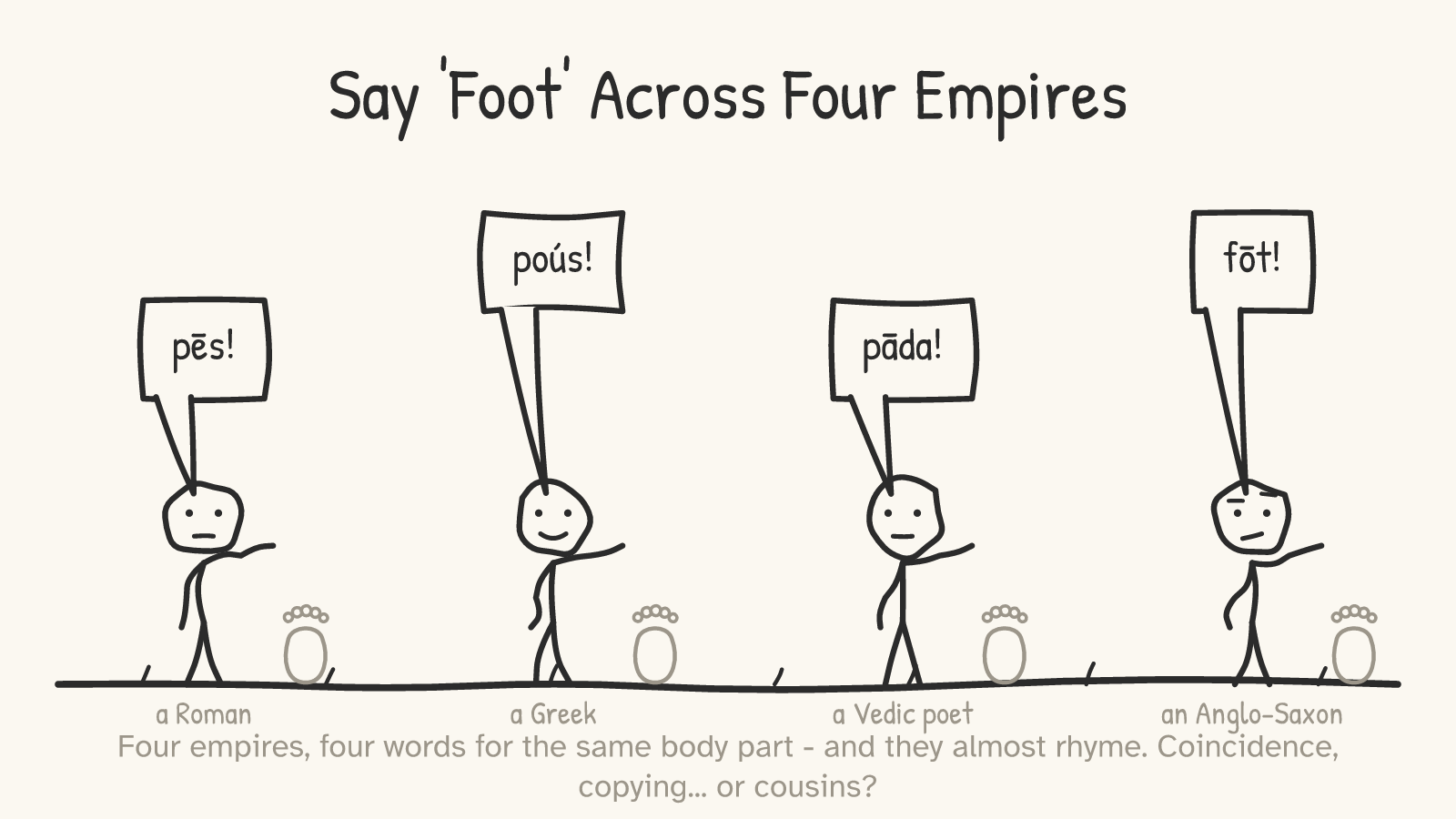
Four peoples, separated by thousands of miles and thousands of years, looked down at the same body part and made almost the same noise. That is either a staggering coincidence, a case of everyone borrowing from everyone, or evidence of something stranger and more beautiful: that all four were saying a word they had each inherited, unknowingly, from the same ancestor — a single speech community that lived before any of them — before Rome and Athens, before the Vedas were sung, before most of their descendants could write.
That last explanation is the true one. The ancestor word is *ped-, and the asterisk is about to do a lot of work.
Part 1The family tree
Linguists group these languages into a family called Indo-European, and they draw it as a tree. *ped- sits at the root; the branches are the daughter languages. (The tree is a simplification — real families are dialects shading into each other, not clean forks — but it captures the inheritance well enough for this tour.)
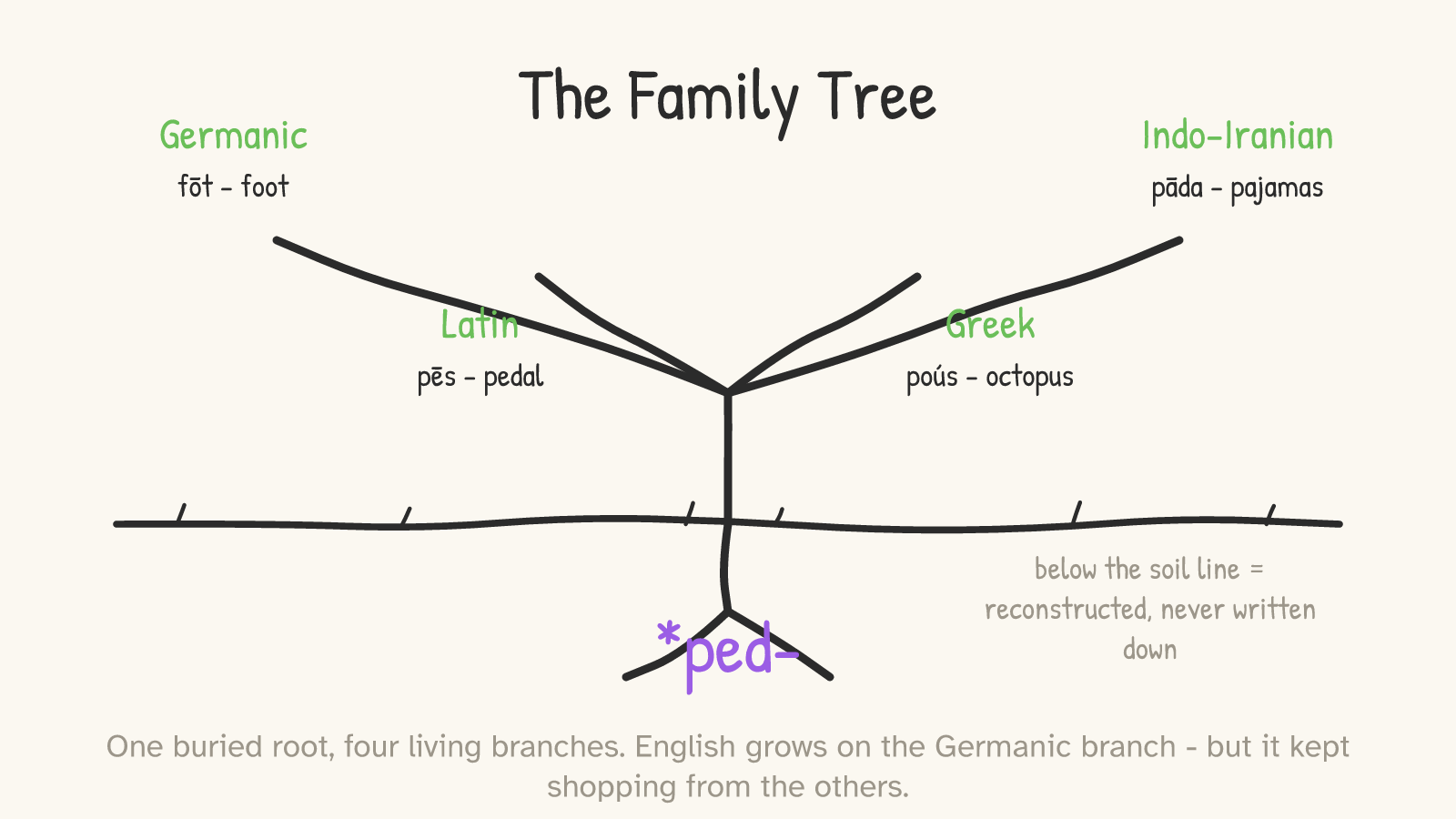
Down the Germanic branch you get fōt → English foot. Down Latin, pēs (stem ped-) → pedal, pedestrian, pedicure. Down Greek, poús (stem pod-) → podium, tripod, octopus. Down Indo-Iranian, Sanskrit pāda and Persian pāy → believe it or not, pajamas (Persian pāy-jāma, "leg-garment").
English sits on the Germanic branch — foot is its birthright. But English is the magpie of languages: over two millennia it went back and bought pedal from Latin, octopus from Greek, pajamas from Persia. It owns the root several times over, by inheritance and by shopping. (More on that double-dipping in Part 4.)
One honest caveat, drawn right into the picture: the root is below the soil line. Nobody ever recorded a speaker of the parent language. So how can anyone write *ped- with a straight face?
Part 2The asterisk is the receipt
Objection: "*ped- was never written down. You are presenting a hypothesis as if it were a fact."
Correct — and the asterisk is exactly how linguists admit it. An asterisk before a word means "reconstructed, not attested." It is a confession, printed in every serious etymology, that nobody ever heard this word. So why trust it?
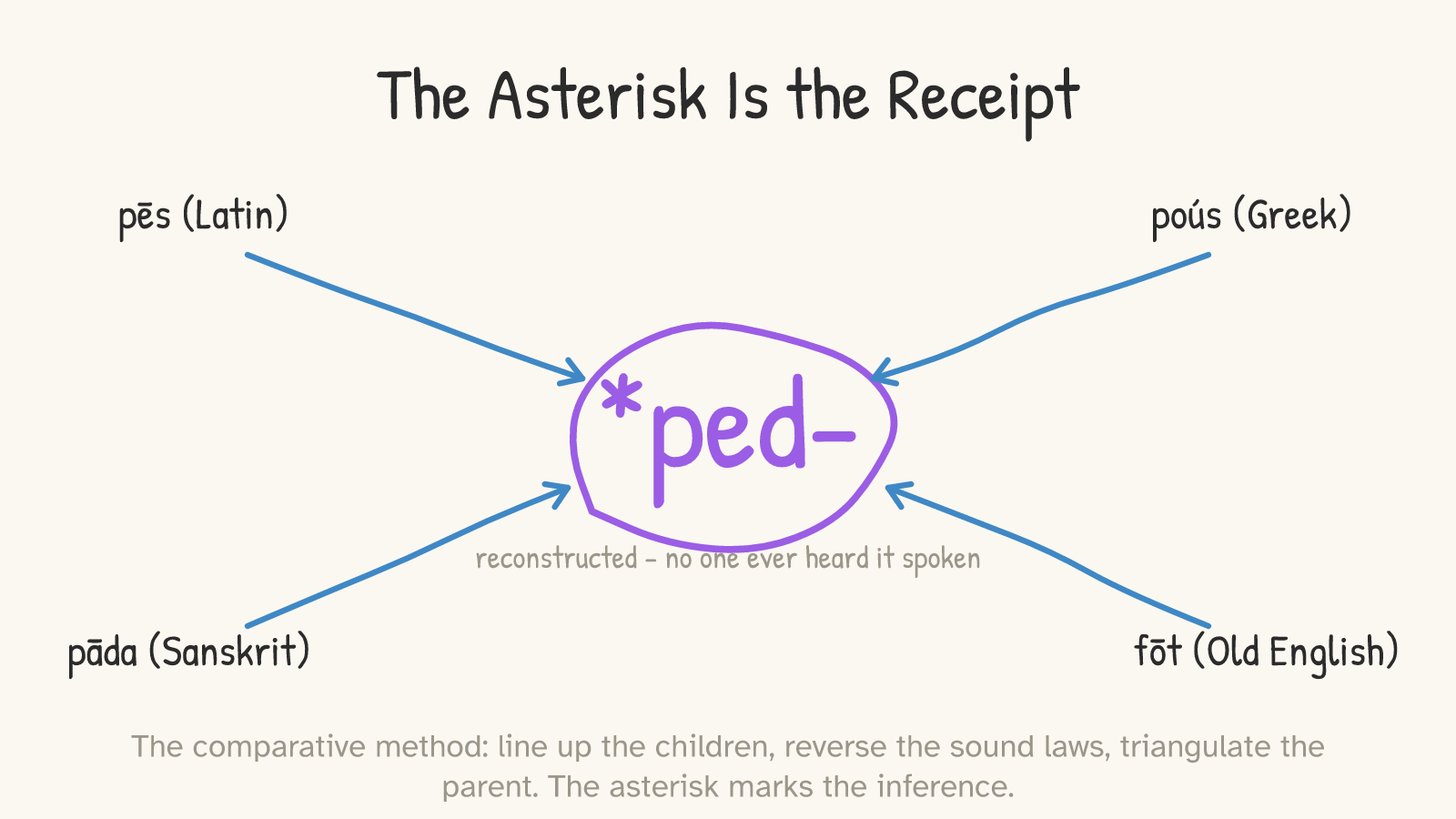
Because it isn't a guess — it's a triangulation. The method is called the comparative method, and it works like reconstructing a crime from four witnesses who never met. You line up the daughter words — pēs, poús, pāda, fōt — and you ask: what single parent form, run through each language's known sound changes, produces all four? When the same regular correspondences show up across hundreds of words (Latin p ↔ English f, every time, not just here), the parent stops being a guess and becomes the best-tested kind of inference we have. The asterisk doesn't mean "we made this up." It means "we reconstructed this, and here's the receipt."
It is, admittedly, a reconstruction — a model, not a recording. The vowel is fuzzier than the consonants; specialists argue about the exact shape. But "we can't time-travel to verify the vowel" is a very different complaint from "you're making it up," and only the first one is true.
Part 3The p-to-f machine
Here's the part that makes foot look so different from pedal even though they're the same word. Sometime in the first millennium BCE — a gradual shift over generations, not a single day — the early Germanic branch ran every word it had through a change so regular it's called a law: Grimm's Law, after the same Jacob Grimm of the fairy tales.
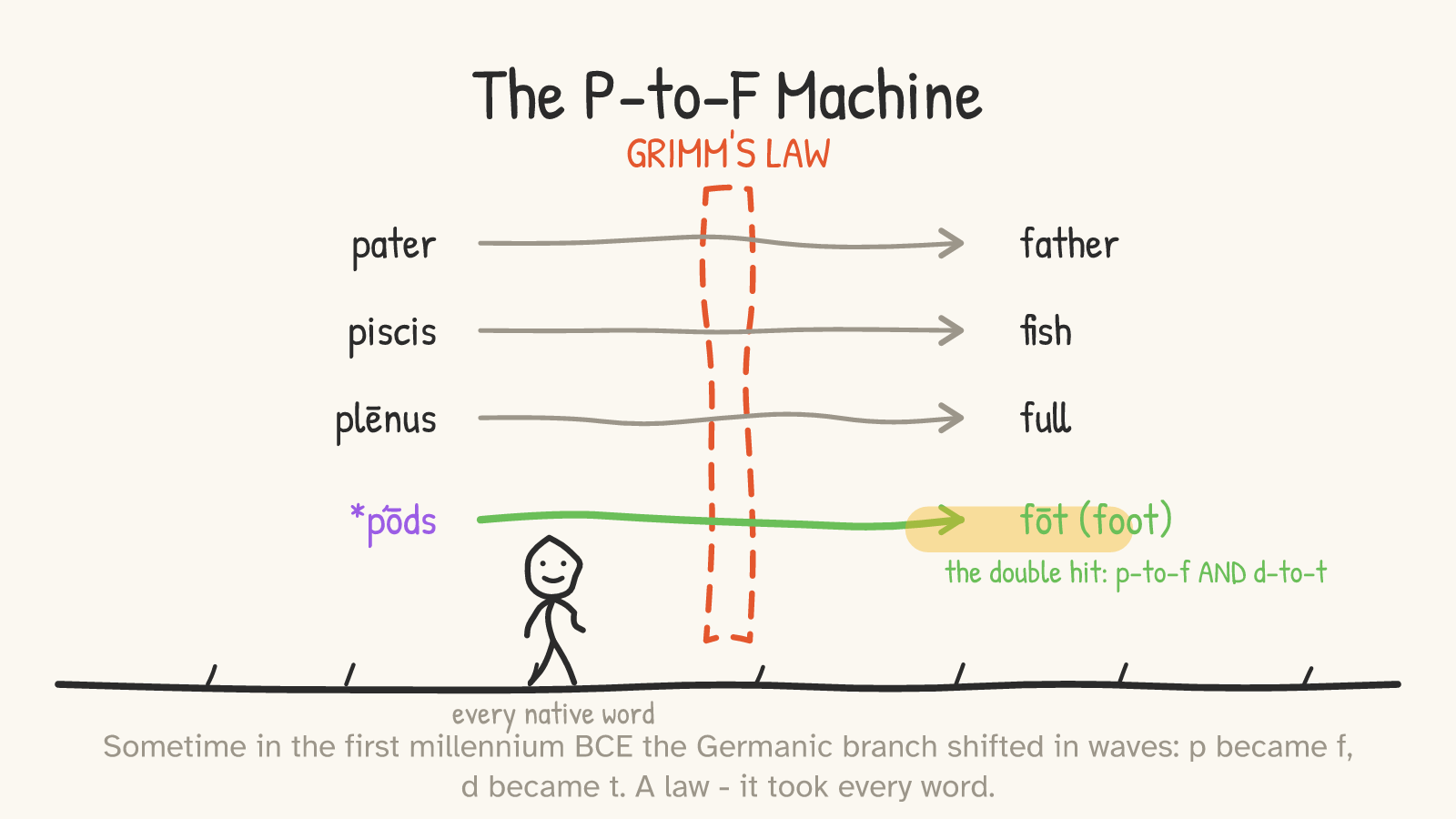
The law came in waves. One wave turned inherited p into f; another turned inherited d into t. Both applied to everything, which is why the fingerprints are everywhere. Latin sat on a branch the law never touched and kept the old sounds; English, on the Germanic branch, shifted them:
| pater | → | father |
| piscis | → | fish |
| plēnus | → | full |
| *pṓds | → | fōt → foot |
— the last one caught by both waves at once: p→f at the front, d→t at the end.
This is also the answer to a fair challenge: isn't "sounds similar" just pareidolia? Pater, father — you could connect any two words if you squint. The defense against squinting is exactly this regularity. Pater/father isn't a lucky resemblance; it's the same law that turns piscis into fish and pēs into foot. A folk etymology explains one word with a nice story. A sound law explains a thousand words with one rule, and predicts the next one. (Real philology is messier than this clean sketch — there's vowel ablaut, the difference between inherited and borrowed words, and the famous apparent exceptions to Grimm's Law. But even those exceptions turned out to obey a second regular rule, Verner's Law, about where the ancient accent fell — which only deepens the point: no genuine exceptions, just more rules waiting to be found.)
Part 4English got it twice
So why does English have both the homely foot and the fancy pedal, if they're the same ancient word? Because the root reached English by two completely different roads.
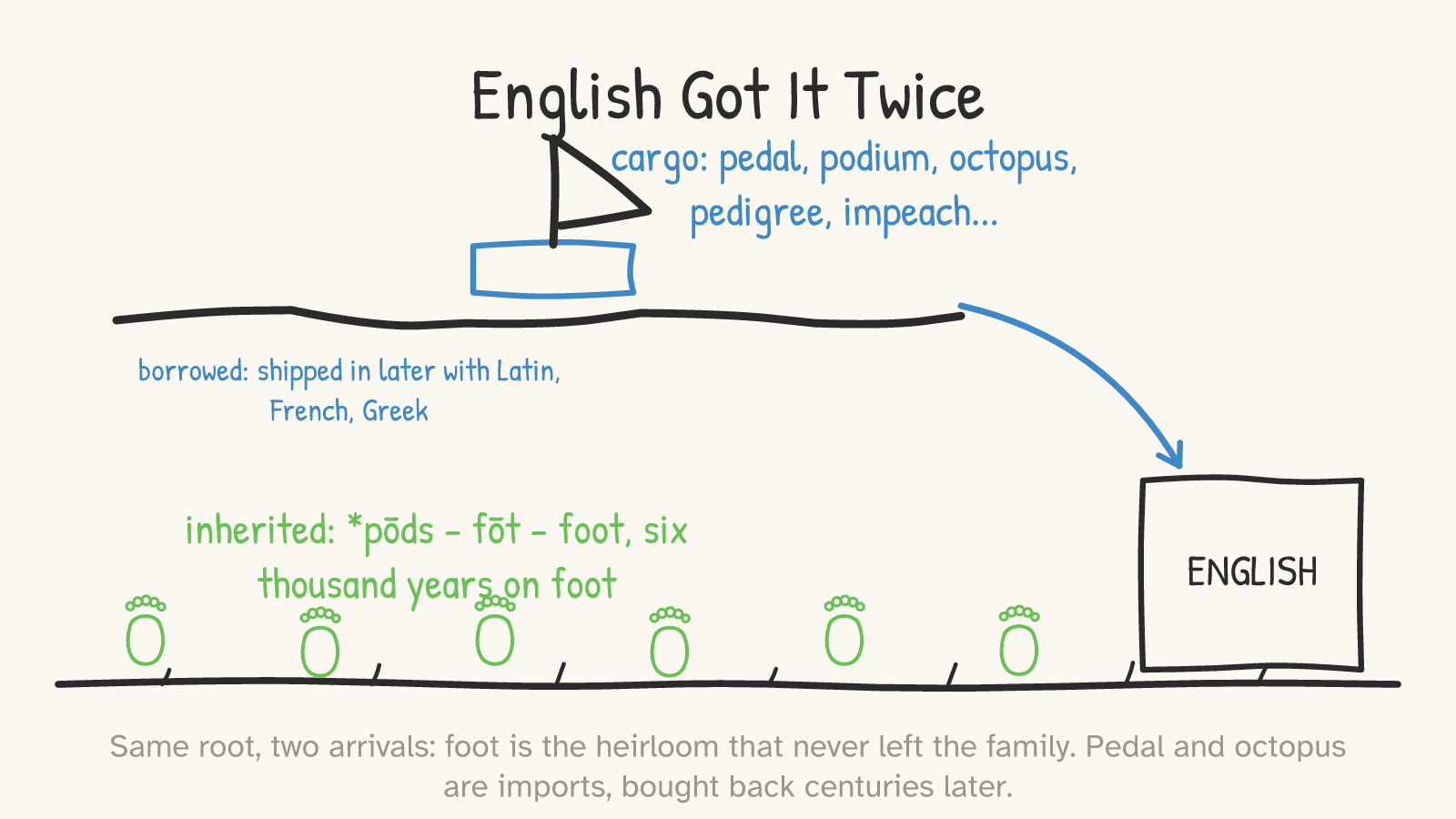
Foot walked the whole way. It came down the Germanic line by unbroken inheritance — parent to child, mouth to mouth, for roughly six thousand years, getting bent by Grimm's Law along the route but never leaving the family. It's the heirloom.
Pedal, podium, octopus, pedigree, impeach — those came by ship. They were borrowed into English centuries later, the polished Latin and Greek forms arriving with scholars, lawyers, doctors, and the Norman conquest. Same root, bought back as an import.
This matters for an honest reason: distinguishing inherited words from borrowed ones is precisely the discipline that keeps etymology from being a parlor game. Foot is evidence about the deep Germanic past; pedal is evidence about medieval book-learning. They are the same root telling two different histories, and a careful etymologist never confuses the two.
Part 5The impostors
Which brings us to the etymology police, because a root this productive attracts forgeries. Some words look exactly like foot-words and are not.
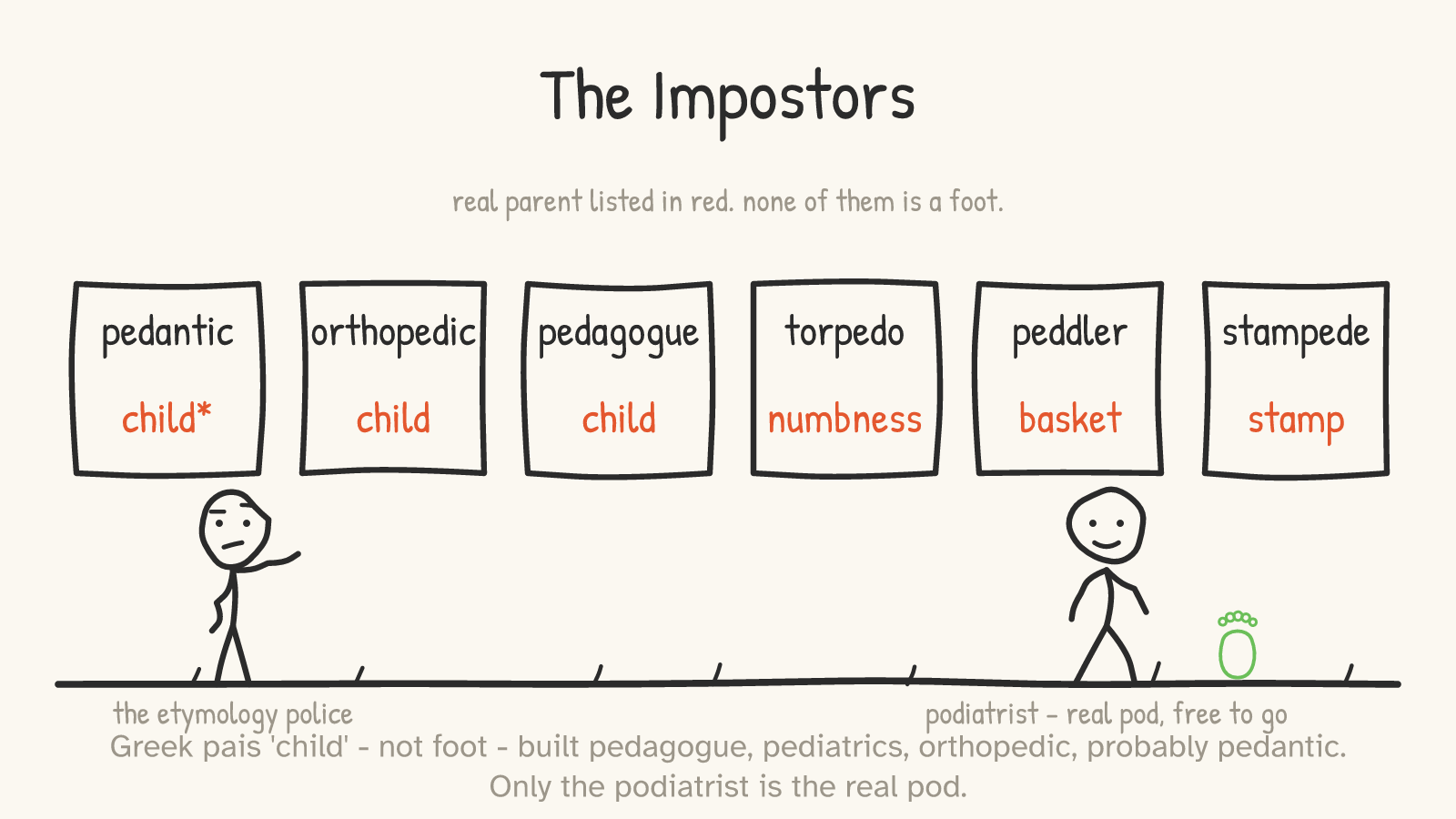
The biggest gang of fakes comes from a different Greek word entirely: país / paid-, meaning "child." It built pedagogue (the slave who escorted a child to school — and the -agogue half means "leader," not "foot," so even the walking is a mirage), pediatrics, encyclopedia, and — coined in 1741 by a French physician straightening children's bones — orthopedic. Even pedantic probably belongs to this child-family rather than the foot one — though the trail runs indirectly through Latin paedagogus, so the dictionaries call it "of uncertain origin," and we'll leave it there. (Your own instinct to file "pedant" under "foot" is the exact trap; consider it sprung.)
Other impostors have nothing to do with either root: peddler most likely comes from an old word for a basket (even that is uncertain); torpedo from Latin for "numbness" (it's named after the electric ray that numbs you); stampede rode in from Spanish. None is a foot.
The cruelest near-miss: a podiatrist treats feet (Greek pod-, the real thing) — but an orthopedist is, etymologically, a child-straightener. The foot doctor is the foot word; the bone doctor is the child word. Etymology owes you nothing.
How do we keep these straight rather than just asserting them? Tiered evidence. The solid descendants have regular sound correspondences and an unbroken paper trail. The impostors have different documented parents. And the genuinely uncertain cases get flagged as uncertain — the word impair, for instance, might trace to *ped- through Latin peior "worse" — if, as some scholars speculate, peior originally meant "one who stumbles." But the dictionaries say "perhaps," so we say "perhaps" too. The honesty is the method.
CodaYour mouth is an archaeological site
Step back and look at one root's harvest.
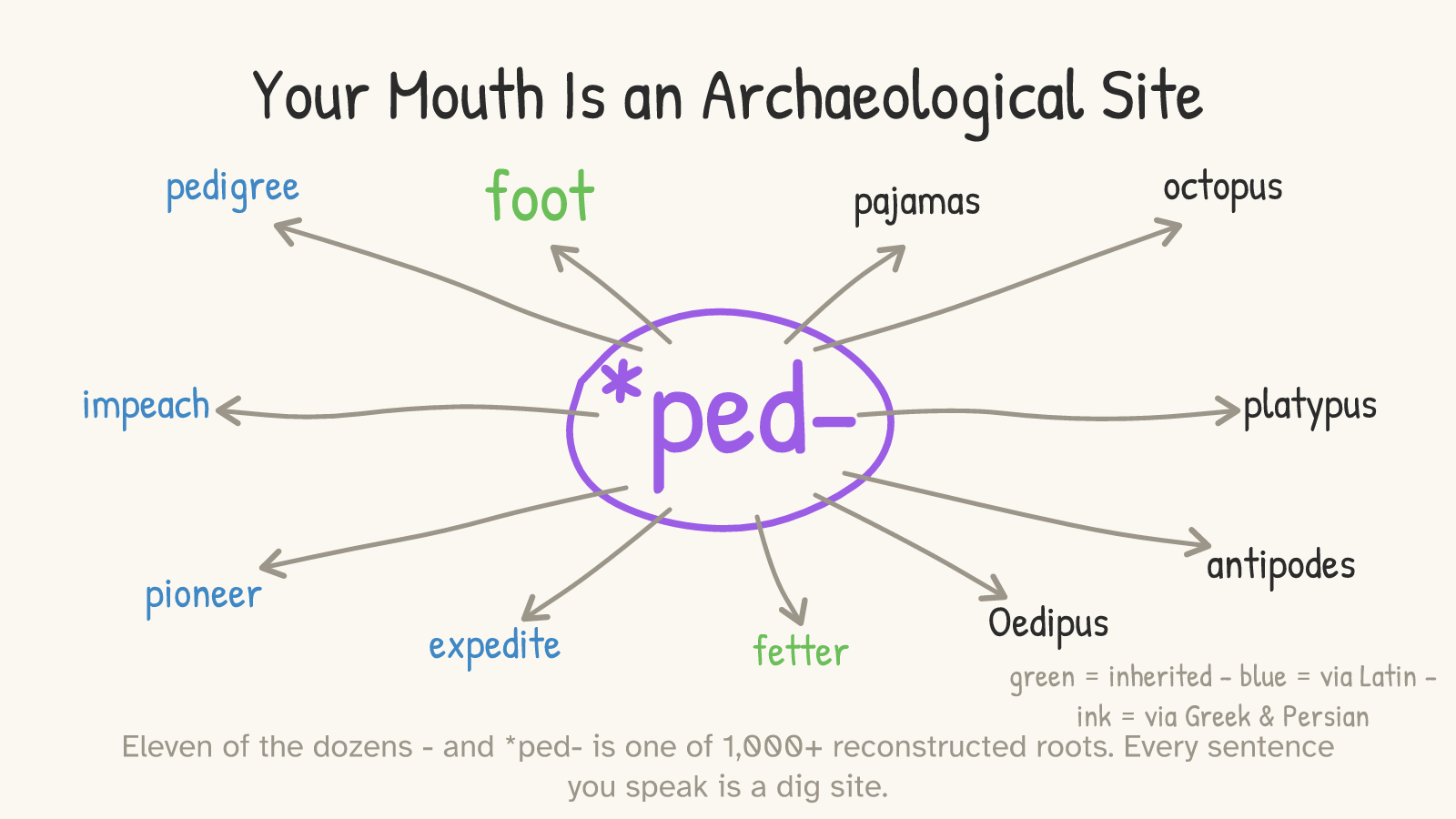
From *ped- alone: foot, fetter, pedal, pedestrian, pedigree (Anglo-French pé de gru, "crane's-foot," the little three-pronged mark in a family tree), expedite ("free the feet from a snare"), impeach ("to shackle"), pioneer (the foot-soldier sent ahead to dig the trenches and clear the way), the chess pawn (another foot-soldier), vamp, pajamas, octopus, platypus ("flat-foot"), Oedipus ("swollen-foot"), antipodes ("the people with opposite feet"), and dozens more.
And now the part that should raise the hair on your arms. There is a fair last objection: anything looks impressive if you cherry-pick one root and list forty of its children. True. So here's the concession that turns into the punchline: *ped- is not special. It is one of more than a thousand such roots that scholars have reconstructed for that ancestral speech community — the family of dialects we call Proto-Indo-European — *méh₂tēr (mother), *ḱerd- (heart), *wódr̥ (water), *gʷṓws (cow), on and on. Pick almost any plain old word in your sentence and you can dig the same shaft straight down through six thousand years.
That's the wonder, and it doesn't shrink under scrutiny — it generalizes. Every ordinary sentence you speak is an archaeological site, packed with tools your ancestors knapped before the wheel, before the alphabet, before history. You use them fluently and never feel their age.
Say "foot." A person you'll never know, in a place we can't quite point to, six thousand years gone, just said it with you.
Notes & receipts
Etymologies follow the American Heritage Dictionary Indo-European Roots Appendix (Calvert Watkins) and the Online Etymology Dictionary, cross-checked where they could differ.
- *ped-/*pod- "foot" — reconstructed PIE root with ablaut grades ped- (Latin), pod- (Greek), pōd- (Germanic, Indo-Iranian). The asterisk denotes reconstruction, not attestation.
- PIE dating / "six thousand years" — the mainstream steppe (Kurgan) model dates Proto-Indo-European to roughly 4500–3500 BCE, i.e. about 5,500–6,500 years ago; "six thousand" approximates the middle of that. (The wider "4500–2500 BCE" range sometimes quoted folds in the later dispersal of the daughter branches, not PIE proper; the rival Anatolian hypothesis dates the family earlier still.) The date is a reconstruction, not a record.
- Grimm's Law — the First Germanic Sound Shift, formulated by Rasmus Rask and Jacob Grimm in the early 1800s, in three series: voiceless stops → fricatives (PIE p t k → f þ x); voiced stops → voiceless (b d g → p t k); voiced aspirates → voiced stops (bʰ dʰ gʰ → b d g, via an intermediate voiced-fricative stage still visible in Gothic). *pṓds → fōt shows the p→f (series 1) and d→t (series 2) legs in one word. Gradual, spanning the later first millennium BCE, not a single dated event.
- pajamas ← Hindi pajama ← Persian pāy-jāma "leg-garment," pāy "leg/foot" ← *ped- (etymonline; the *ped- chain is explicit). pedigree ← Anglo-French pé de gru "crane's foot" (the form English actually borrowed; continental Old French had pied de grue). pioneer and pawn both ← Medieval Latin pedonem "foot-soldier" ("pawn" = the chess piece, not the verb). impeach ← Late Latin impedicare "to fetter." vamp ← Old French avantpié "front of the foot." All foot-words.
- Impostors — pedagogue, pediatrics, orthopedic, encyclopedia, and (per etymonline, "apparently") pedant/pedantic derive from Greek país/paidos "child," not "foot." orthopedic coined 1741 by Nicolas Andry for correcting children's deformities; English 1840. peddler ← probably a word for "basket" (uncertain); torpedo ← Latin torpere "be numb"; stampede ← Spanish estampida. None relate to *ped-.
- impair / pejorative — Latin peior "worse," which etymonline marks as perhaps originally "stumbling" from *ped-. Presented as disputed, not settled.
- "more than a thousand roots" — Watkins's Appendix runs to well over a thousand entries (counts of ~1,350–1,700 are cited for different editions); "more than a thousand" is the conservative floor.
- "nearly half of humanity" — Indo-European languages are spoken as a native language by roughly 46% of the world's population (Ethnologue-derived, c. 2017); higher still if second-language speakers are counted.