You memorized a wall of science words — infrared, AM/FM, bandwidth, isotope — as if each were a random string of letters to be feared. But a surprising number of them carry a built-in clue: the prefix hints at a direction, the root names a thing, and the two together point at what the word means or where the idea came from. Nobody ever explained that the vocabulary was, half the time, a map.
Everyone can chant the rainbow. Roy G. Biv — red, orange, yellow, green, blue, indigo, violet — a mnemonic drilled into you next to the water cycle and the parts of a cell. But here is a thing that was sitting in plain sight the whole time and probably never got pointed at: the two most famous kinds of light just off the ends of that rainbow have names that point you straight to where they sit.
Infrared. Infra is Latin for below. Infra-red = below the red.1
Ultraviolet. Ultra is Latin for beyond. Ultra-violet = beyond the violet.2
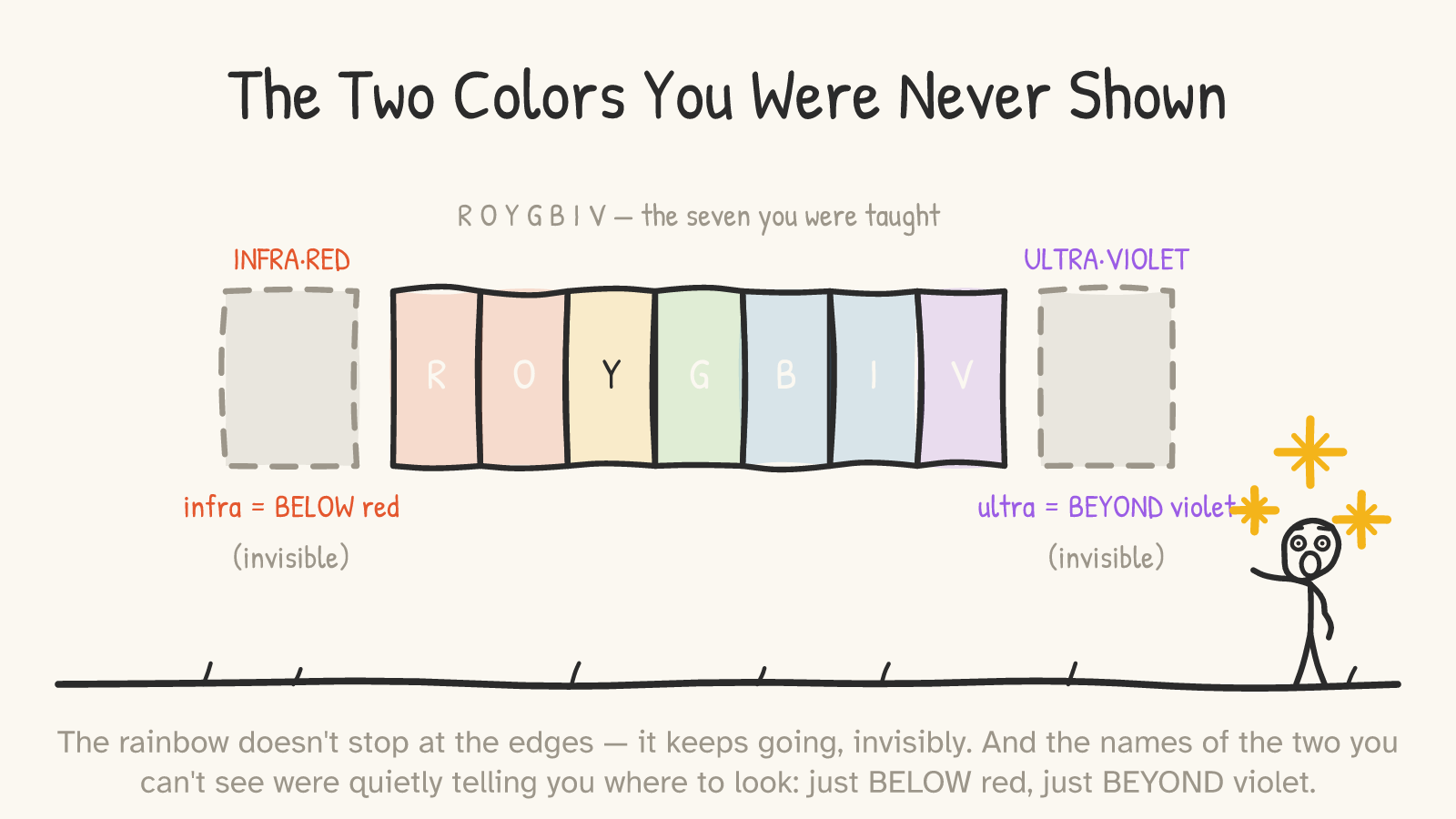
The rainbow doesn't stop at its edges. It keeps going in both directions into light your eyes can't catch — and the names of those invisible bands were quietly giving you the directions all along. Below the red. Beyond the violet. You were handed a coordinate, dressed up as a scary word.
This essay is about that pattern, because it is everywhere in the science vocabulary you were told to memorize. A huge fraction of those intimidating terms are not arbitrary at all — they are little Greek and Latin machines, assembled out of a prefix that points a direction and a root that names a thing.
One caveat I'll hold to the whole way through, because it's the honest version and the essay falls apart without it: the word usually hands you a clue, not the whole concept. Decoding infrared tells you where to look on the spectrum; it does not tell you what infrared radiation actually does — that physics you still have to learn. But the clue is real, and it's free, and once you can read it, a wall of jargon turns from wallpaper into a set of hints someone left you.
One more honest promise, because it's the fair thing and it's also the best part: not every word plays this game. Some decode to a person's name instead of a meaning; some decode to an honest shrug; one famous one decodes to a picture that turned out to be exactly wrong; and plenty barely decode at all. Those get their own section near the end — and they're arguably the most fun of all. But first, the words that do.
Part 1The whole rainbow is a rounding error
Here's the part that reframes everything. Infrared and ultraviolet aren't exotic add-ons bolted onto the edges of visible light. Visible light is the exotic add-on. It's all one thing — a single continuous ruler of electromagnetic radiation, sorted by frequency, running from radio waves at the low end to gamma rays at the high end.3
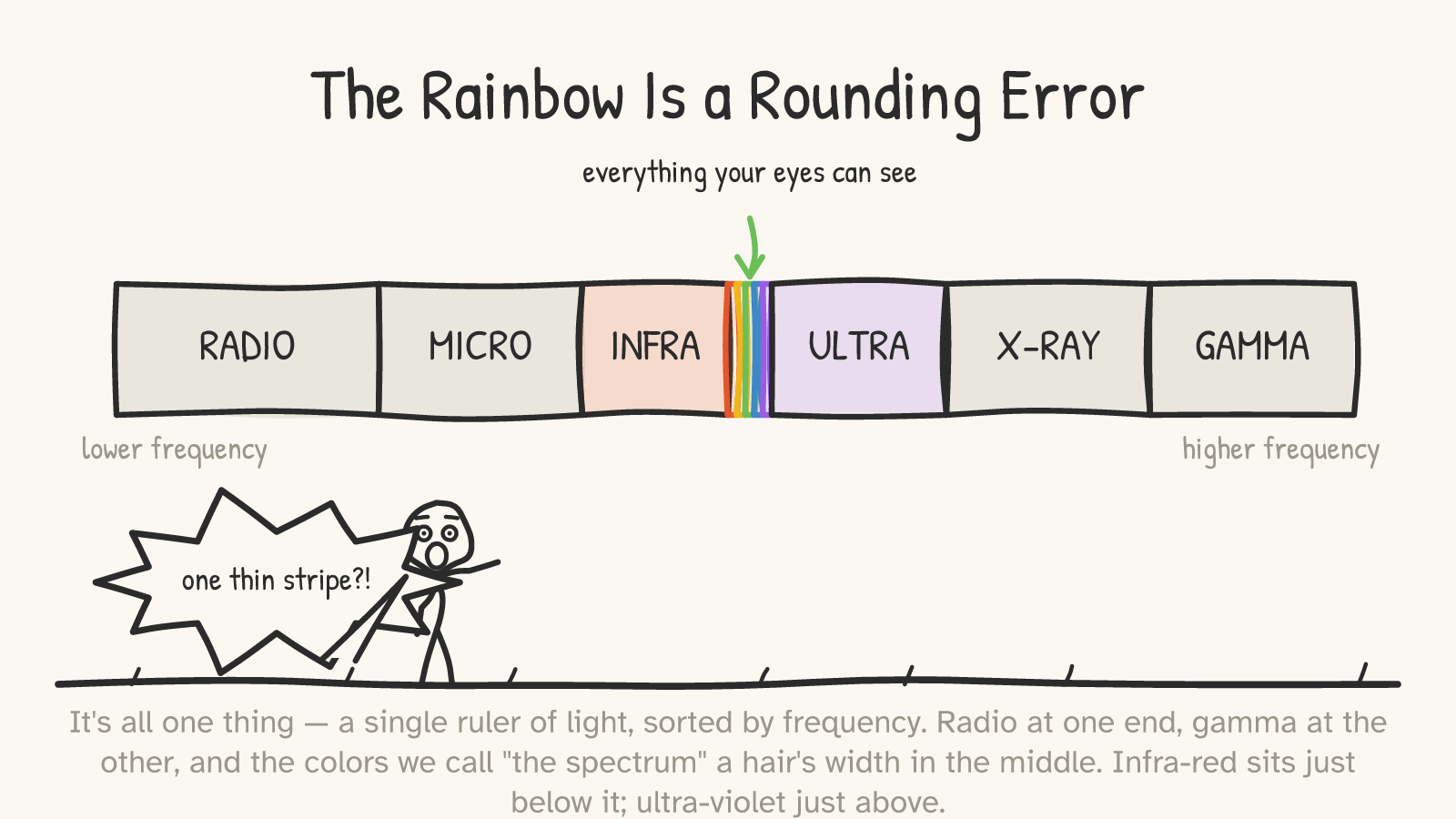
On that ruler, the entire rainbow — everything every human eye has ever seen, every sunset and traffic light and painting — is a hair's width. Radio waves at one end can be miles long; gamma rays at the other are smaller than an atom. And "the colors" are a sliver spanning less than a single doubling of frequency in a range that doubles dozens of times over.3 Red just happens to be the lowest-frequency light we can see, and violet the highest — so below red lands you in infrared, and beyond violet lands you in ultraviolet. The words aren't decoration. They're map pins on a ruler.
(A quick precision note, because a physicist is right to ask what "below" and "beyond" mean. Infrared is lower in frequency (and longer in wavelength) than red; ultraviolet is higher in frequency (and shorter in wavelength) than violet. The prefixes track the conventional order of the spectrum — infrared just past the red edge, ultraviolet just past the violet edge — so what they really pin down is the neighbor, which is exactly what we need here.1)
Even the word spectrum is a tell. It's Latin for "appearance" or "apparition" — the same root that gives us specter, spectacle, inspect. Newton borrowed a word that meant a ghostly image for the band of colors thrown by his prism.4 The scary technical term is a 350-year-old poetic flourish.
Part 2AM and FM tell you which knob they turn
Every car radio has the two buttons. Almost nobody who presses them can say what the letters stand for — and the letters are, once again, a surprisingly complete hint.
A radio station has to get your song across empty space. It does this by taking a steady, fast, invisible wave — the carrier — and modulating it: nudging one of its features up and down in time with the music, so the wiggle carries the sound.5 There are two obvious features of a wave you could wiggle. Its height (how tall each peak is) or its frequency (how tightly the waves are packed). And those are the two behind the two buttons. AM — Amplitude Modulation — means wiggle the height. FM — Frequency Modulation — means wiggle the spacing. (Engineers can wiggle other features too — the phase, for one — but height and frequency are the two you grew up with.)
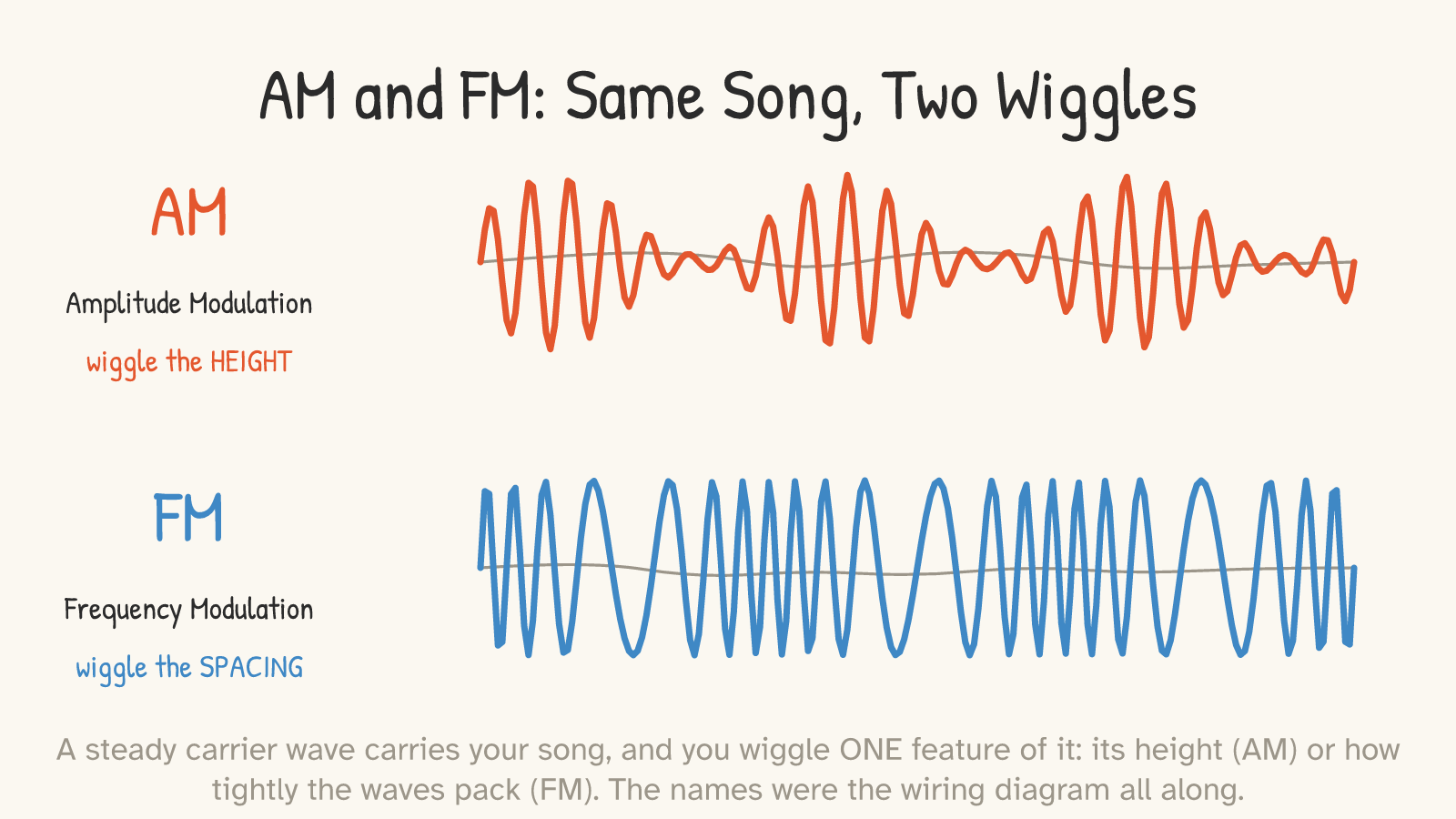
That's it. "Amplitude" is just the fancy word for how big, and "frequency" is the fancy word for how often. The acronym on the button is a wiring diagram. And it even explains why FM tends to sound cleaner: most of the static and crackle the world throws at a signal — lightning, sparks, bad wiring — shows up as changes in amplitude, in height. An FM receiver carries the music in the spacing, so it can shave most of that height-noise off the top before it reaches the song.6 It isn't magic and it isn't free — FM pays for the trick with a wider band, and some noise still leaks through — but it's a big part of why your FM station sounds crisp and your AM station hisses. And that part is spelled out, letter by letter, on the two buttons.
Part 3"Bandwidth" is not a metaphor. It's a measurement.
You've said this word this week. "I don't have the bandwidth." It has drifted so far into office-speak that its literal meaning has gone invisible — but the literal meaning is almost comically plain.
Every radio station, every Wi-Fi channel, every phone call gets assigned a band of frequencies to live in — a low edge and a high edge on that big ruler from Part 1. The bandwidth is exactly what it says: the width of that band. The distance in frequency from the bottom of your slice to the top of it, measured in hertz.7
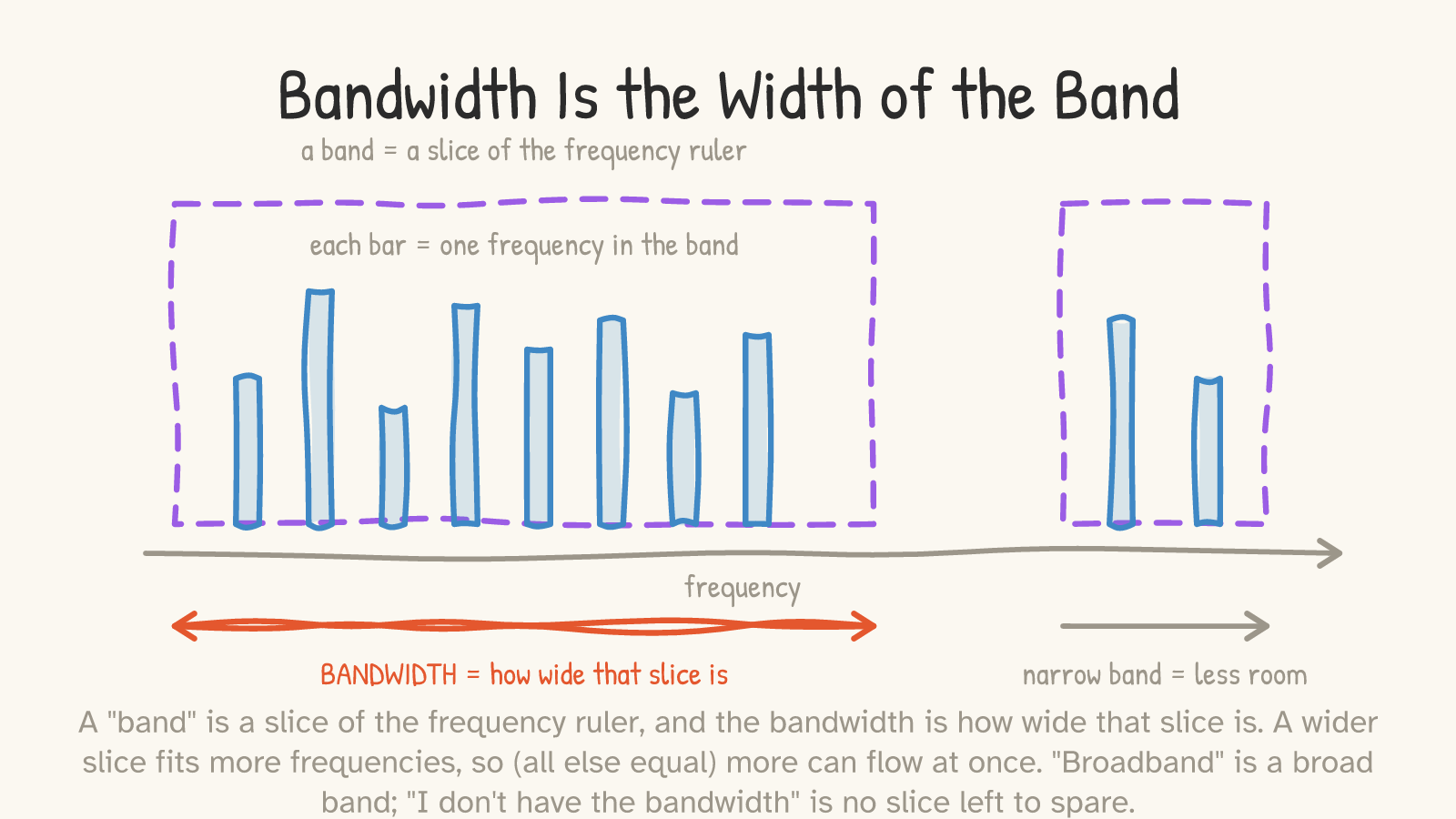
A wider band has room for more frequencies at once, which (all else equal) means more information can flow through it — so more bandwidth, more data. That's not just a loose analogy: Claude Shannon made it precise in 1948, showing that a channel's capacity climbs with the width of its frequency band — though also with its signal-to-noise ratio, so bandwidth is the headline knob, not the only one.7 Which is why broadband started life meaning, literally, a broad band — a fat slice of the ruler — even if today the word has drifted into a marketing category for "fast internet."8 Only the office-meeting sense ("I don't have the bandwidth for another project") is a pure metaphor — and even that one draws the right picture: no room left in the band for one more thing.
Part 4The trick generalizes — prefix is the direction, root is the thing
Once you've seen it three times, you can't unsee it, and the real payoff arrives: this isn't a handful of cute coincidences. It's a habit of scientific naming. Generations of people who read Latin and Greek coined these terms out of parts they expected each other to recognize — a prefix pointing a direction or a quantity, a root naming a thing. Not every word was built this way, and the ones that were don't hand you the full concept. But snap the parts together and a usable clue falls out.
Watch two words that are one letter apart and aimed in opposite directions:
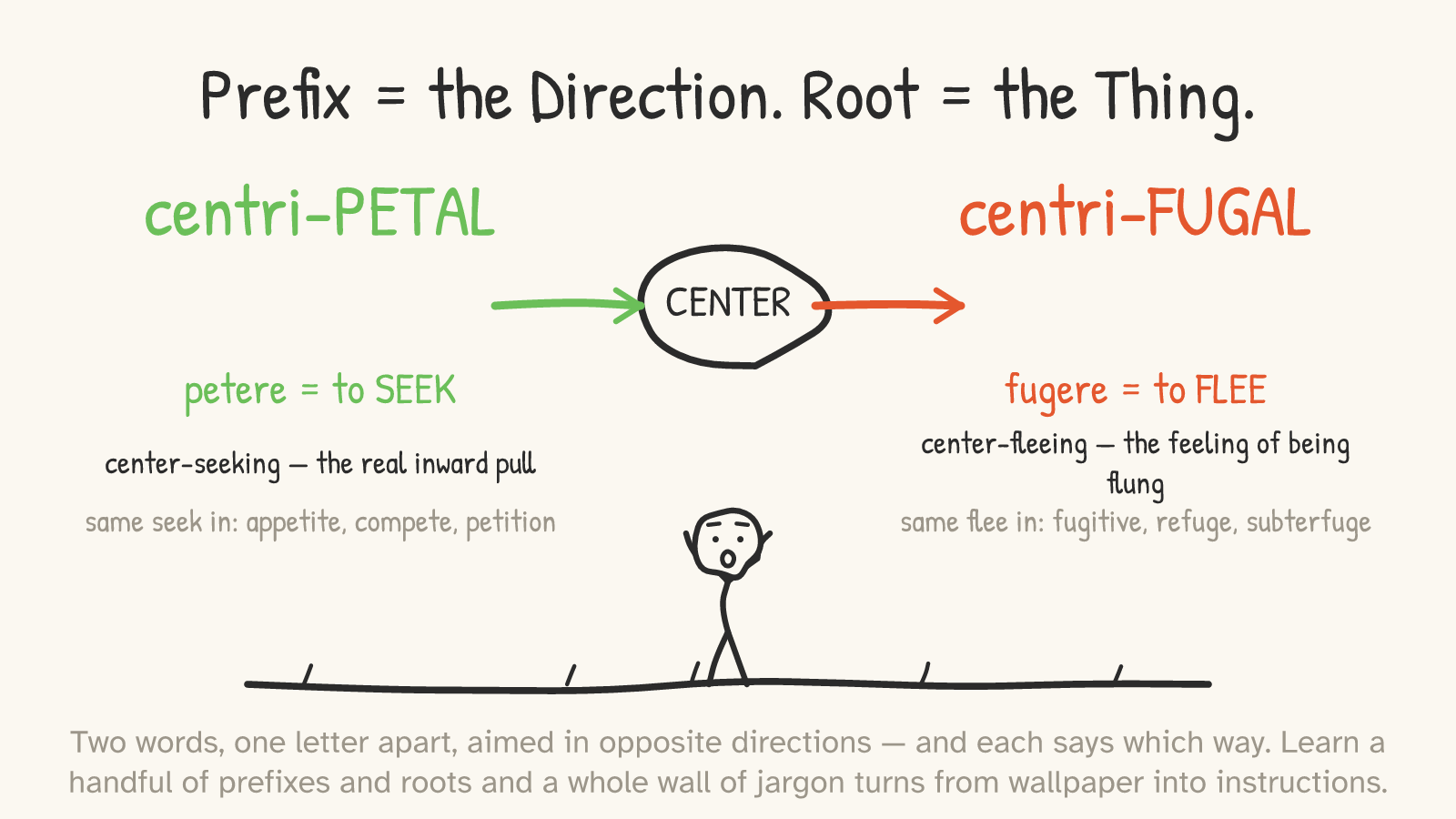
Centripetal and centrifugal. Both start with centri- (center). The endings carry the direction: petere, Latin to seek, versus fugere, Latin to flee. Centri-petal = center-seeking. Centri-fugal = center-fleeing. The words tell you which way each arrow points — though here's a wrinkle they paper over, and it's worth having: only centripetal points at a real, inward pull — the one actually supplied by a string, gravity, or friction — that bends something into a circle. The centrifugal "force" that seems to fling you against the car door on a hard turn is really your own inertia trying to go straight; it only looks like an outward force from inside the spinning frame.9 So the pair is a perfect mnemonic for direction and a slightly rigged one for force — which is exactly the kind of thing the etymology can't tell you, and the physics has to. Those roots are hiding in words you already use: petere (seek) in appetite, compete, petition; fugere (flee) in fugitive, refuge, subterfuge. You've been carrying both roots around for years; nobody mentioned they were the same ones.
Or isotope — two atoms of the same element with different masses (they carry different numbers of neutrons). Iso- (Greek, same/equal) + -tope (from topos, place) = same place, because they sit in the same seat on the periodic table.10 The word isn't the physics — the real definition lives in counts of protons and neutrons, not in Greek — but it hands you the picture the physics is about: same element, same slot, different weight. That's the honest reply to the person muttering "this is just etymology, not science." The etymology won't replace the physics. It points straight at it, which is far more than a random label would do.
Part 5Some words are their own lab report
The pattern gets almost cheeky in earth science, where the three rock types don't just have names — they have origin stories baked into those names. The name hints at how the rock was made.
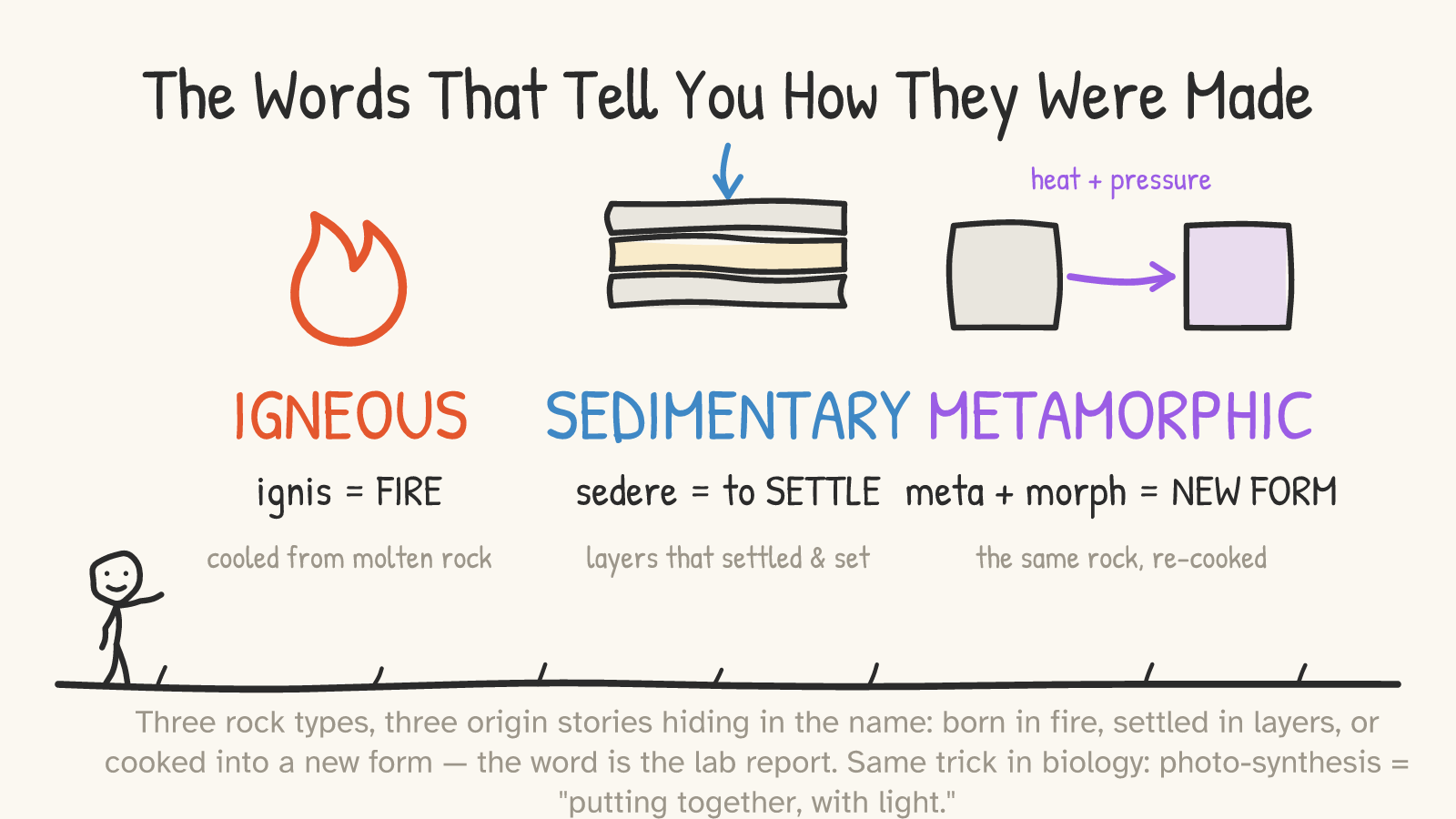
Igneous — from ignis, Latin for fire (the same root as ignite). Rock that froze out of molten stone. Sedimentary — from sedere, to settle (as in sediment, sedentary, reside). Rock built from stuff that settled and hardened. Metamorphic — meta- + morphē, the pieces of metamorphosis: rock changed into a new form by heat and pressure, without ever melting (melt it and you'd get igneous rock instead).11 Hand a kid three rocks and, if they can read the labels, they can tell you roughly how each one was born. That's not the whole rock cycle — you still have to teach the weathering and melting and uplift that shuttle rock between the three — but the names have already given the first day of the lesson for free.
Biology plays too. Photosynthesis = photo (light) + synthesis (syn, together + thesis, placing) = putting together, with light — roughly what a leaf does.12 Its green pigment is chlorophyll = chloros (pale green) + phyllon (leaf) — the name describes the color, not the light-catching chemistry behind it; the same chloros named the yellow-green gas chlorine.12 And out in astronomy, the calendar's turning points are labels too: a solstice is sol (sun) + sistere (to stand still) — the stretch where the sun's rising point on the horizon slows almost to a stop and reverses — and an equinox is aequus (equal) + nox (night), "equal night." Though only roughly: because our air bends the incoming light, the day of truly equal day and night falls a few days off the equinox, not on it.13 Even here, the honest move is to put the caveat in the sentence, not hide it in a footnote.
Part 6Where the decoder ring runs out
Time to keep the promise from the top, because a fair-minded skeptic has had a hand up for a while, and the objection is exactly right: you've been showing me the words that decode and quietly skipping the ones that don't. Guilty. So here's the honest accounting — the places the ring runs out — and it runs out in more than one way.
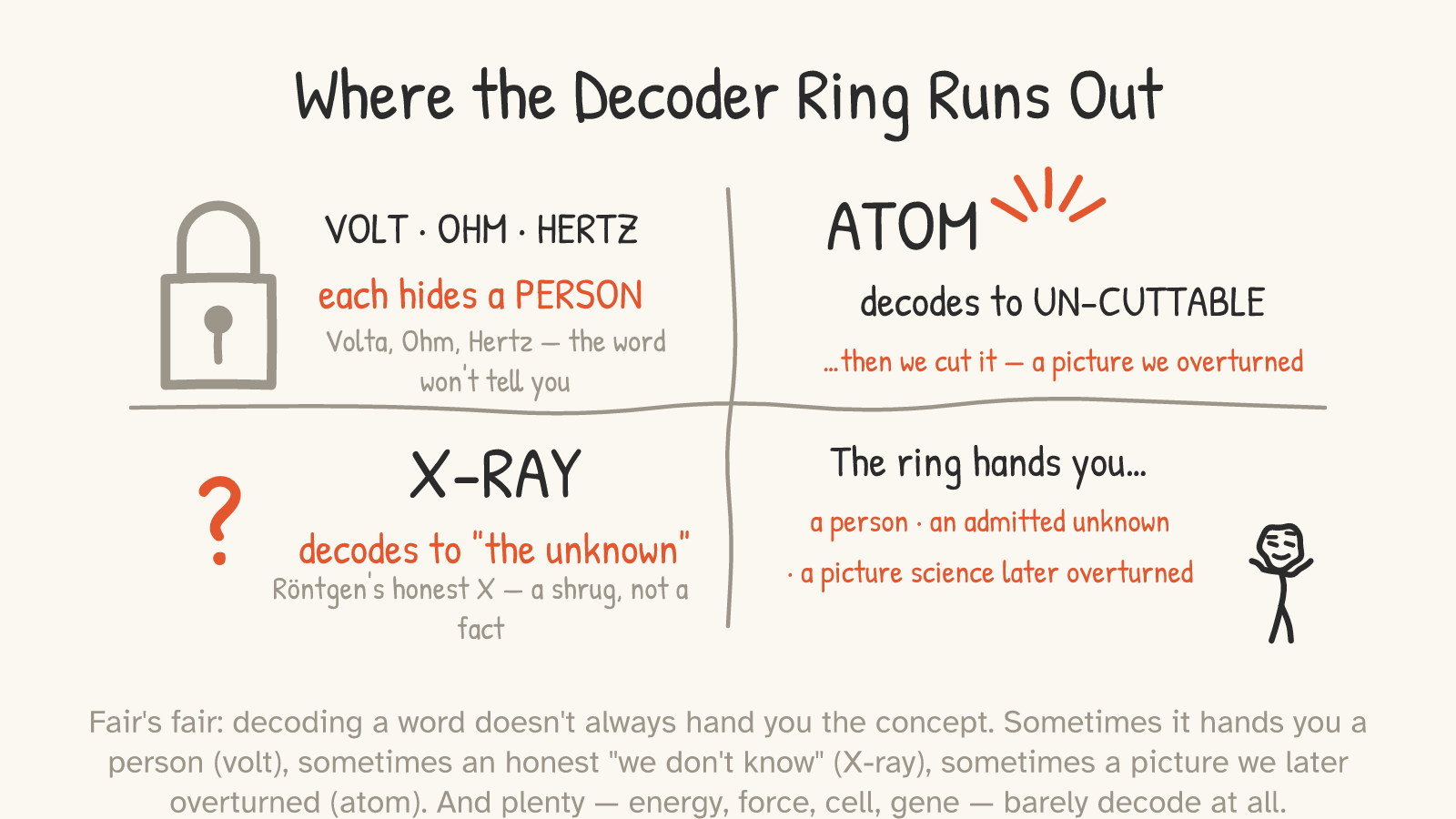
Sometimes it hands you a person. The units of physics are a graveyard of scientists. A volt is Alessandro Volta. An ohm is Georg Ohm; a hertz is Heinrich Hertz, a watt is James Watt, an ampere is André-Marie Ampère, a newton is Isaac Newton.17 You can stare at volt forever and never work out how big one is, because the name is a surname — there's no meaning to decode, only a person to already know. (There's a fingerprint of this: a unit named after a person is written out in lowercase, but its symbol gets capitalized — V, W, N, Hz — a small flag that it honors someone. Kelvin is doubly hidden — a title Lord Kelvin borrowed from the River Kelvin in Glasgow.17)
Sometimes it hands you an honest shrug. When Wilhelm Röntgen found a strange new radiation in 1895 and had no idea what it was, he called it X-radiation — X for the unknown, the same x you solve for in algebra.15 Here the word decodes perfectly; it just decodes to we don't know yet. (The particle electron is the opposite, happier case: it decodes to Greek ēlektron, amber, because the ancients found that rubbing amber made it crackle and grab things — a real chain of meaning, not a shrug. Your whole electric civilization is named after a staticky tree resin.16)
And sometimes it hands you a picture we later tore up. Atom is the best word in the essay. It's Greek a-tomos — a- (not) + temnein (to cut) — literally the uncuttable thing, the old philosophers' name for the smallest possible piece of matter, the place where cutting had to stop.14 It decodes flawlessly. It's also wrong: we named it uncuttable, and then we split it, and called the most famous release of energy in history splitting the un-splittable. (In fairness to the Greeks, their atomos was a philosophical ideal, and the chemist's atom really is the smallest unit of a chemical element — it's the nucleus we split, not the chemistry. But the name promises uncuttable, and we cut it, and that will never not be funny.14) That same -tom- "cut" hides in anatomy and in every -ectomy a surgeon performs.
And then there's the category I've been carefully stepping around: the words that decode to almost nothing useful. Take entropy, enthalpy, ion, or plasma apart and the Greek pieces don't hand you the concept — you simply have to be taught what each one means. Others are false friends that decode to a clue and then strand you: cell really does trace to the little monastery "rooms" Robert Hooke saw under his microscope, but you'd never reach "the basic unit of life" from that alone — which is the whole point, and the honest limit of the trick. And some coinages are near-whimsy: quark was a sound Murray Gell-Mann already had in his head when he borrowed the spelling from a nonsense line in Joyce's Finnegans Wake — a word picked for how it sounds, not what it means.18 So no, the decoder ring is not a universal key, and yes, I chose my examples. The honest claim is the smaller one, and it's still worth your afternoon: a large, learnable chunk of science vocabulary was built to carry a clue — and school handed you all of it, clue-bearing and opaque alike, as one undifferentiated list to memorize.
Coda: you had the key the whole time
Think back to ninth grade. Somewhere in a hot classroom, a list of vocabulary went up on the board, and you were told to memorize it for Friday. Infrared. Amplitude. Isotope. Sedimentary. You wrote them out, you drilled the definitions, you passed the quiz, and you filed the whole business under things I had to know once.
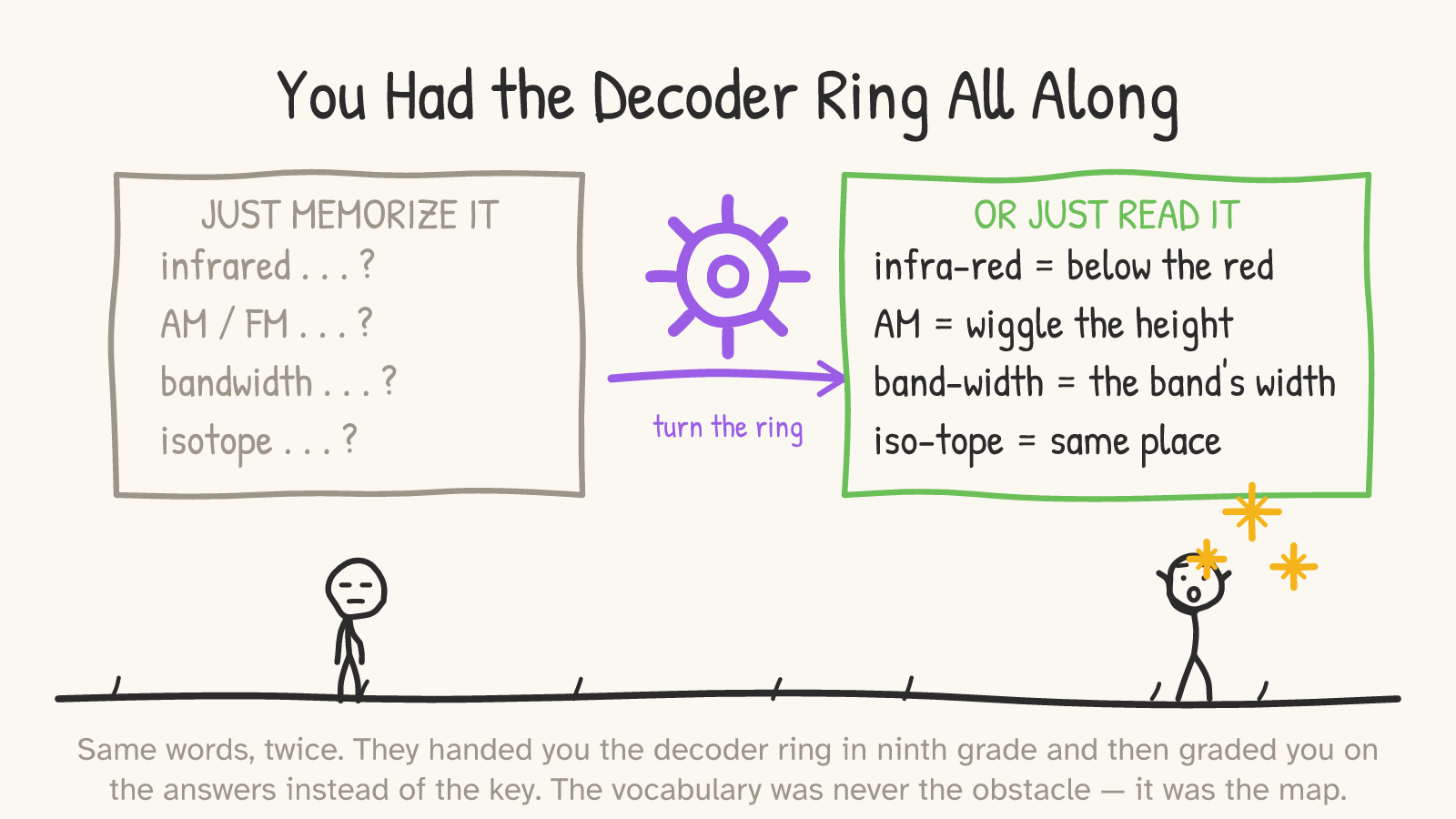
But the clues were right there inside the words. Infra-red was telling you below the red. Amplitude was pointing at bigness. Iso-tope was same place. None of those is the whole concept — each is a handhold, not the summit — but the vocabulary you were told to fear was covered in them, and somehow the assignment was almost always to memorize the output instead of learning to read the key.
You still have the ring. It's a few dozen prefixes and roots — infra, ultra, iso, meta, photo, tele, micro; -tope, -morph, -tomy, -scope, -graph, -phyll. They won't always behave (meta- means "change" in metamorphic but "about, higher-order" in metadata), so take a decoded word as a first guess, not a guarantee — then check it against the real thing. But learn them like a handful of chords and the wall of jargon stops being a wall. It becomes what it half was all along: a pile of small hints, each one quietly pointing at its own meaning, waiting a few hundred years for you to notice.
The rainbow never stopped at violet. And the words never stopped telling you so.
Footnotes & receipts
- infrared / "infra" = below. Infra- is Latin "below"; infrared is the band of ↩
- ultraviolet / "ultra" = beyond. Ultra- is Latin "beyond"; ultraviolet lies beyond ↩
- the visible span vs. the whole spectrum. Visible light runs roughly 380–750 nm, ↩
- spectrum. Latin spectrum, "appearance, apparition," from specere, "to look at" — ↩
- modulation / carrier wave. A carrier is a steady high-frequency sinusoid; to ↩
- FM's noise immunity; Armstrong. Most additive noise perturbs amplitude, so an FM ↩
- bandwidth. Literally the width of a frequency band, in hertz (e.g. an FM channel ↩
- broadband. A "broad band" — a wide range of frequencies — contrasted historically ↩
- centripetal / centrifugal. Centrum + petere ("to seek") = center-seeking; ↩
- isotope. Greek isos ("same/equal") + topos ("place") = "same place" — isotopes ↩
- igneous / sedimentary / metamorphic. Igneous ← Latin ignis, "fire" (cf. ↩
- photosynthesis / chlorophyll / chlorine. Photosynthesis ← phōto- ("light") + ↩
- solstice / equinox. Solstice ← sol ("sun") + sistere ("to stand still") — the ↩
- atom. Greek átomos, "uncuttable" — a- ("not") + temnein ("to cut"); ↩
- X-ray. Wilhelm Conrad Röntgen discovered them in 1895 and named them ↩
- electron / electricity. Greek ēlektron = "amber"; rubbing amber produces static ↩
- eponymous SI units. volt (Volta), ohm (Ohm), hertz (Hertz), watt (Watt), ↩
- decibel / quark. Decibel = deci- (Latin "tenth") + bel, the bel named after ↩