You did something this morning that would have made a medieval king weep with envy, and you don't remember doing it.
You turned a small metal handle, and clean, cold, drinkable water came out of the wall. It kept coming out for as long as you wanted. When you were done, you made it stop. Total cost: about a penny a gallon. Total thought given to where it came from: zero.
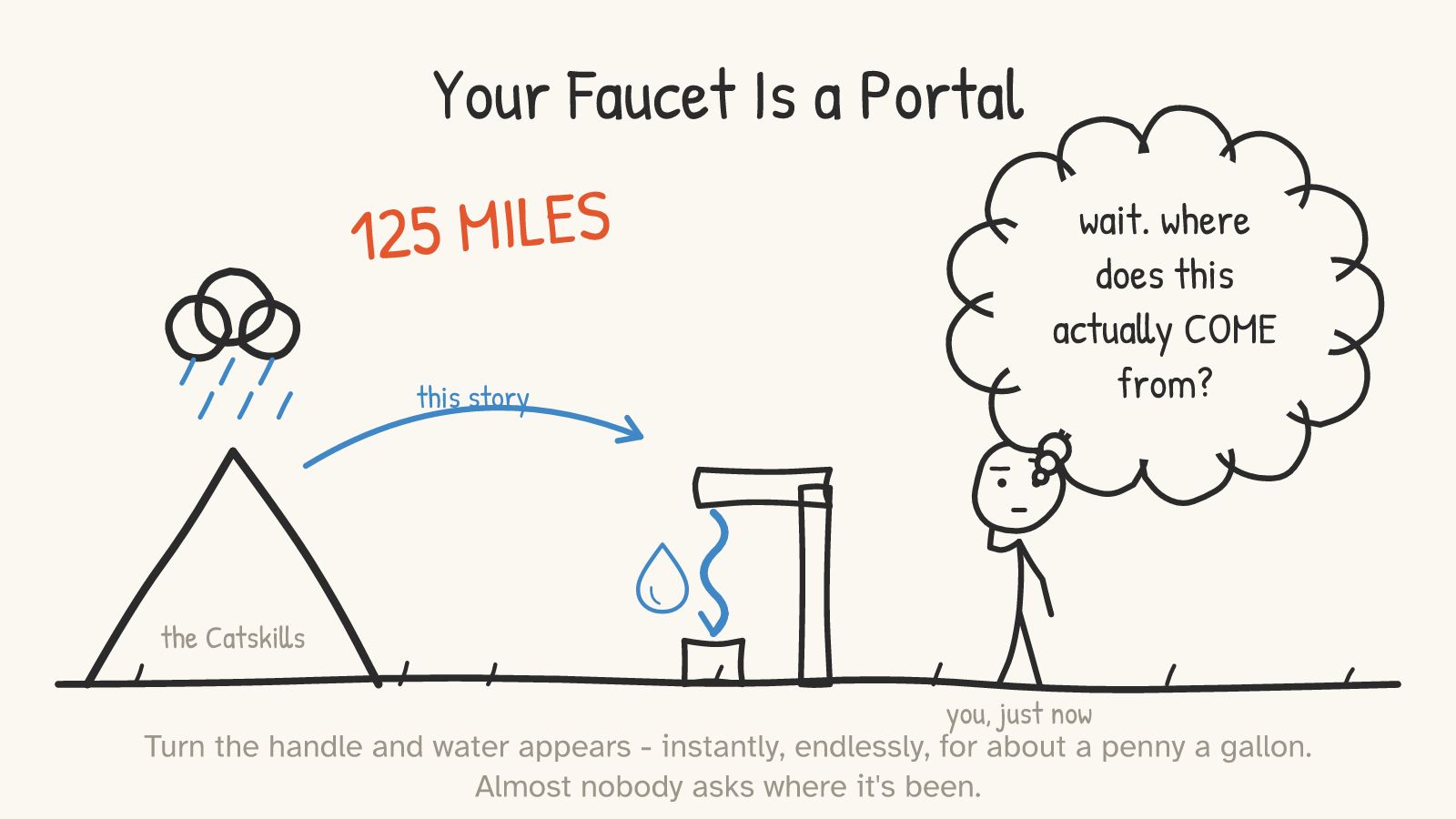
Which is a shame, because the answer to "where does this actually come from?" is one of the great hidden machines of the world. The water in your glass was, not that long ago, rain falling on a mountain 125 miles away. Getting it from that mountain to your sink — without you ever thinking about it — is arguably the most impressive thing New York City has ever built. It's also, in a very real sense, the thing that let New York City get built.
So let's follow a raindrop.
Part 1First, you have to own the rain
New York didn't always have good water. For its first two hundred years it had spectacularly bad water — a few brackish wells and one increasingly disgusting pond.1 The lowlights of the bad-water era: a cholera epidemic in 1832 that killed thousands, and a fire in 1835 that burned down most of lower Manhattan partly because there wasn't enough water pressure to fight it.
The city's response was gloriously unsubtle: go far away, find clean water, and buy everything around it.
In 1842 the first aqueduct opened, carrying water from the Croton River in Westchester. The city outgrew it almost immediately, so New York went further — into the Catskill Mountains, then all the way to tributaries of the Delaware River. Each time, the playbook was the same: dam a valley, flood it into a reservoir, and protect the land that drains into it.2
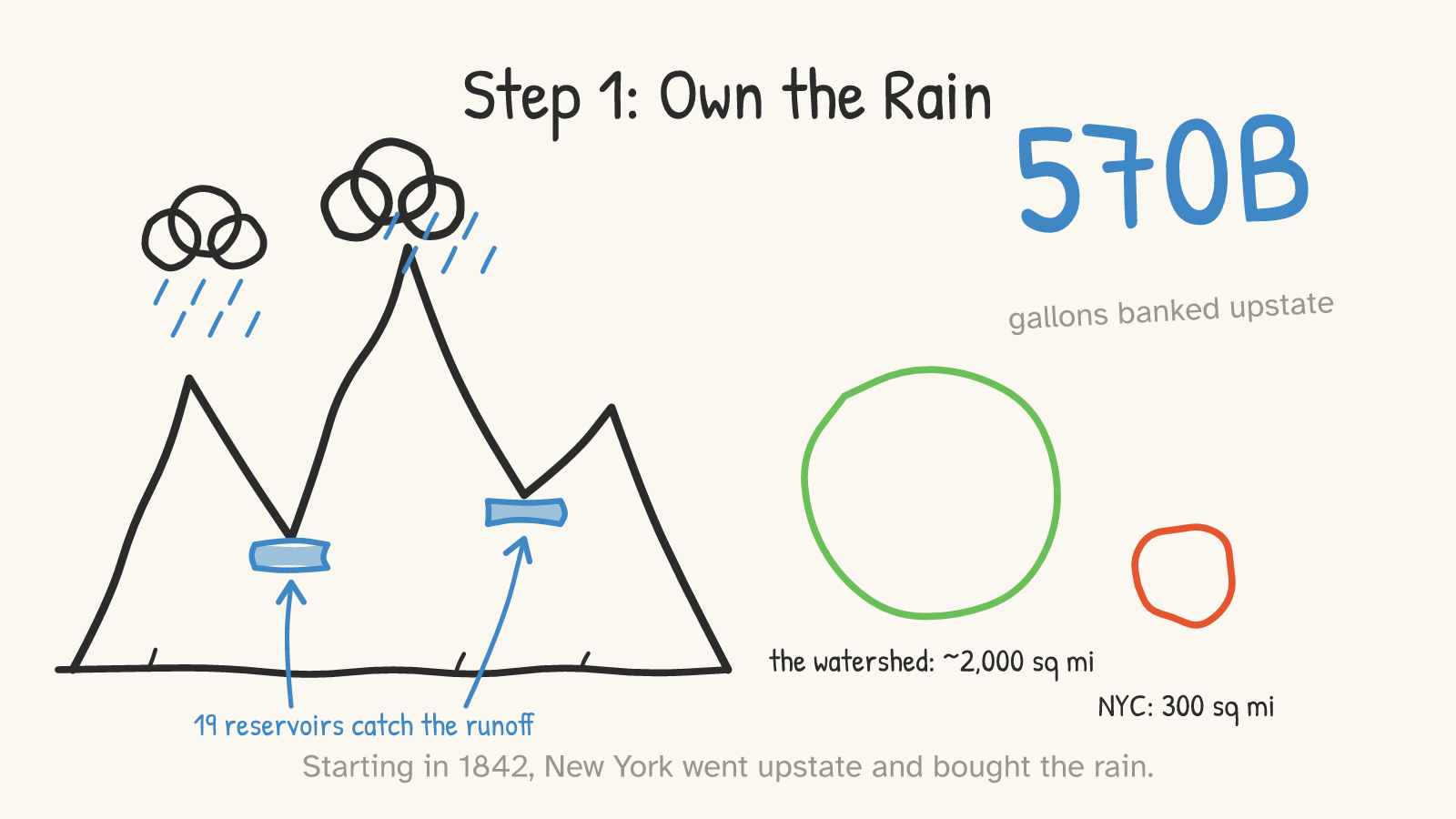
Today the system is 19 reservoirs and 3 controlled lakes spread across roughly 2,000 square miles of upstate land — a watershed more than six times the size of the city it serves, bigger than the entire state of Rhode Island. When it rains on a hillside in Delaware County, that rain is, administratively speaking, already yours. It just hasn't arrived yet.
At any given moment the reservoirs hold about 570 billion gallons. The city drinks roughly a billion gallons a day — more than nine million people, counting the upstate towns that tap the same system. So New York keeps about a year and a half of water in the bank.
Part 2The part where nobody pumps anything
Here's the fact that should permanently change how you look at your faucet:
This was not luck. The 19th- and 20th-century engineers who designed the system obsessively chose reservoir sites that were high — the Rondout Reservoir, where the biggest branch of the system gathers, sits about 840 feet above sea level. The city, helpfully, sits at roughly zero. Everything in between is engineered as one continuous, extremely gentle downhill ride: the aqueducts drop just enough per mile to keep the water moving.3
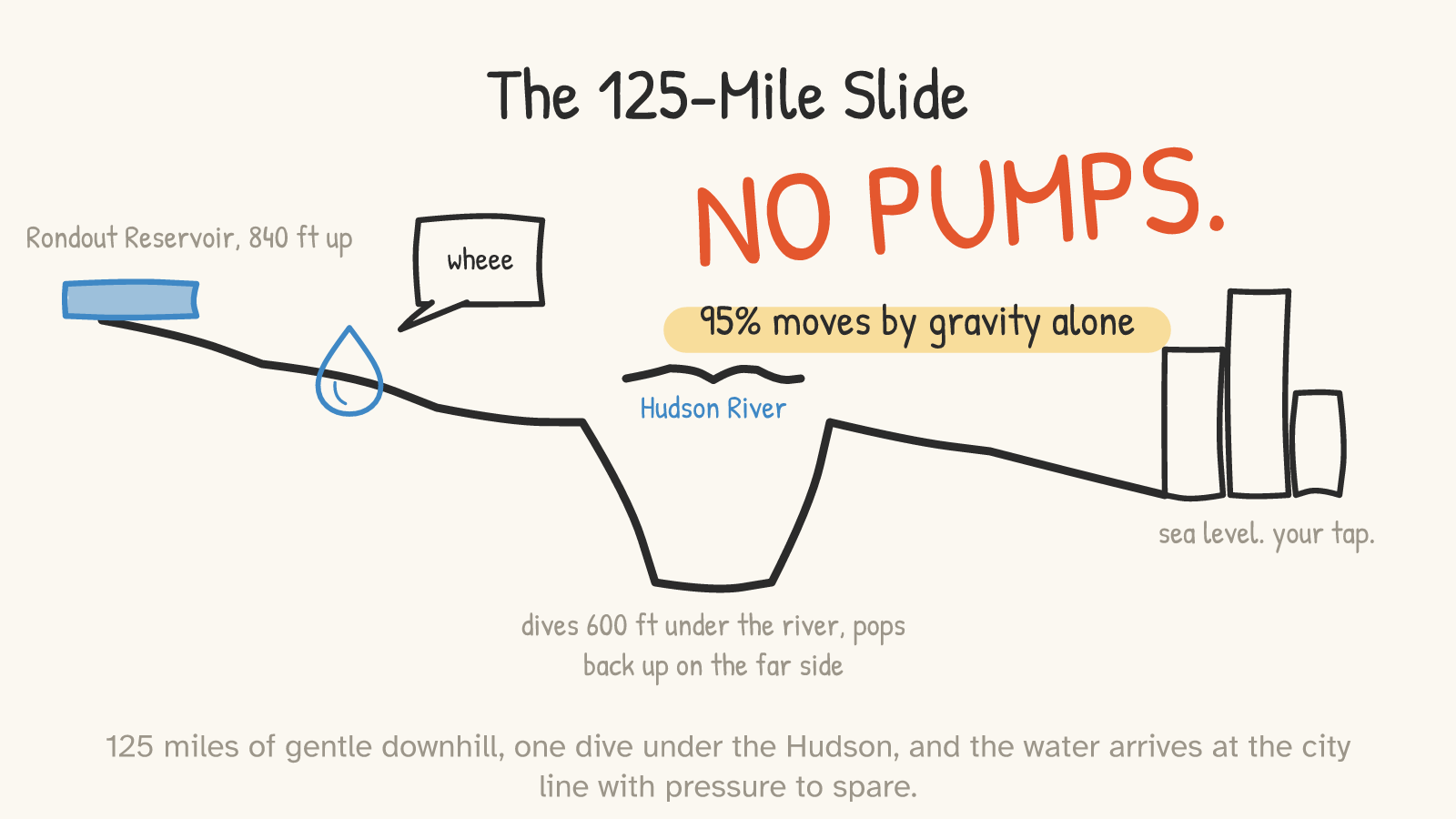
And when the route hits an obstacle — say, the Hudson River — the water doesn't get pumped over it. The tunnel simply dives under the riverbed and comes back up on the other side, like a straw bent into a U. Water in a sealed pipe doesn't care; pressure from the high side pushes it back up the low side. The Delaware Aqueduct crosses 600 feet beneath the Hudson this way.4
By the time the water reaches the city's doorstep it still has hundreds of feet of elevation in its pocket — which, as we'll see, is what shoots it up through the pipes of your building with no help from anybody.
Part 3The most heroic plumbing on Earth
The aqueduct that does most of the work — the Delaware Aqueduct — is a single concrete-lined tube, 13.5 feet across, running 85 miles through solid rock. It is the longest tunnel of any kind on the planet, and it was finished in 1944. Most New Yorkers have never heard of it.
Then the water has to get into and under the city, which is its own epic. Manhattan schist is hard rock, and everything shallow is already taken — subways, sewers, steam, cables. So the city's three water tunnels go deep. Really deep.
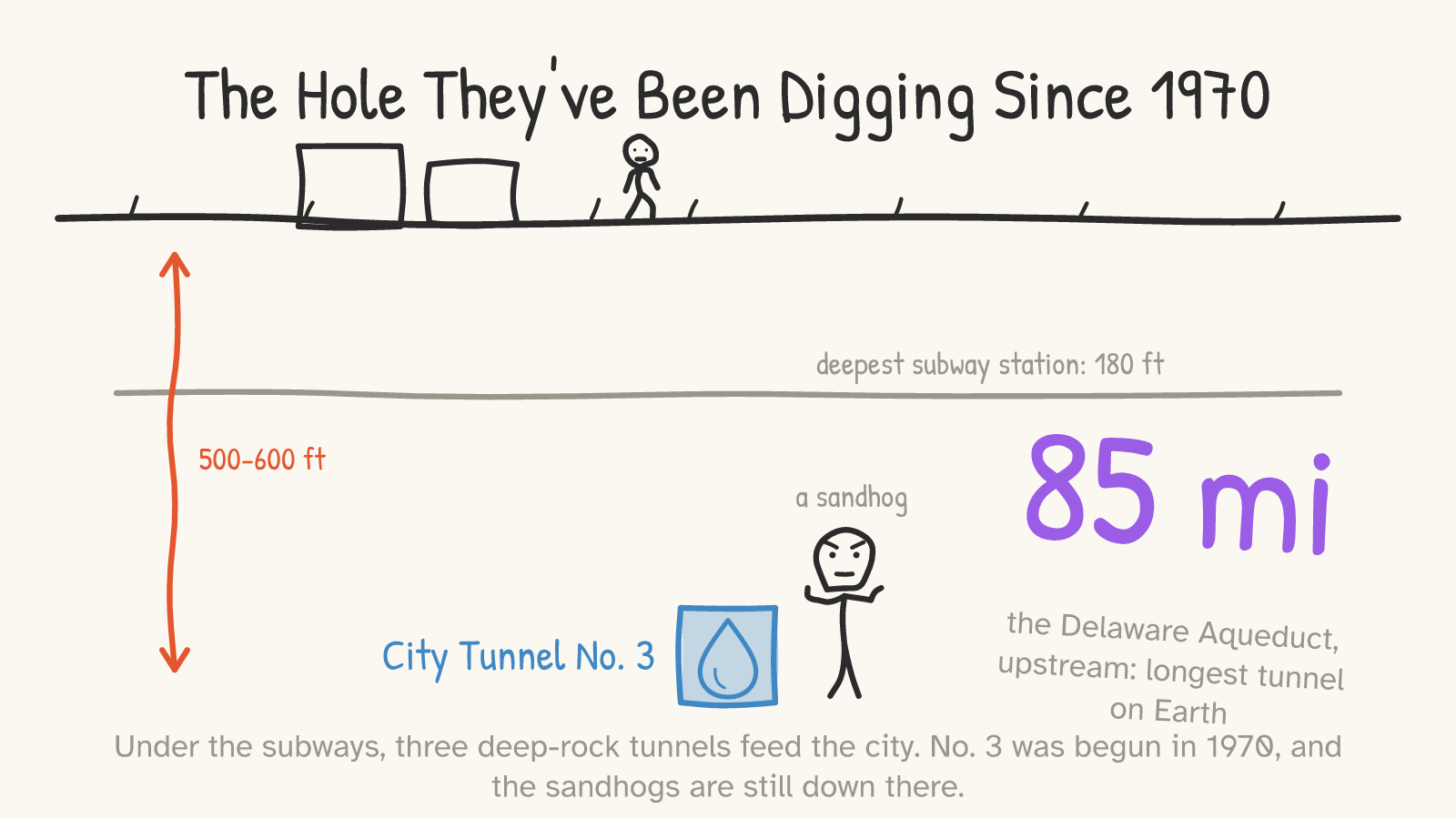
City Tunnel No. 1 opened in 1917. No. 2 in 1936. And City Tunnel No. 3 — the insurance policy that will finally let the first two be inspected and repaired — has been under construction since 1970. It runs 500 to 600 feet below the street: three Statues of Liberty, stacked, below the deepest subway platform. The men who dig it (it's a hereditary trade — the same families, generations deep) are called sandhogs, and twenty-four of them have died building this one tunnel. When it's finally complete, it will have taken longer to build than the Brooklyn Bridge, the subway, and the Empire State Building combined.
Meanwhile the 85-mile Delaware Aqueduct sprang a leak — tens of millions of gallons a day seeping out near Newburgh — so the city spent the last decade carving a brand-new 2.5-mile bypass tunnel under the Hudson to route around the bad section. The fix is plumbing, but at a scale where "patch the pipe" means "bore a new tunnel through bedrock beneath a river."
Part 4The filter is a forest
Here's the part that surprises people most: for 90% of the supply, nobody filters this water.5
Nearly every big city pushes its drinking water through an industrial filtration plant. New York is one of only five large American cities with a waiver to skip it — because the EPA agreed to a bet the city made: instead of building a machine to clean the water, we'll spend the money keeping the water from getting dirty.
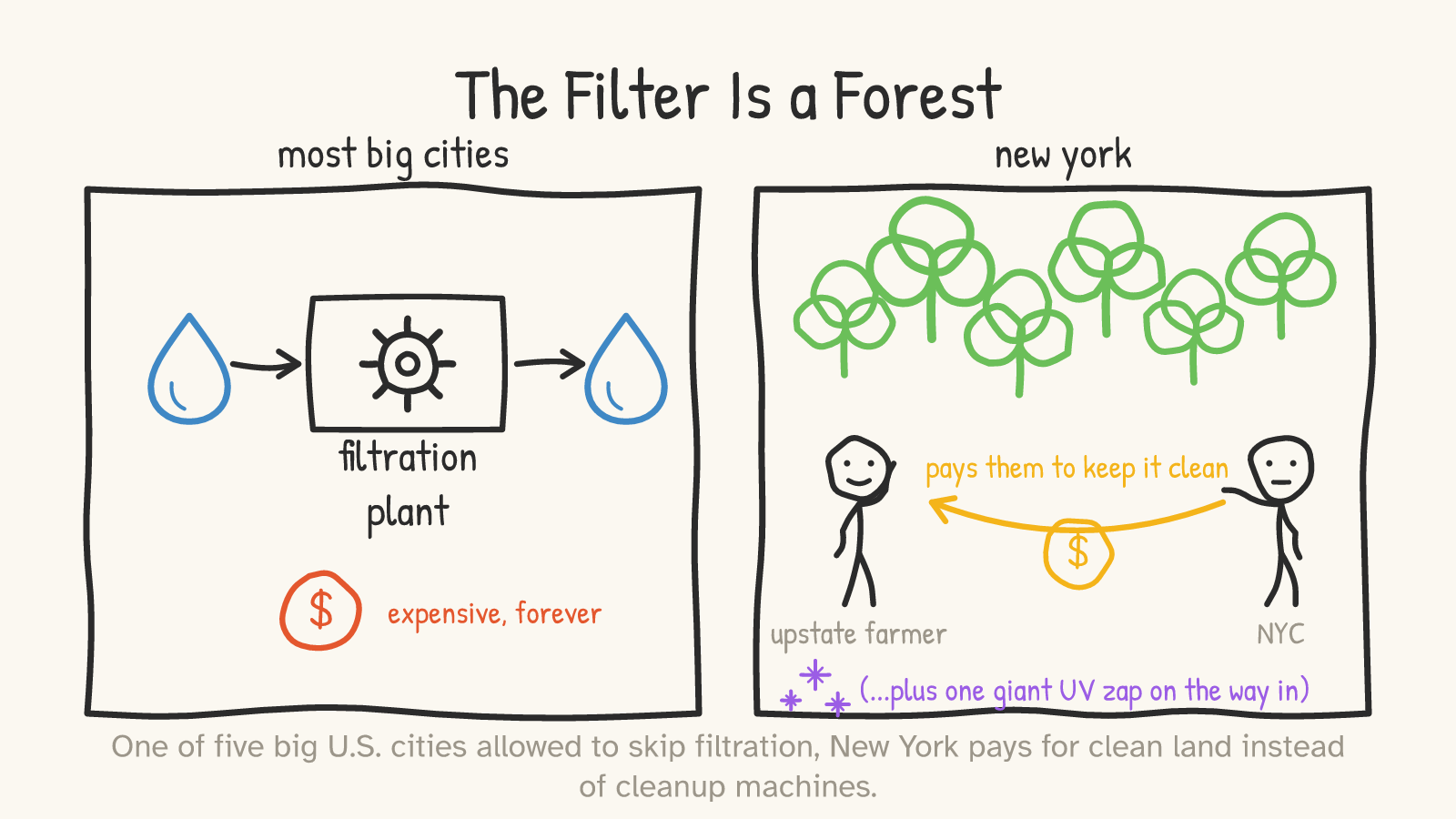
So New York buys land around its reservoirs and keeps it wild. It pays upstate farmers to fence cows out of streams and manage manure. It upgrades small-town septic systems and wastewater plants it doesn't even own, because they're upstream of its glass. Over a billion dollars spent on, essentially, forest — which still beats the estimated ten-plus billion a filtration plant for that volume would cost. The trees, soil, and wetlands do the filtering for free.
(The water isn't untouched, to be clear. On the way in it gets a small dose of chlorine, a shot of fluoride, food-grade phosphoric acid to keep old pipes from leaching lead — and it passes through the largest ultraviolet disinfection plant in the world, 600-odd million dollars of industrial-strength sunburn for microbes. The one part of the supply that is conventionally filtered, the Croton branch, runs through a plant hidden under a park in the Bronx with a golf driving range on the roof. New York remains New York.)
Part 5The last six floors
So the water arrives under your street, still riding the pressure of an upstate mountain. That free pressure is enough to push it up through a building's pipes to about the sixth floor. For most of the city's history, that's roughly why so much of New York is six stories tall.6
What about taller buildings? This is where the skyline gives the game away.
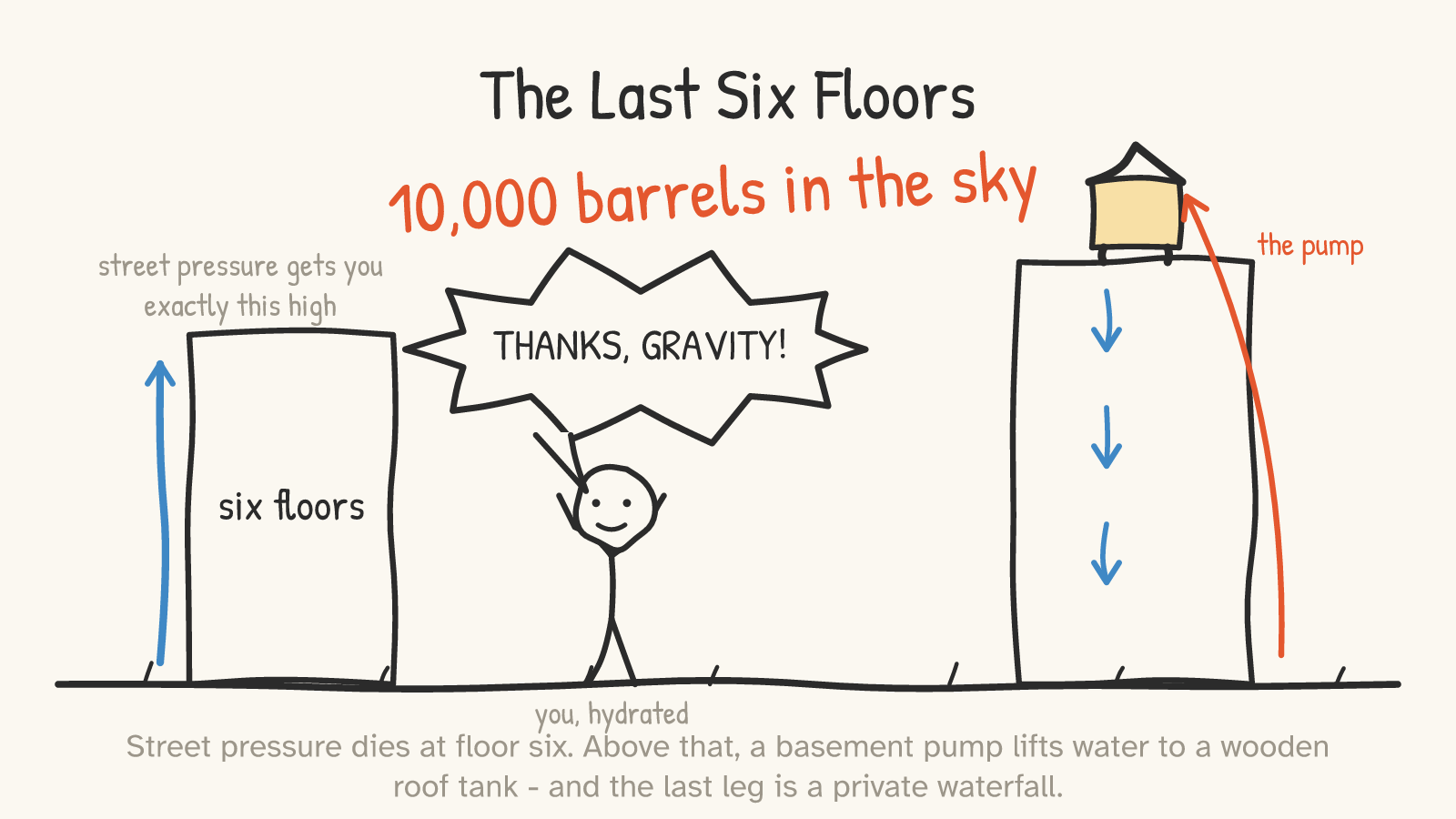
Look up at almost any New York building over six stories and you'll see a squat wooden barrel on stilts on the roof. There are something like ten thousand of them. They are not decorative and not historic relics — they are working infrastructure, most of them built of wood, by hand, by the same two or three family companies that have been doing it for over a century. A basement pump (for many buildings, the only powered machine in this entire 125-mile story) lifts water up to the rooftop tank; gravity takes it from there, floor by floor, the same way gravity carried it down from the Catskills.
Your tap, in other words, is the bottom of a very short waterfall that's fed by a very, very long one.
CodaThe whole machine, in one sentence
Rain falls on a mountain; a forest filters it; a flooded valley stores it; gravity slides it 125 miles through the world's longest tunnel, under a river, six hundred feet beneath the subway, up into a wooden barrel on your roof, and down into your glass — and the entire journey, from cloud to kitchen, took months and required almost no energy at all.
People sometimes call New York tap water "the champagne of tap water," usually as a joke about bagels. But the joke undersells it. Champagne is just wine with good marketing. This is a billion gallons a day of mountain water delivered by an invisible, mostly self-powered machine that three generations of New Yorkers built and most of the next three forgot existed.
Anyway. You're going to get a glass of water now, aren't you?
Footnotes
- The Collect Pond, once the city's main water source, became so polluted with tannery runoff that the city filled it in. The neighborhood built on top of it promptly sank into the soggy landfill and became the Five Points slum. The bad-water era also features Aaron Burr chartering a "water company" in 1799, spending almost none of it on water, and using the charter's fine print to start a bank — which survives today as JPMorgan Chase. The water was terrible; the scam was excellent. ↩
- The reservoirs drowned about two dozen villages along the way — homes, churches, and cemeteries relocated or submerged. Upstate has not entirely forgiven this, and honestly, fair. ↩
- The Catskill Aqueduct drops only about one foot per mile for long stretches — a slope so gentle you couldn't see it, maintained for a hundred miles through mountains, in the 1910s, largely with hand tools and mules. ↩
- The siphon principle also explains the system's one famous flaw: a pressurized tunnel leaks from wherever the rock is weak, which is exactly what the Delaware Aqueduct started doing under the Hudson Valley. ↩
- Filtration removes particles; disinfection kills microbes. New York skips the first (for the Catskill/Delaware supply) and does the second aggressively. The EPA re-examines the arrangement regularly, which is a strong incentive to keep buying forest. ↩
- Modern pumps make height limits moot for new construction, but the six-story walk-up city — the tenement, the brownstone, the prewar — is partly a fossil of water pressure. ↩