You say it a dozen times a day without a flicker of thought. It started as a blessing — "God be with ye" — and you can watch it wear down to "goodbye" right there in the written record. The same move hides inside adiós, adieu, and addio. Here's the history, the honest limits of it, and why the wearing-away is the actual marvel.
Say goodbye to someone today — at a door, on a call, in a text — and you will not feel a single thing pass through you except the small social click of this is the part where I leave. It is the most automatic noise in your mouth. You have said it to strangers, to people you love, to a barista you will never see again.
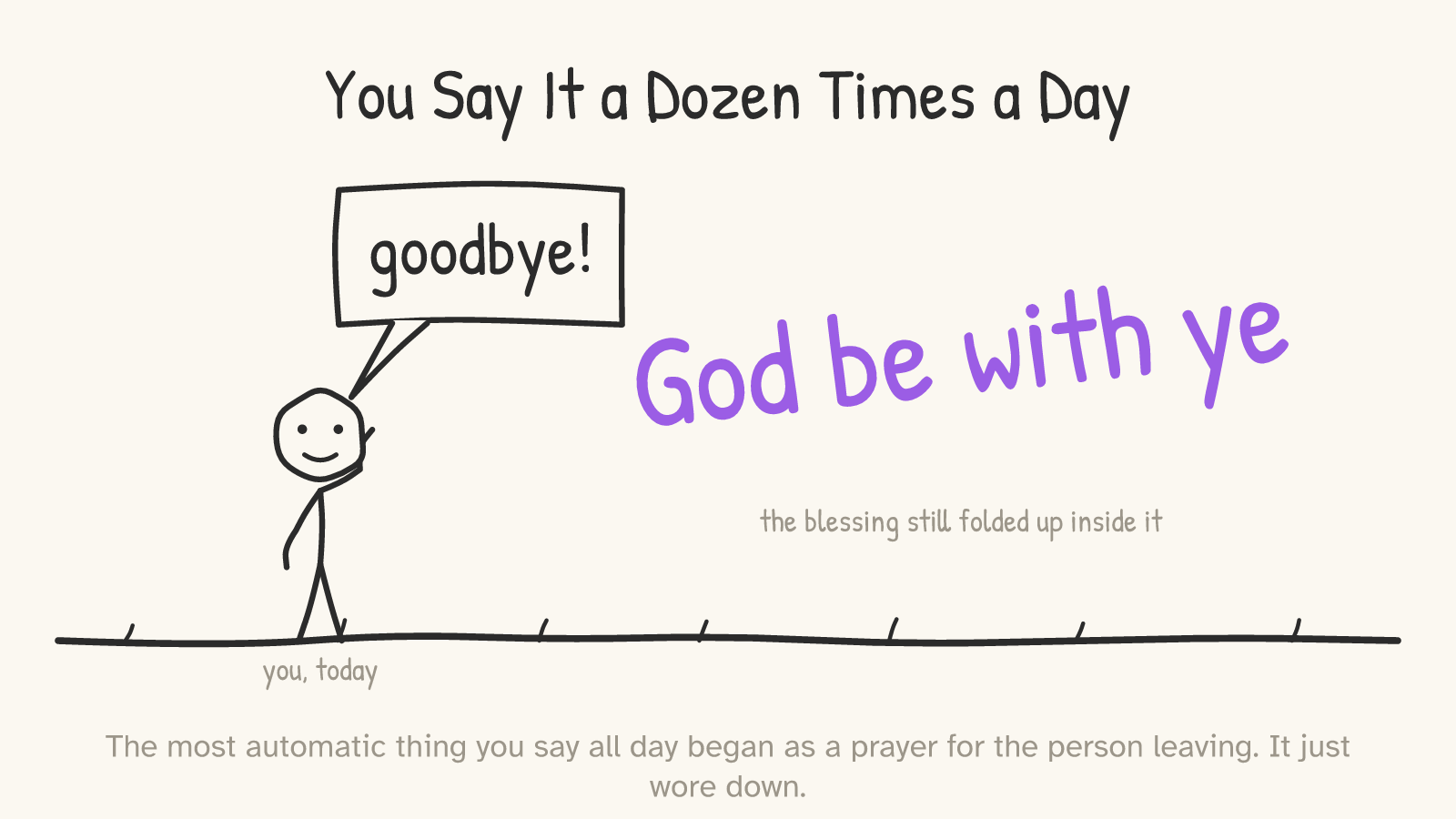
And every one of those times, the word in your mouth was a worn-down descendant of a blessing — a formula that once asked God to be with the person leaving. "Goodbye" is a contraction — sanded down over four and a half centuries — of the parting phrase "God be with ye."1 The old blessing is still in there, folded up so small you can't hear it. That is either a charming bit of trivia or a slightly eerie one, and which it becomes depends entirely on a distinction we'll get to. First, the receipt.
Part 1The word wore down on the record
Here's the objection a careful person should raise immediately: "God be with ye → goodbye" is the kind of thing people say at dinner parties. Half of those stories are folk etymology invented after the fact. How do you actually know?
It's the right question, and the answer is unusually clean: you don't have to take it on faith, because the wearing-down was written down at every stage. We can watch it happen.
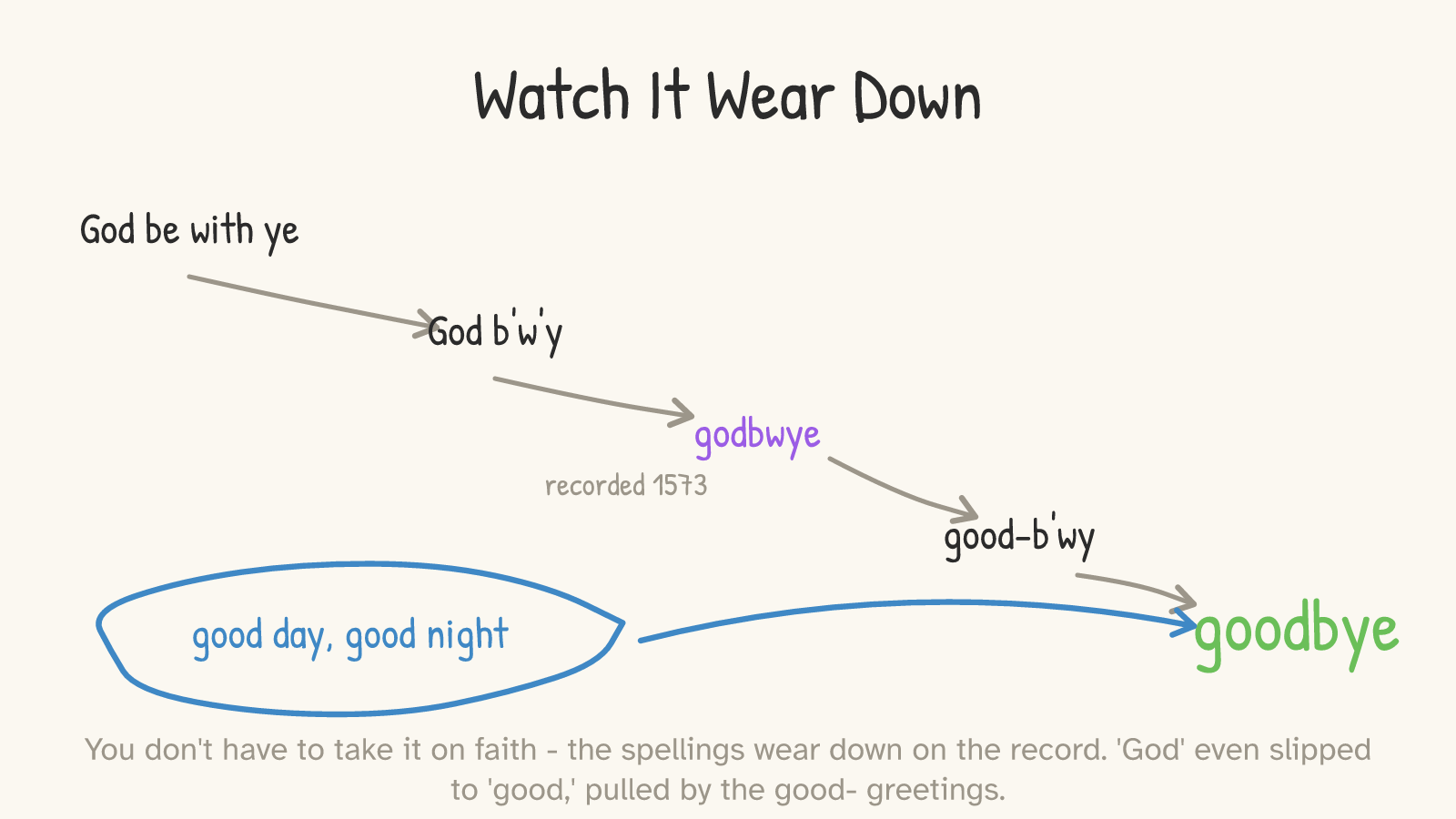
The full farewell formula — God be with you (the older ye and you both turn up) — is ordinary late-Middle-English, attested in the 1300s. Said often enough, it starts collapsing in on itself the way going to becomes gonna, and the contracted, near-one-word spellings show up across the 1500s: forms like God be wy you, God buy', godbwye, good-b'wy. One of the earliest recorded is in a 1573 letter from the writer Gabriel Harvey, who griped (in the plural): "To requite your gallonde of godbwyes, I regive you a pottle of howdyes." (A gallon of goodbyes for a half-gallon of how-do-you-dos. People have always been like this.)
Then comes the strange part — the part that's a genuine twist rather than a smooth decay. The God at the front quietly turns into good. Not because anyone decided it meant "good," but by sheer gravitational pull from the good- greetings already crowding the same slot in the day: good day, good night. Sitting in that company, god-b'wy got tidied up to rhyme with its neighbors, and the deity at the head of the word was overwritten by an adjective. So "goodbye" is, precisely, a blessing with a typo — and the typo is the reason almost nobody hears the prayer anymore.
(Worth being exact here, because it's the kind of thing that gets overstated: the original first element was God. Good is a later refashioning. Anyone who tells you "goodbye literally means good + bye" has the history running backwards.)2
Part 2But you're not praying when you say "bye"
Now the objection that actually matters — the one a linguist would lead with, and the reason this essay could easily curdle into something smug and false:
“So your big reveal is that I'm secretly praying every time I wave at someone? I'm not. "Goodbye" doesn't mean a blessing. It means goodbye. You're committing the etymological fallacy — pretending a word's buried history is its real, true content.”
Correct. Completely correct, and it's important to hand it over without a fight: a word's origin is not its meaning. When you say "bye," you are not invoking anything. The religious charge is gone — not hidden, not subconscious, gone — and reading it back in would be a mistake with a name (the etymological fallacy, the idea that the oldest sense is the "real" one).
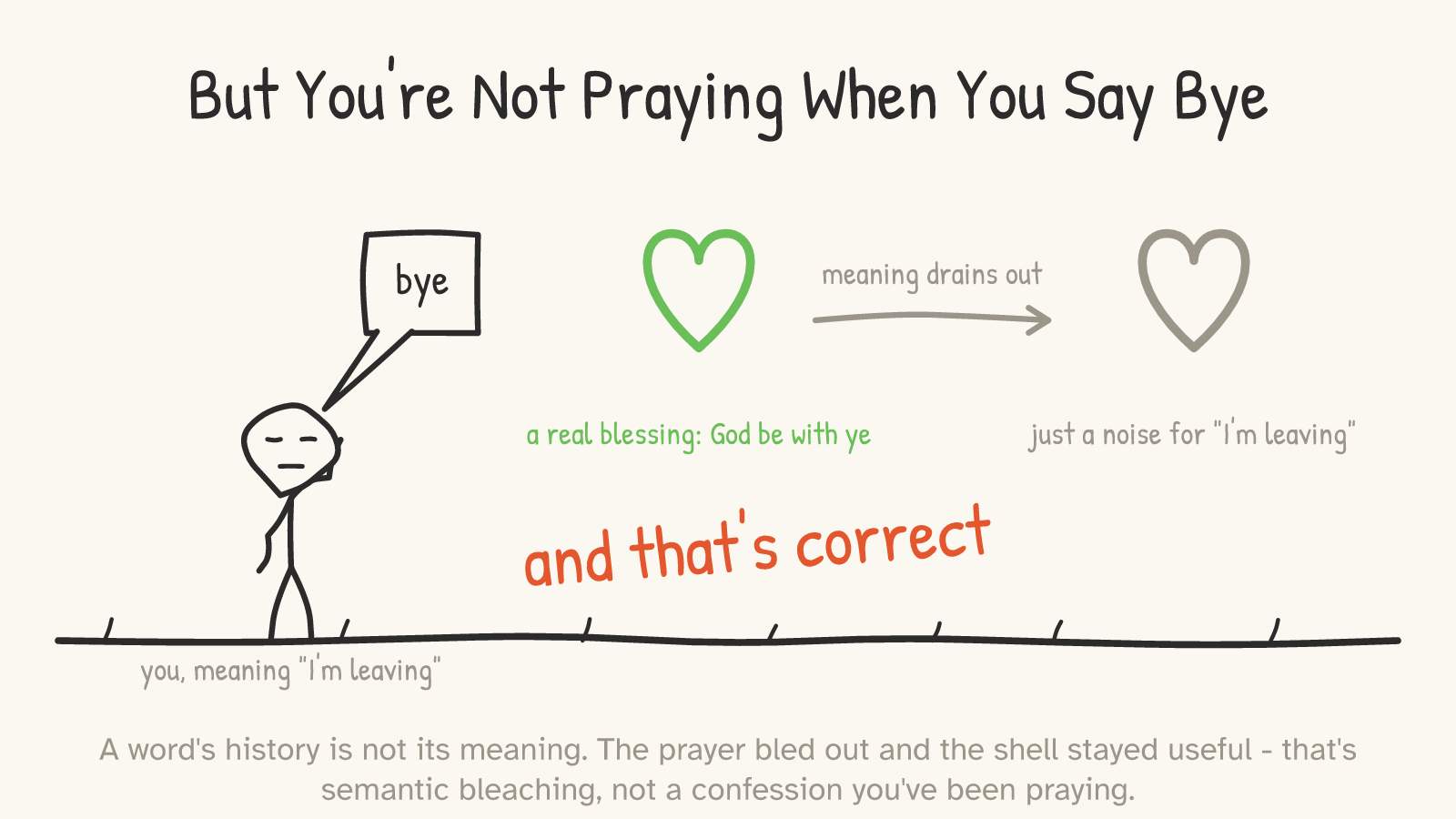
So let's be clear about what's actually being claimed, because it is not "you're secretly praying." What happened to "goodbye" is a completely ordinary process with its own name: semantic bleaching.3 A word starts out loaded — concrete, vivid, charged — and through millions of casual uses the color drains out of it until only the function remains. It's why descends from a Latin word for ignorant. The meaning bleeds out; the useful husk stays.
"Goodbye" is the husk of a prayer. Not a prayer in disguise — a husk. And here's the move this whole piece rests on: that's not a debunking, it's the wonder. The marvel was never "you are secretly religious." The marvel is that a genuine blessing could be repeated so many billions of times that it wore down to a reflex with no content at all — and you kept saying it anyway, every single day, a smooth river stone that used to be a prayer.
Part 3The same move, in five languages
Once you can see the shape, you start finding it shelved in other languages — and several of them never sanded the God off, so the blessing is sitting right there in the open.
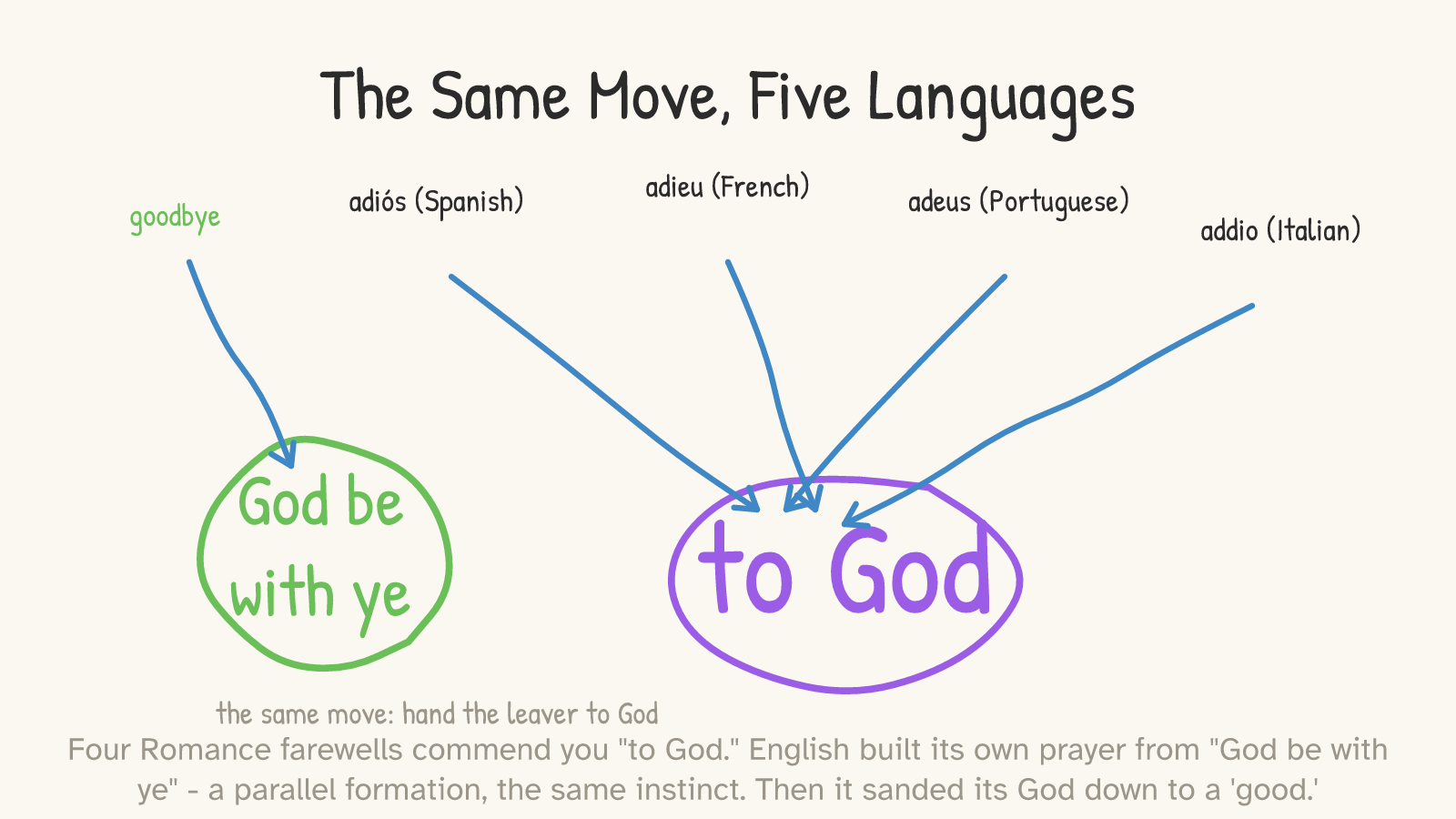
The Romance languages built their everyday farewell out of the very same brick: to God. Spanish adiós, French adieu, Portuguese adeus, Italian addio, Catalan adéu5 — every one of them is à Dieu / a Dios, "to God," the surviving stub of a fuller commendation like "I commend you to God." (French keeps the medieval long form on record, "a Dieu vous comant.") Two things worth being exact about: these are not children of one another — not borrowings down a single wire from French — but parallel developments, the same Christian leave-taking habit growing the same word independently in each language. And English isn't outside this family; it borrowed adieu whole, God intact, in the 1300s4 — so English owns the move twice, once as the homegrown goodbye it filed down past recognition, once as the imported adieu it never bothered to translate.
English is the odd one out only for hiding it. Spanish, French, Portuguese, and Italian still wave goodbye with God visible in their hands; we sanded ours to a good and lost the thread.
Part 4Why a goodbye is a blessing in the first place
Step back and ask why this particular kind of farewell — the blessing kind — got built at all, and so productively, across a whole language family.
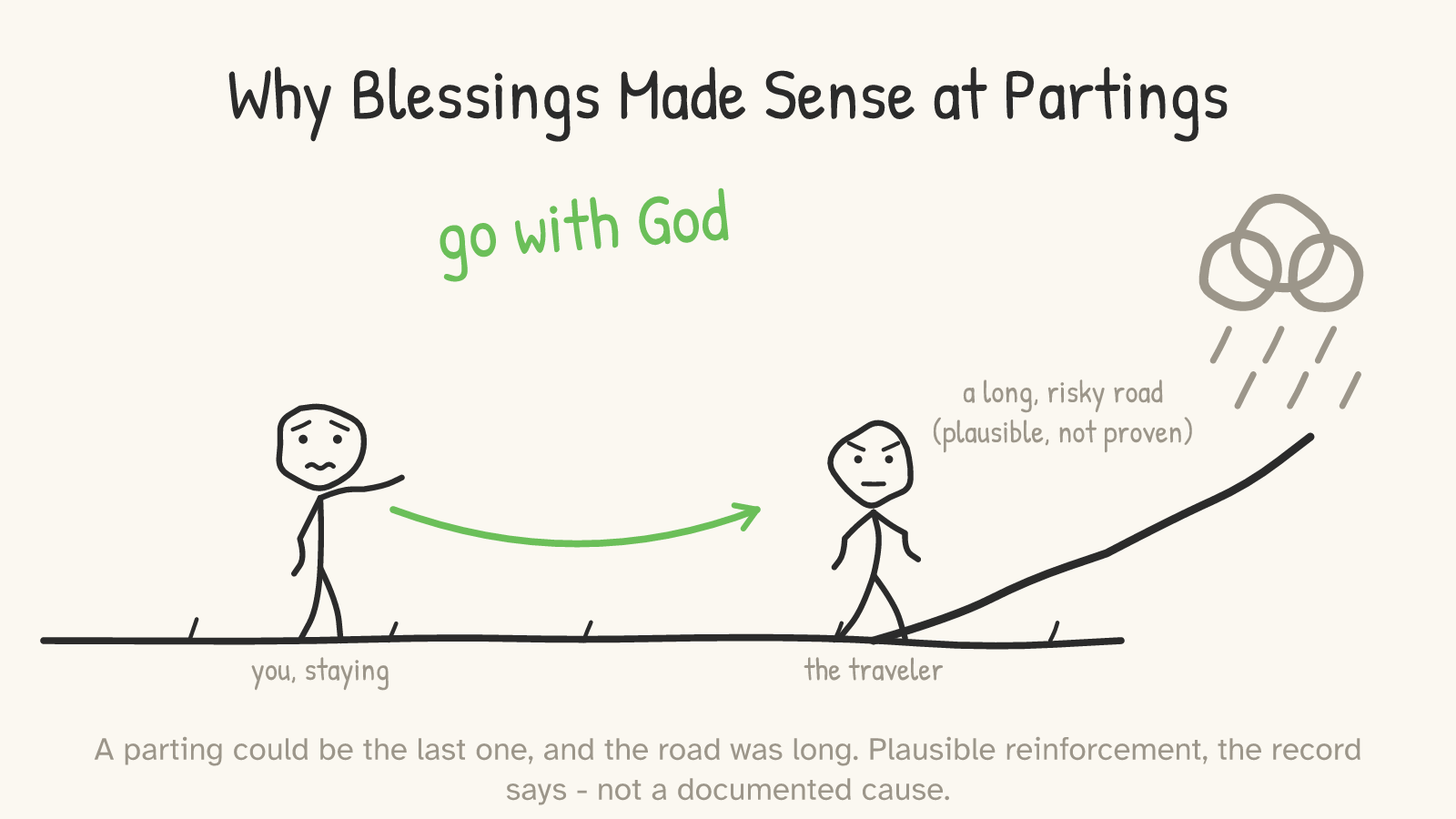
Here I have to be careful, because there's an easy just-so story and a more honest version. The honest version: in Christian Europe, the standard polite thing to do as someone left was to entrust them to God — à Dieu, vaya con Dios, God be with you — and that habit is reason enough on its own. The tempting add-on is that partings were dangerous: the person walking out your door was setting off down a long road, on foot or by ship, through weather and bandits and disease, with a real chance you'd not see them again, so you reached for the one protection you believed could watch the whole road. That's plausible and often repeated, and I'll flag it as exactly that — a sensible reinforcement, not a documented cause.6 (Plenty of farewells never came from peril at all; we'll meet them in a second.) What's not speculative is the shape of the words themselves: Godspeed really is "may God make you prosper," from an old sense of speed meaning success, not velocity7 — a blessing aimed squarely at a journey. The casualness of our own goodbyes is, either way, a kind of luxury.
Part 5Not every goodbye is a prayer
Time to turn the skepticism on myself, because there's a cheap version of this essay that deserves to be caught: you went looking for farewells that mean "to God," found a handful, and waved them around as if they were the whole story. Pick farewells at random and they don't all point at heaven.
True. They don't.
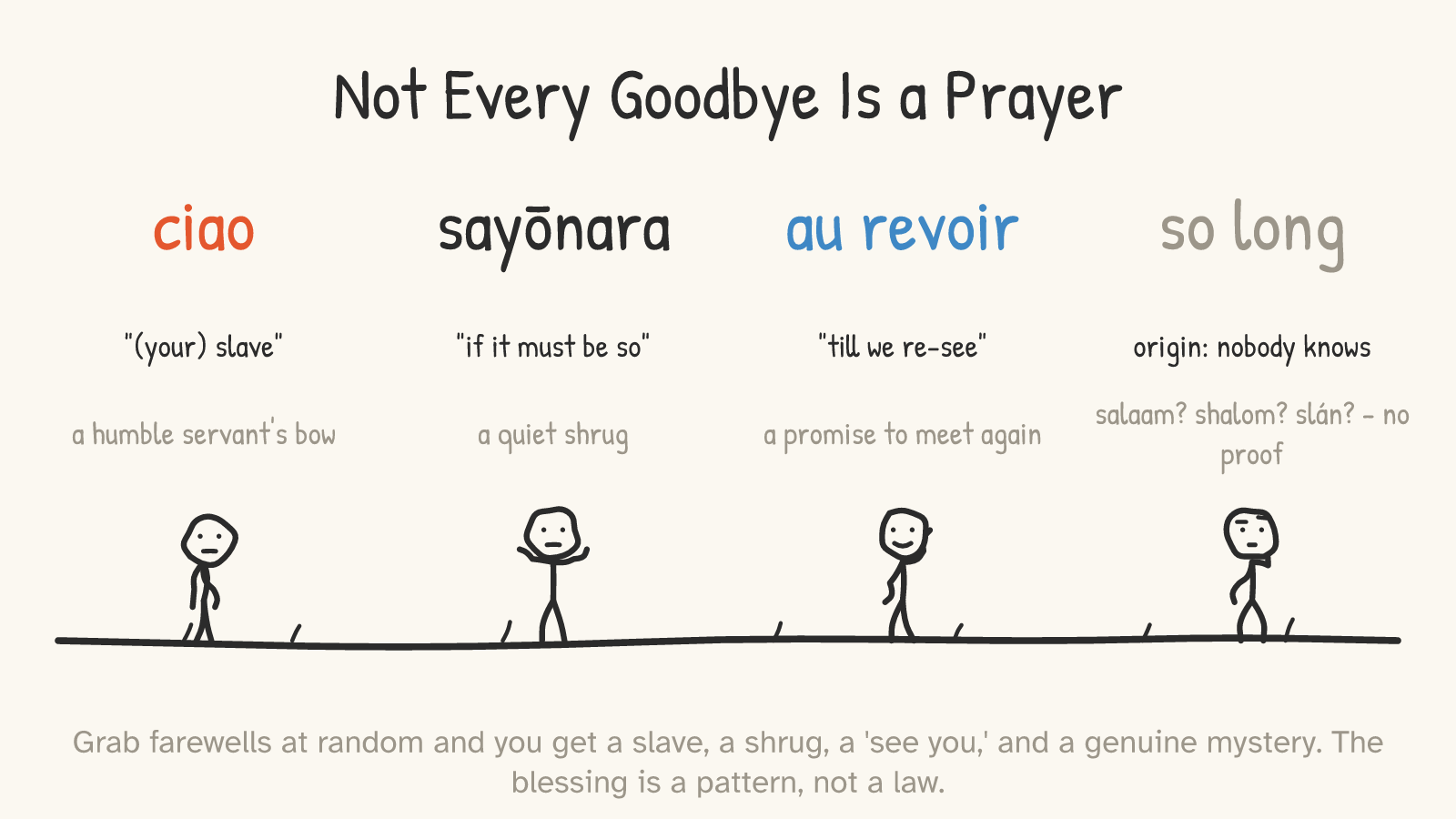
And here's the important correction to make to myself before anyone else does: these aren't all the same machine running under different paint. Farewells come from genuinely different impulses, and lumping them into one grand pattern would be its own kind of dishonesty. At least five distinct mechanisms are at work:
- Commend you to God — goodbye, adieu, adiós, godspeed. The cluster this essay is about. - Wish you wellbeing or a safe trip — farewell is just "fare well," the old imperative travel well (fare is the old verb for journeying); Latin's everyday goodbye was valē, "be strong, be well."8 No deity required. - Defer the parting — au revoir, auf Wiedersehen, arrivederci, hasta la vista all literally mean "until we see each other again." A promise, not a prayer.11 - A flourish of humility — ciao, the breeziest goodbye in the world, comes from Venetian s-ciavo (vostro), "(your) slave/servant" (the same sclavus that gives us slave) — a deferential "I'm your servant" worn smooth into a hello.9 - A resigned closure — Japanese sayōnara isn't a blessing or a wish at all; it's a conjunction left dangling, sayō nara(ba), "if it must be so" — a quiet well, then.10
And some farewells defeat everyone: so long has been chased by etymologists for over a century — Whitman printed it in 1860, and proposed sources run from Scandinavian så lenge to Hebrew shalom to Irish slán, none of them provable. The honest verdict is that nobody knows.12
So the claim was never "every goodbye is a secret prayer," and it isn't even "all farewells share one origin" — they plainly don't. The narrower, truer claim is this: a farewell is almost always a little formula worn smooth by use, and one of the most productive of those formulas — across an entire language family and our own — happens to be commend you to God. A pattern inside the variety, not a law over it.
Coda: a pocketful of worn-down blessings
Here's where it stops being about one word.
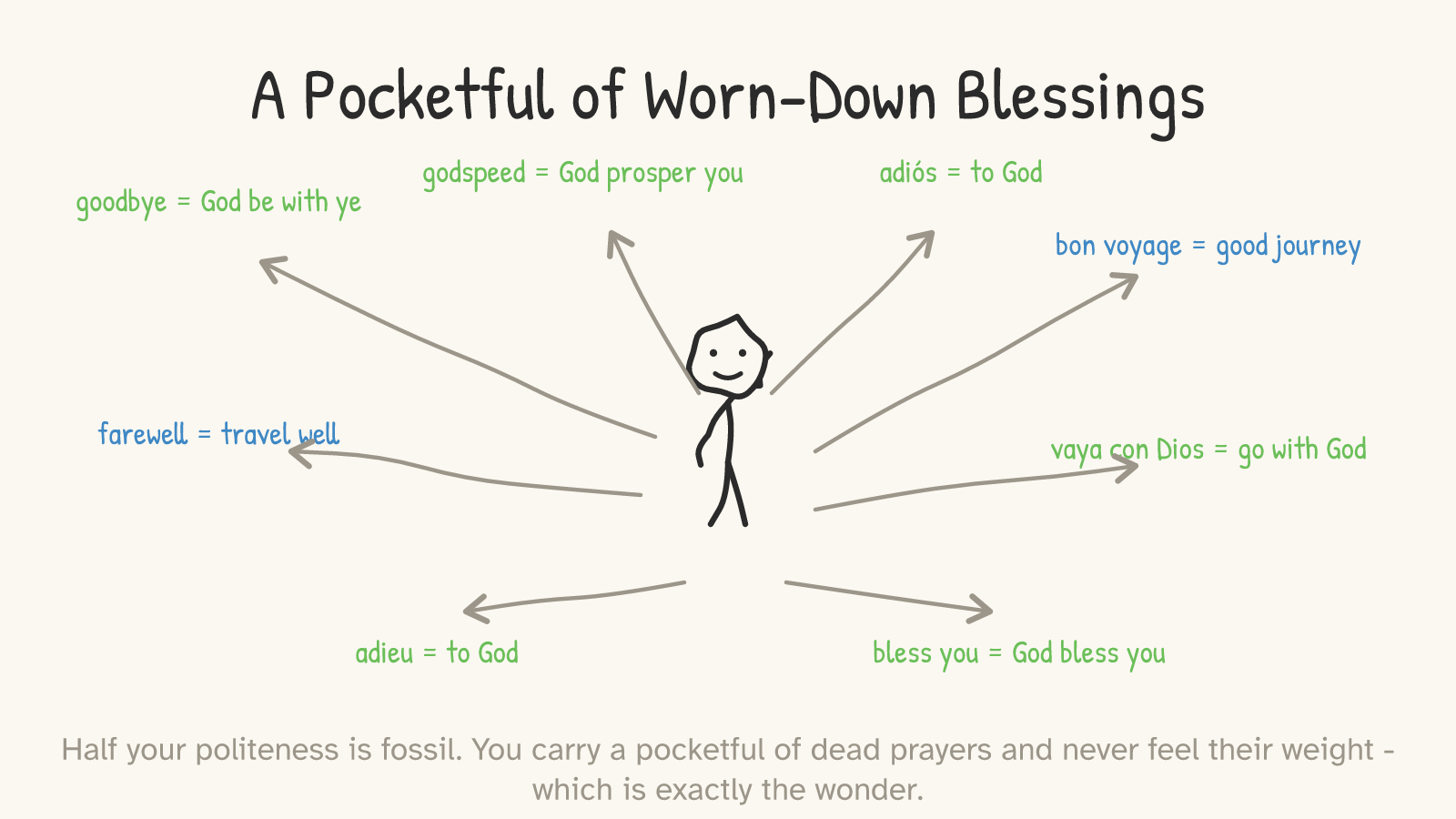
Once you go looking, the buried sentences are everywhere. Godspeed was a blessing for the road. Adiós and adieu trace back to "to God" in two languages you didn't learn them in. Bless you — what you say to a stranger's sneeze — is a clipped God bless you. Bon voyage, vaya con Dios, farewell — a whole drawer of phrases that each began as a fuller sentence somebody once meant with their whole chest. None of them means that now; every one of them descends from it.
And this is the deepest objection: anything sounds profound if you dig under it far enough — you've just sentimentalized small talk. Maybe. But keep the distinction the whole essay has insisted on, and the wonder survives it intact. You are not secretly praying. You move through an ordinary day saying words whose original force you don't feel, in languages you don't speak, for dangers that are gone — and the not-meaning-them is not a failure, it's the mechanism. This is the human trick: we take an utterance that once cost a real feeling, wear it down by repetition until it costs nothing, and hand the smooth stone to the next person so they have something easy to say at the door. Your small talk is a museum of feelings nobody has to feel anymore, and you're the curator who never reads the labels.
So say goodbye to someone today. The word won't mean what it once meant — it shed that centuries ago, and that's exactly as it should be. But its history remembers a time when letting someone walk away felt heavy enough to answer with a blessing. You don't have to feel it. It's enough that it's there.
Footnotes & receipts
Etymologies follow the Online Etymology Dictionary (Douglas Harper, which cites the OED and standard scholarship) and Merriam-Webster, cross-checked where they could differ. Uncertain origins are marked as uncertain rather than smoothed over.
- goodbye ← "God be with you/ye." The full farewell formula God be with you is ordinary ↩
- "God" → "good." The first element goes back to God; the modern good- spelling is an ↩
- Semantic bleaching / the etymological fallacy. Semantic bleaching is the standard term ↩
- adieu. Middle English borrowing (late 14c.) of Old French adieu, from à Dieu, "to ↩
- adiós / adeus / addio / adéu. Spanish adiós is from a Dios, "to God," shortened from ↩
- "Partings were dangerous → farewell = blessing." Presented as a *plausible ↩
- godspeed. From God speed (you), where speed means prosper / give success (Old ↩
- farewell / valē. farewell is the Middle-English imperative phrase fare wel, ↩
- ciao. First recorded in English in the 20th century (dictionaries often give 1929); ↩
- sayōnara. Japanese, from sayō nara(ba), "if that is so" (the -ba is optional/ ↩
- au revoir / auf Wiedersehen / arrivederci / hasta la vista. All literally "until we ↩
- so long. Origin genuinely uncertain; no theory is established. First attested in ↩