Imagine we wall Central Park off from the rest of the world. Nothing comes in; nothing goes out. Inside there's a fixed crowd of people, a fixed set of things to buy — hot-dog carts, rowboats, portrait artists, a guy who'll juggle for a dollar — and some fixed pile of dollars circulating among everyone. That's it. That's a complete economy, small enough to hold in your head all at once.
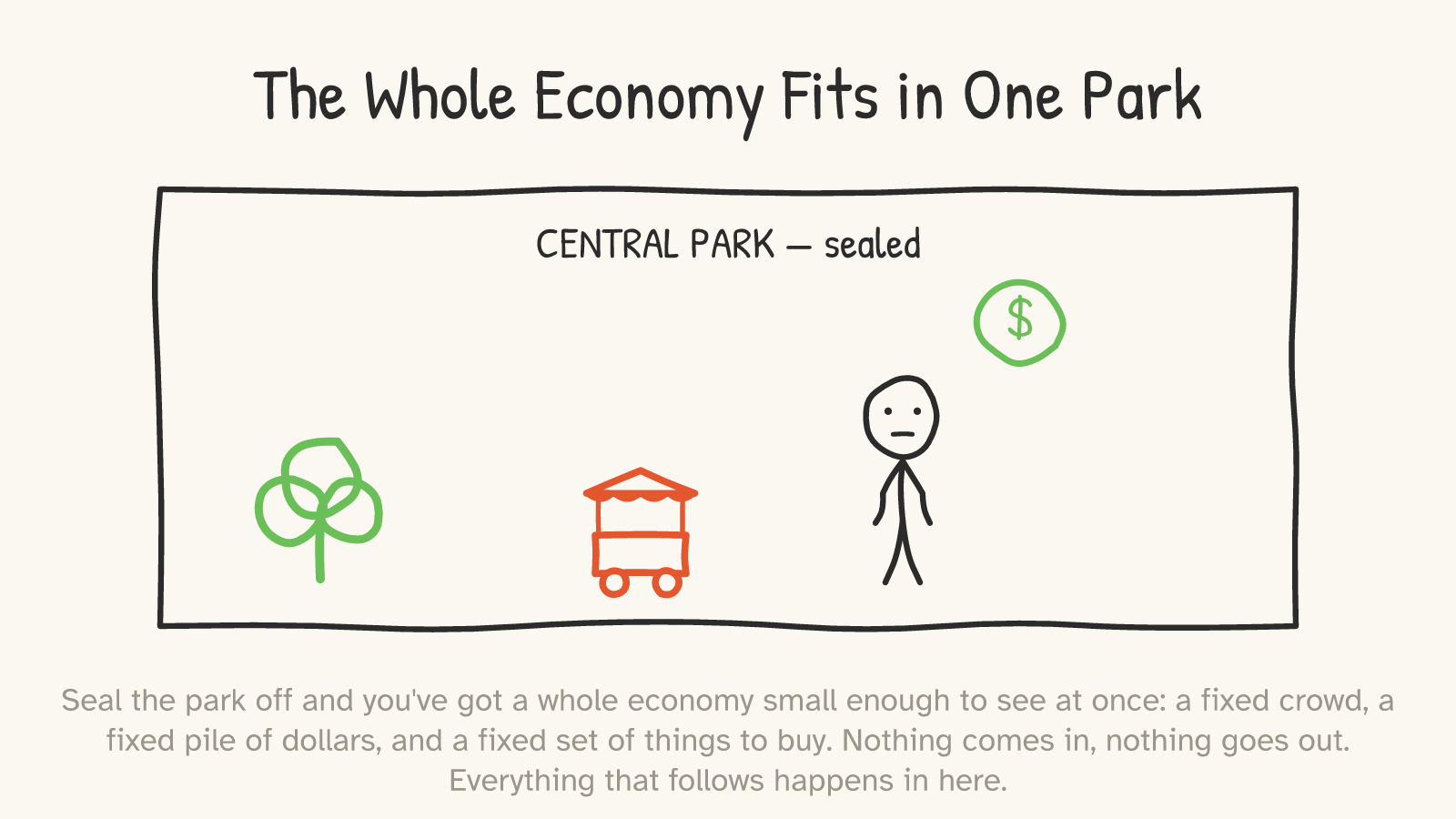
That smallness is the whole trick. Real economies have eight billion people and a hundred million products and you can't see the shape of it. The park you can see — and inside it live both halves of economics. Microeconomics is what happens at one cart. Macroeconomics is what happens to the whole park at once. Let's do them in that order, because the small one explains the big one.
Micro: a price is just supply meeting demand
Walk up to the hot-dog cart. It's selling dogs for $2. Who decided $2? Nobody, really. The price is just the meeting point of two things: supply — how many dogs this cart can actually produce — and demand — how many people want one, and how much money they're holding.
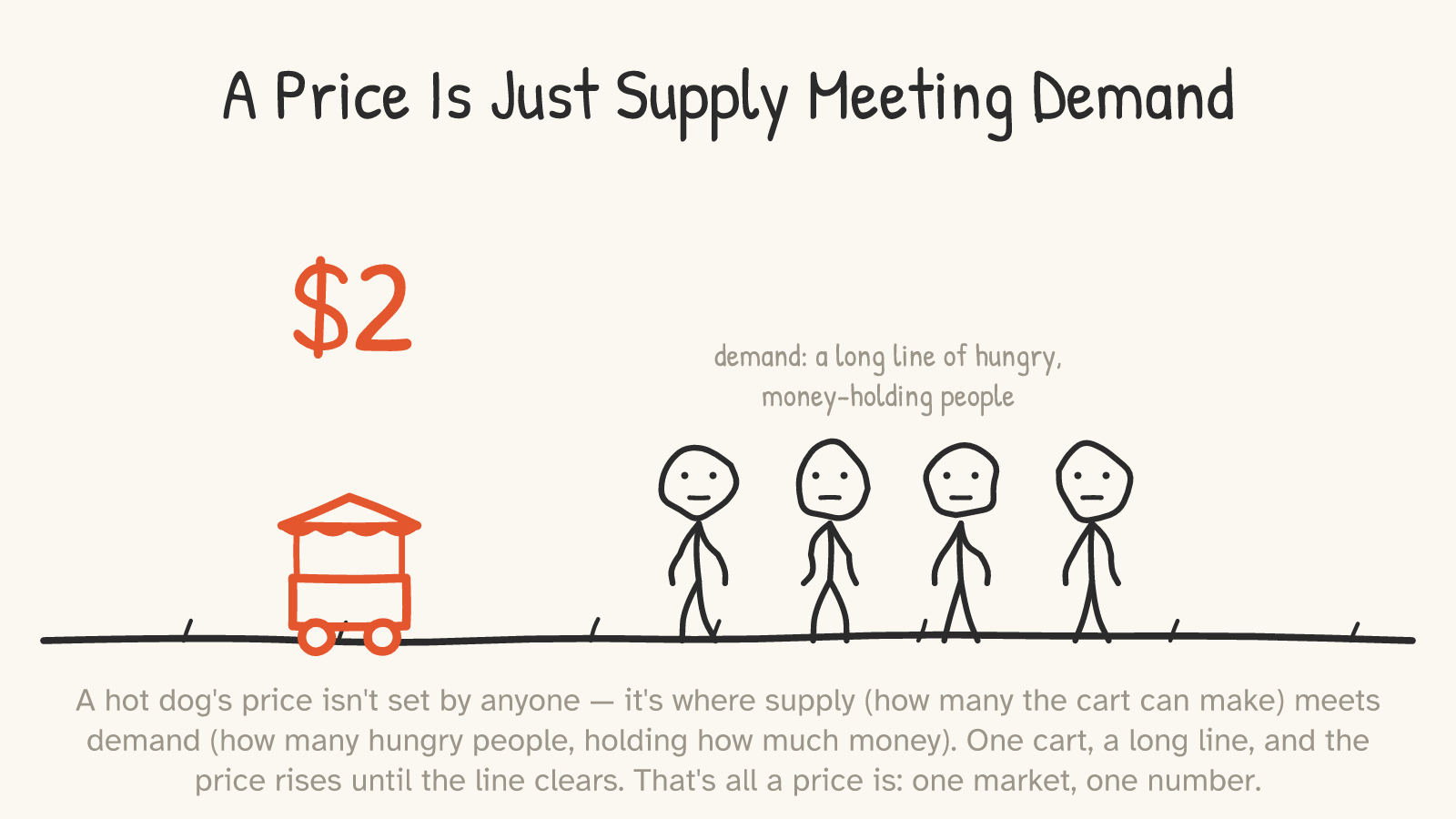
If there's one cart and a line out to the duck pond, the vendor notices he could charge more and still sell every dog, so the price drifts up until the line is just short enough to clear. If half the park suddenly craves a hot dog, the price climbs; if everybody's already eaten, it falls. A price is a thermometer for that one little market — one good, one number, set by the tug-of-war between how much exists and how much people want it.1
Now watch what happens when a second cart opens.
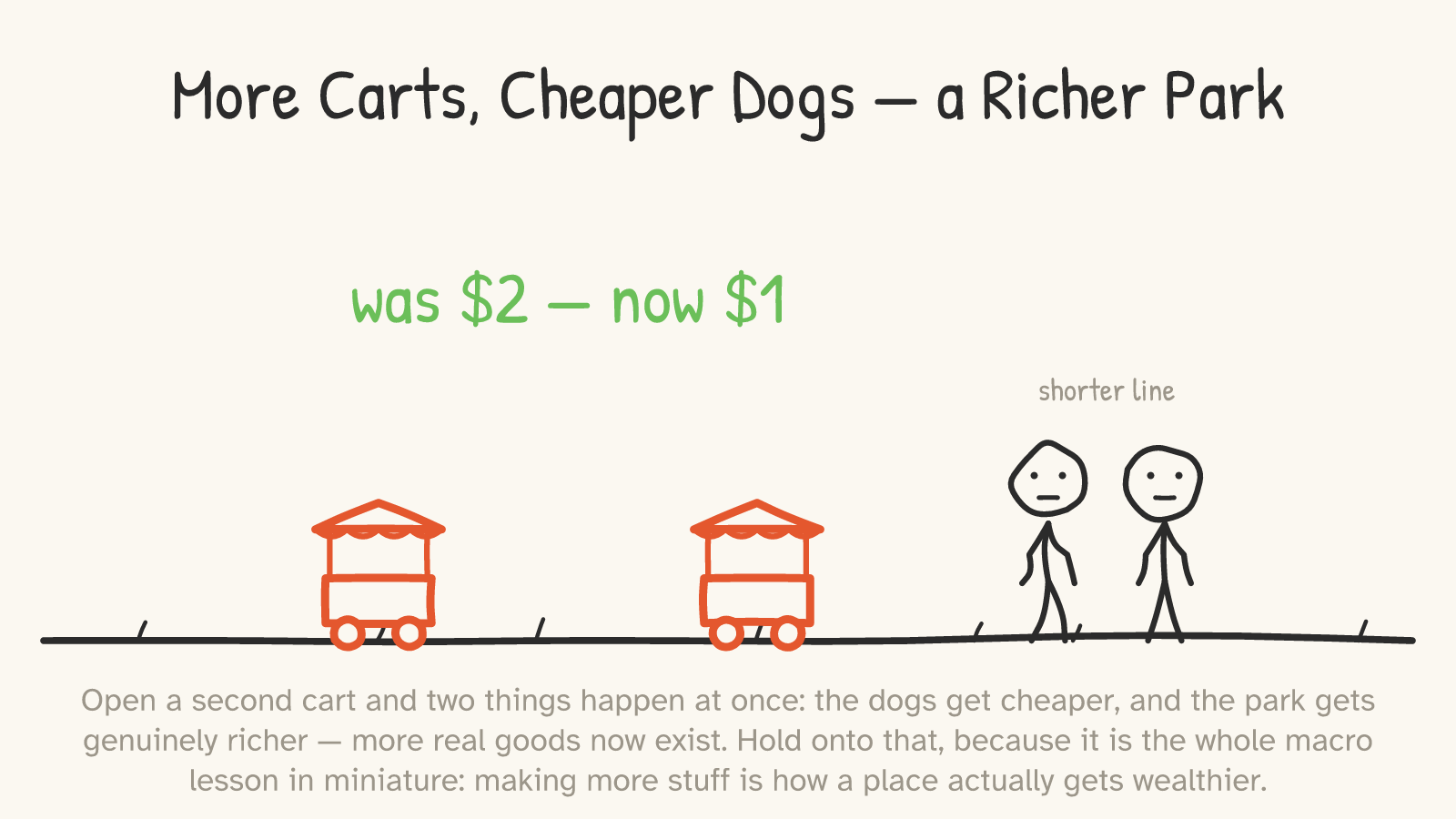
Two things happen at the same time, and the second one is secretly the entire point of this essay. First, the obvious thing: with more dogs available, the carts compete, and the price falls — say to a dollar. But second, quietly: the park just got richer — in the only sense this essay means by the word. There are genuinely more hot dogs in the world now; more real stuff exists for people to enjoy. Hold onto that, because it's the macro lesson in miniature — making more things is how a place actually becomes wealthier. File it away. We'll need it at the end.
Macro: zoom out to the whole park
Now stop staring at one cart and take in the entire park at once. Don't track the price of dogs; track the average of all the prices — dogs, boat rides, portraits, juggling. Economists call that average the price level. Don't track one person's wallet; track all the dollars in the park at once — the money supply. Macroeconomics is just micro with your eyes unfocused: not one price, but the whole cloud of them; not one wallet, but all the money there is.
And it's at this altitude that the famous question lives: what happens if everybody suddenly gets more money?
The helicopter
Let's make it dramatic. Overnight, a helicopter flies over the park and drops a fresh stack of bills on every single person. Everyone's wallet exactly doubles. (This isn't my metaphor, by the way — economists genuinely talk about a "helicopter drop" of money.2)
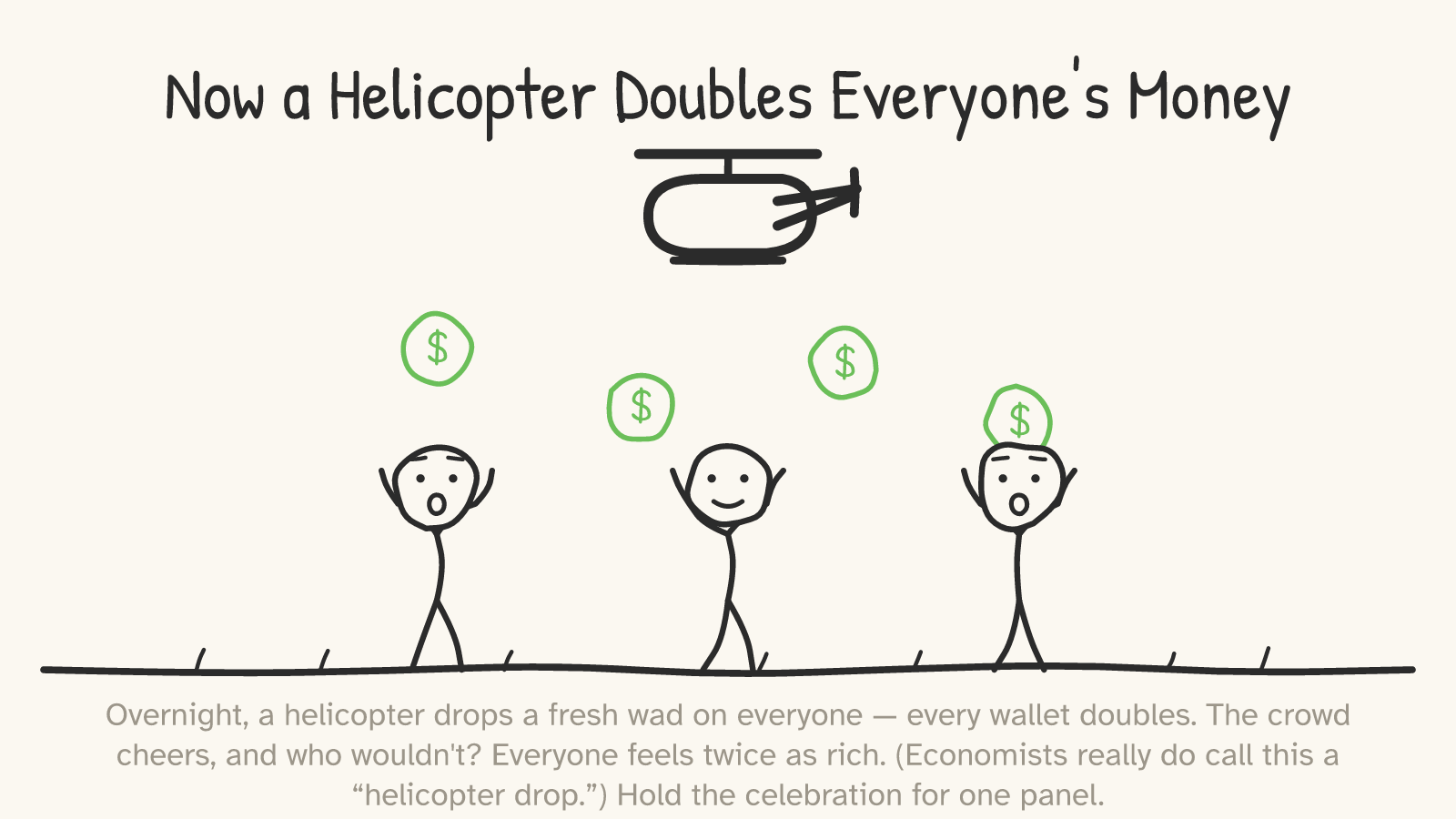
The park erupts. Everyone's twice as rich! Twice the money means twice the hot dogs, twice the boat rides, twice of everything you wanted — right?
Hold the celebration for exactly one panel.
The catch: the dogs didn't multiply
Here's the problem the cheering crowd hasn't noticed yet. The helicopter dropped money. It did not drop hot dogs. The park still has the exact same number of dogs, boats, and portrait artists it had yesterday. The amount of actual stuff is unchanged.
So now everybody rushes to the carts at once, waving twice as much cash. The vendor has the same dogs he always had and a stampede of buyers — which, as we just learned in the micro section, means the price goes up. Every vendor figures this out the same week. The $2 hot dog drifts toward a $4 hot dog. The boat ride climbs. The portrait climbs. Before long every price in the park has roughly doubled, and your doubled pile of money buys just about what your old pile bought.
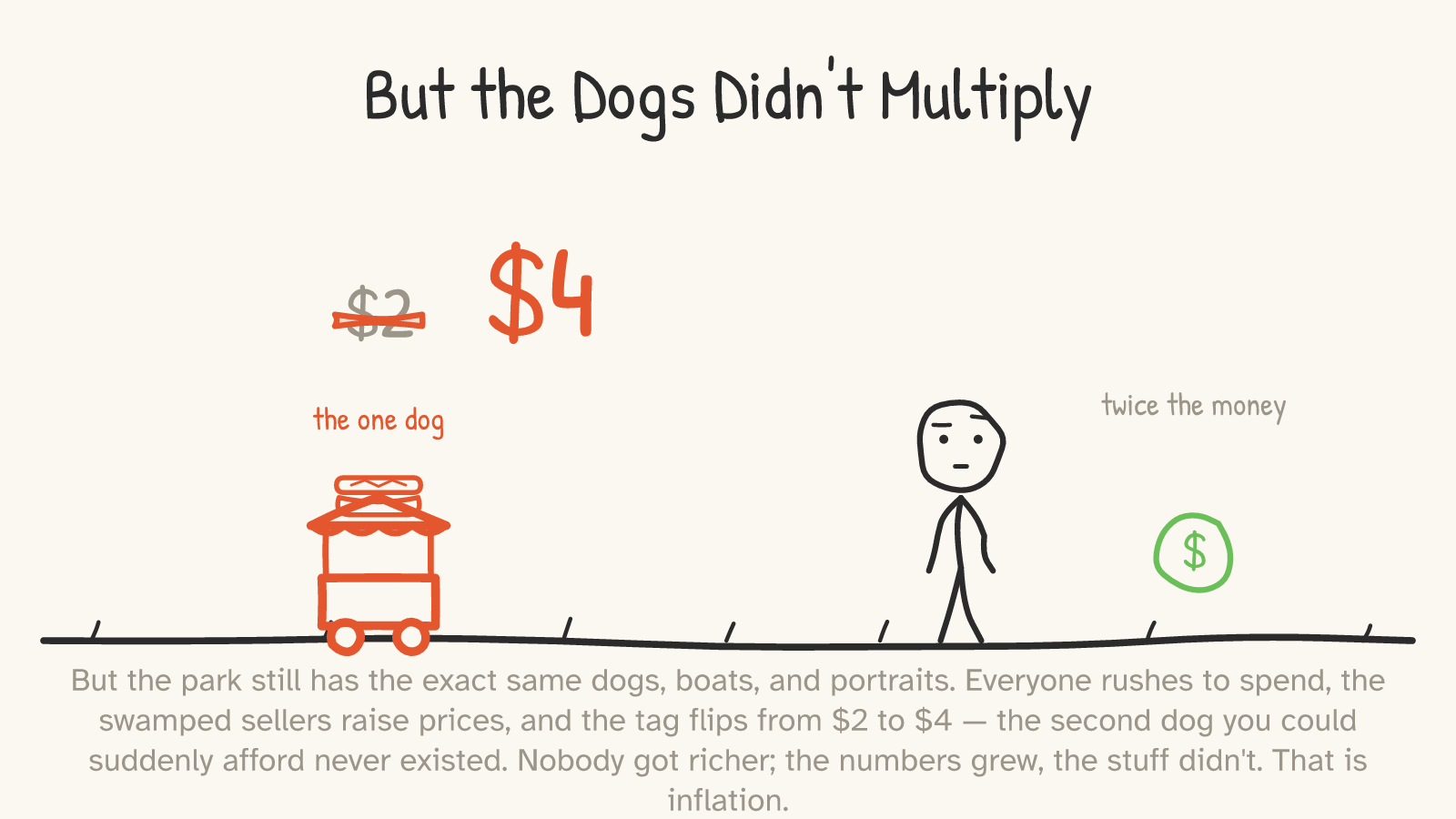
Nobody got richer. You have twice the dollars and they're each worth half as much, and the second hot dog you thought you could finally afford never existed to be bought. The numbers grew; the stuff didn't. That gap between the two — more money pushing on the same pile of goods until the prices float up to meet it — is inflation, at least the money-driven kind everyone pictures when they worry about printing money.3 And it's the cleanest reason you can't make a country wealthier just by handing everyone money: you've added claims on the goods without adding any goods.
One honest caveat I'll make loudly, because everything below depends on it: this "prices just double" result assumes the park was already full — every cart busy, every vendor maxed out, no slack anywhere. Keep that assumption in view. We're going to knock it out shortly, and the story changes.
The bookkeeping, in one line
You can write everything we just did as a single tidy equation, the equation of exchange:
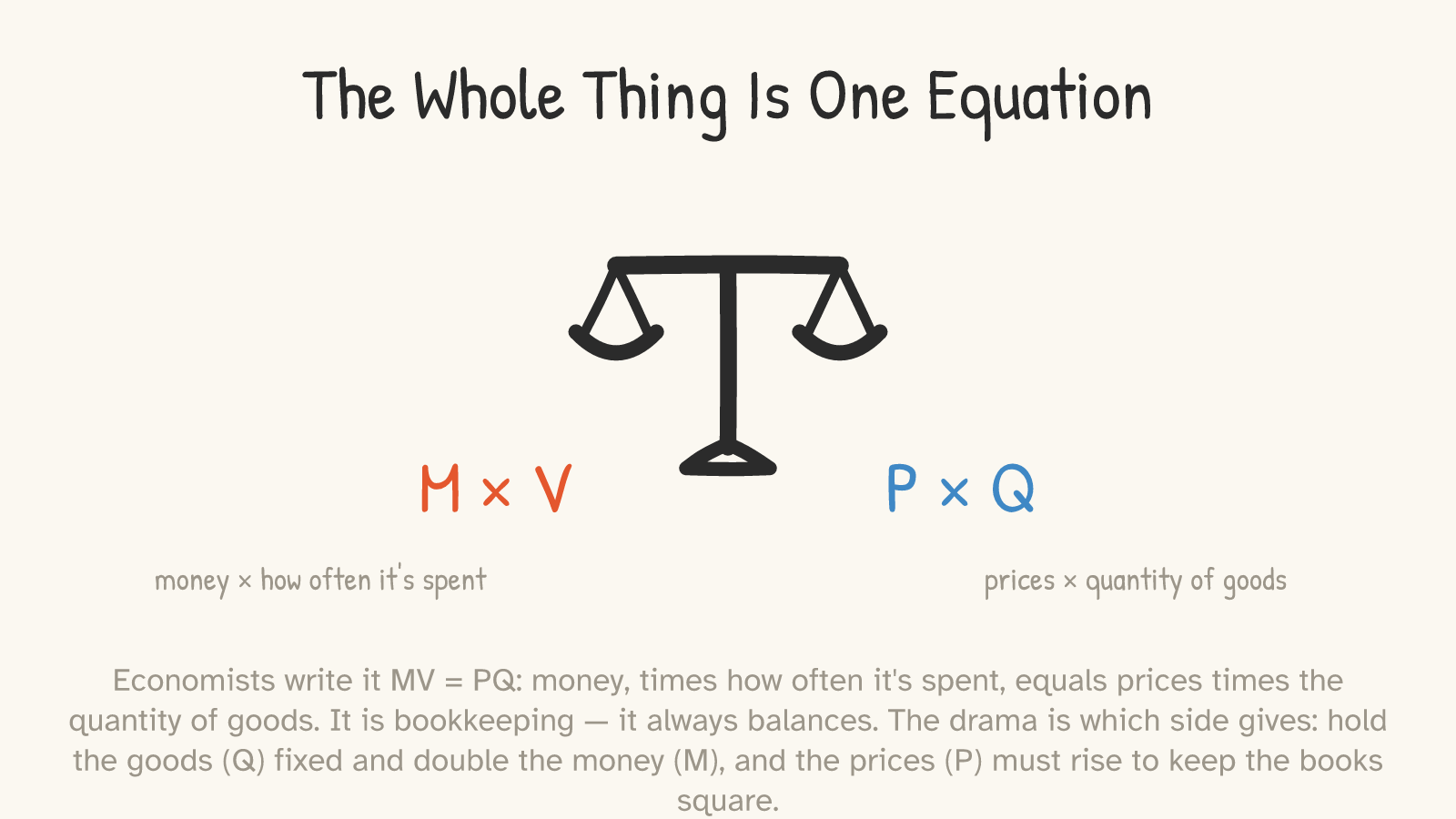
On the left, M is the money supply and V is velocity — how many times each dollar gets spent in a year (a dollar that changes hands ten times does as much work as ten dollars that move once). On the right, P is the price level and Q is the real quantity of goods and services produced. The left side is total spending; the right side is the total value of everything sold. They're the same transactions counted two ways, so the equation is an identity — it's true by definition and always balances, like a scale that can't tip.4
That's also its famous trap: the equation by itself doesn't prove anything, because it always holds no matter what. The economics is entirely in which term moves when you jostle another. Our helicopter doubled M. If the quantity of goods Q can't grow (the park was full) and V holds steady, then the only way to keep the scale balanced is for P — prices — to double. That's the whole story of the last three panels, in four letters.
But look at the equation again and you can see the escape hatch the cheering crowd needed. Prices only have to rise if Q can't grow (and V holds steady). So the real question was never "does printing money cause inflation?" It's "can the park make more stuff to soak up the new money?"
Unless the carts were sitting idle
Here's where the simple story has to grow up, because there's a powerful objection to everything I've said: in the real world, giving people money often doesn't cause much inflation at all. And that's true. The honest reason is that I quietly assumed a full park.
Suppose instead the park is in a slump. Carts are parked and shuttered. Vendors are sitting on benches with nothing to do, wishing someone would buy something. There's slack — idle capacity going to waste. Now fly the same helicopter over and drop the same money.
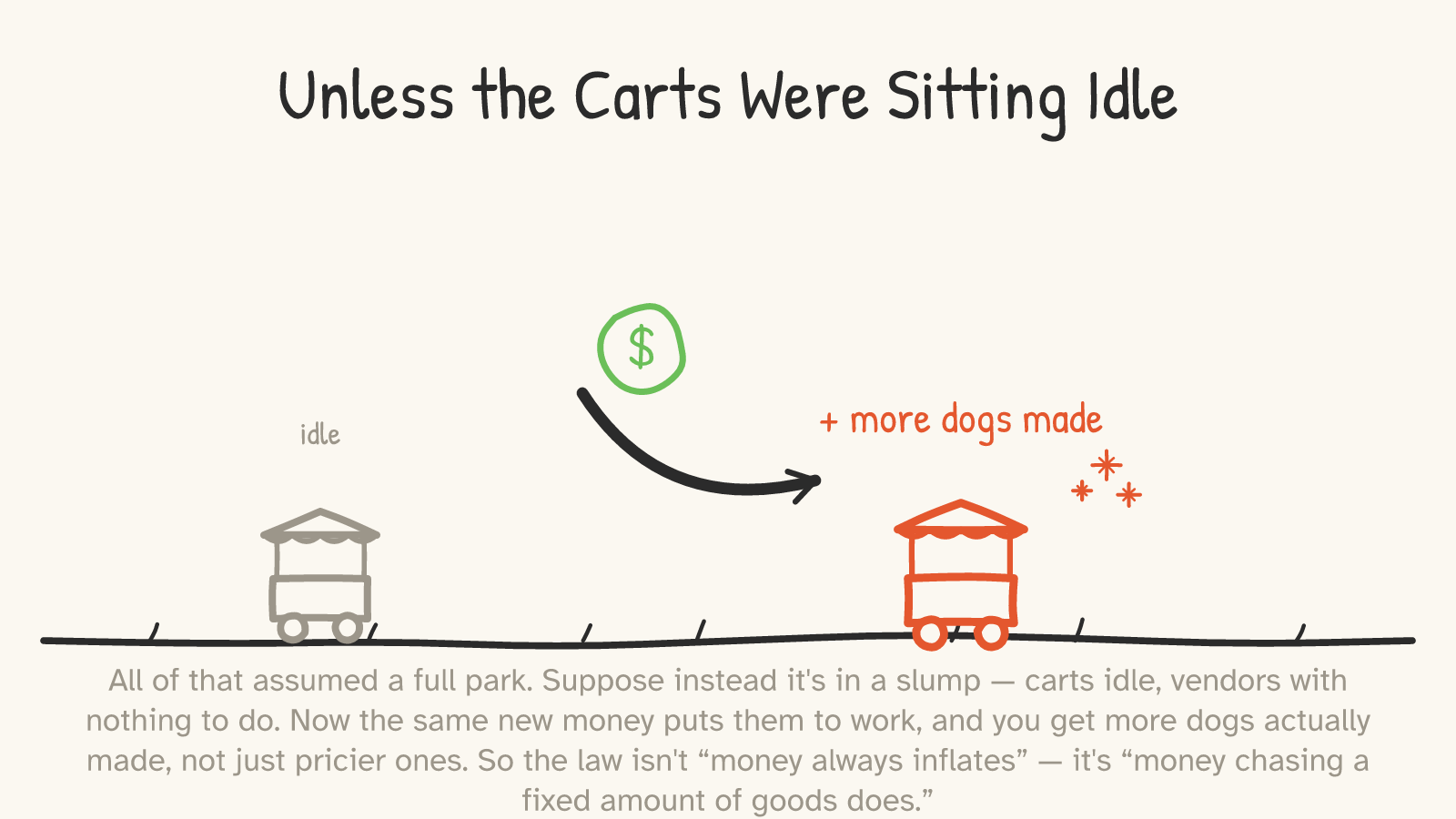
This time the new money doesn't just bid up the price of a fixed number of dogs. It wakes the idle carts. The benched vendors fire up their grills, hire a hand, and start cooking — because now there are customers. The park ends up with more hot dogs actually made — real output rising, with far less of the money spilling into prices than a full park would have suffered. (Not zero extra inflation — some prices still tick up; but mostly stuff, not just stickers.) The slack gave the new money somewhere real to go.5
So the law isn't "money always causes inflation." The honest version is narrower and sturdier: *money chasing a fixed amount of goods causes inflation — and whether the goods can grow to meet the money is the entire question.* A full park has nowhere to put new money except into prices. A slack park can turn much of it into stuff instead. That single distinction is most of the daylight between economists who want to spend in a downturn and economists who fear it: they're really arguing about how full the park is.
A couple of footnotes to the footnote, so I'm not cheating you. If people simply pocket the new money and don't spend it — if velocity V falls because everyone's saving — then M can rise without P moving much at all; the money just sits there.6 And a one-time helicopter drop gives you a one-time jump in prices, not endless inflation; to get prices rising year after year, you need the money supply to keep growing year after year.7 The park is a model, too, not the world — real economies can trade through the gates, buying goods from outside with their money, which loosens the bind further. The point isn't that money mechanically equals inflation. It's that money is a claim on stuff, and claims and stuff are not the same thing.
What the park was trying to tell you
Which is the lesson, and it's worth saying plainly, because it's the thing the helicopter made everyone forget.
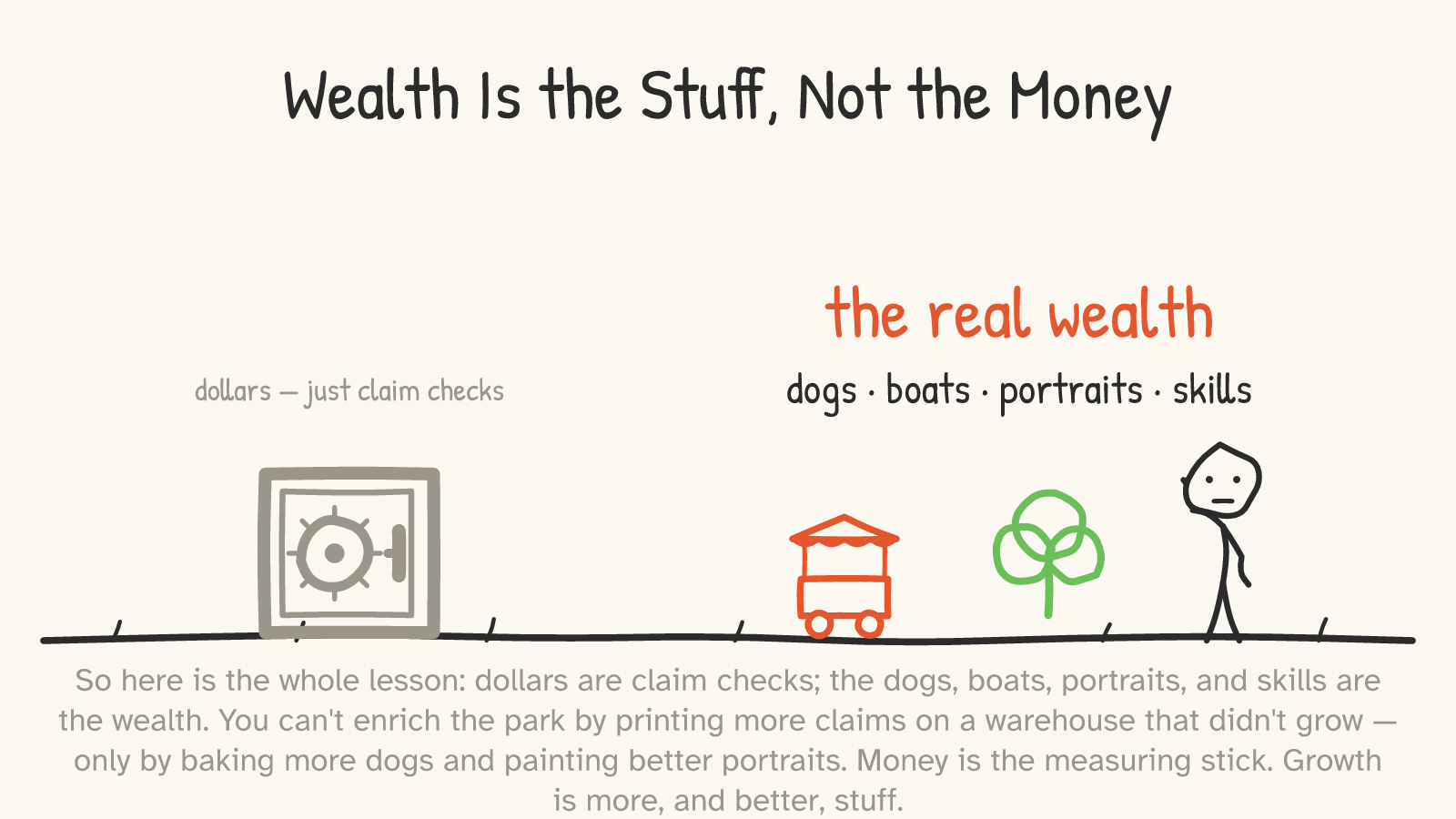
Money is not wealth. Money is a claim on wealth — a clever, transferable IOU that lets you trade your portrait-painting for someone else's hot dogs without the two of you having to want each other's stuff at the same moment. That's a genuinely brilliant invention, and the park would be poorer and weirder without it. But the wealth itself was never the dollars. The wealth is the dogs and the boats and the portraits and the juggling — and, most of all, the skills and tools and effort that bring those things into being. The money is just the measuring stick we hold up against them.
And you cannot get richer by printing more measuring sticks. If you double everyone's claim checks but the warehouse holds the same goods, all you've done is rename the prices. The only thing that ever actually made the park wealthier was back in the third panel, when a second cart opened and there were simply more hot dogs in the world. That's it. That's growth — more things, and better things, made more cleverly: more carts, faster grills, a vendor who learns to make a sandwich nobody had thought of. Everything real comes from the making. The money only ever counts it.
So the next time someone promises to make everyone richer by handing out money, picture the helicopter over the park, and the same lonely hot dog, and its price tag quietly climbing to meet the cash. Then ask the only question that was ever the point: and where are the extra hot dogs going to come from?
Footnotes & receipts
- Supply and demand set a single price. A competitive market clears at the price where the quantity buyers want equals the quantity sellers offer; excess demand pushes the price up, excess supply pushes it down. This is the core of price theory. Alfred Marshall, Principles of Economics (1890). The hot-dog cart is the standard one-market illustration. ↩
- The "helicopter drop." The image of money dropped from a helicopter to illustrate a pure increase in the money supply is Milton Friedman's, from The Optimum Quantity of Money (1969). It's a thought experiment for "everyone suddenly has more money," not a policy proposal. ↩
- Inflation as too much money chasing too few goods (at capacity). The result that a one-time rise in the money supply, with output and velocity unchanged, produces a proportional rise in the price level is the quantity theory of money — David Hume, "Of Money" (1752); Irving Fisher, The Purchasing Power of Money (1911). Crucial scope, stated in the body: this is the full-capacity case. With idle resources the same money can raise output instead (see footnote 5). Confusing "more dollars" with "more wealth" is a cousin of what Fisher called money illusion (The Money Illusion, 1928) — the mistake of treating a nominal increase as a real gain without adjusting for the price level. ↩
- MV = PQ is an identity. The equation of exchange (Irving Fisher, 1911) is true by definition: total spending (money times the number of times it's spent) necessarily equals the total value of sales (the price level times real output). Because it always holds, the identity alone proves nothing; the economic content is in what determines each term — and whether velocity (V) and output (Q) are stable is exactly what's contested. Note the version used here: this is the modern income form (M·V = P·Q, with Q ≈ real output and P the GDP-style price level); Fisher's 1911 original was written in terms of total transactions T (MV = PT). (Milton Friedman's line that "inflation is always and everywhere a monetary phenomenon" is a famous sustained-inflation rule of thumb, not a claim that the identity settles the matter — and it's genuinely contested: supply shocks and cost-push dynamics, like a sharp jump in energy or supply-chain costs, can drive sustained price increases without a prior surge in the money supply.) ↩
- With slack, new money raises output and less of it goes to prices. Below full employment — idle capacity, unemployed resources — extra spending calls forth more real output, so a larger share of new money shows up as goods and a smaller share as price increases. It is a matter of degree, not a binary: a slack economy still gets some inflation, just much less than a full one (the standard aggregate-demand / Phillips-curve point). This is the central insight of John Maynard Keynes, The General Theory of Employment, Interest and Money (1936), and the output-gap framework built on it — the honest limit on the quantity-theory result, hence its own panel. ↩
- Velocity can absorb money. If newly created money is saved rather than spent, velocity (V) falls and total spending (MV) barely rises, so prices needn't move much. This is one reason large increases in central-bank money need not translate one-for-one into consumer inflation. (The mechanism — money can sit idle — is the point here, not any specific historical episode.) ↩
- One-time level shift vs. ongoing inflation. A single, one-off increase in the money supply produces a one-time jump in the price level; a sustained rate of inflation requires the money supply to keep growing period after period. Distinguishing a price-level jump from an inflation rate is standard in monetary economics. ↩
- Real wealth is goods, services, and the capacity to produce them; money is a claim on them. That lasting enrichment comes from producing more and better output — not from increasing the money stock — is the classical view (Adam Smith, The Wealth of Nations, 1776; J.S. Mill, Principles of Political Economy, 1848) and the premise of modern growth theory (Robert Solow, "A Contribution to the Theory of Economic Growth," 1956): long-run living standards rise with productivity — more and better output from the same effort and resources, driven above all by technological progress — not with the quantity of money. ↩