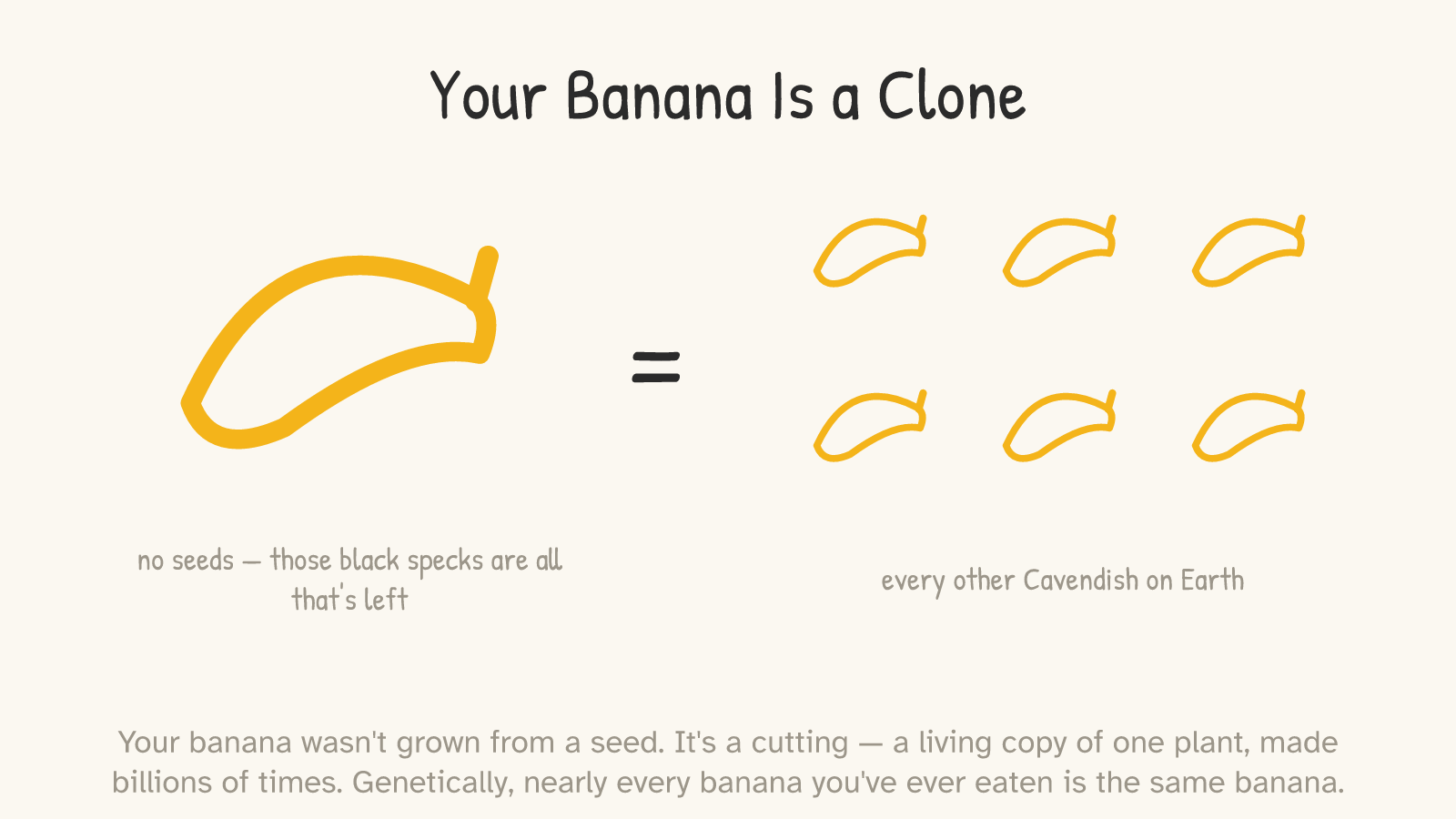
Pick up a banana. Peel it. Look at the little brown specks running down the middle. You probably think of those as seeds — but they're not. They're the ghosts of seeds: ovules that start to form and then quit, because the fruit grows without ever being fertilized.1
Which raises a strange question: if a banana has no seeds, where do new banana plants come from? They don't grow from seed. They grow from cuttings — a shoot taken off one plant and replanted, then again, and again, millions of times.2 That means the banana in your hand isn't really a variety, the way there are varieties of apple. It's closer to a single individual. Genetically, nearly every banana sold in every supermarket on the planet is a copy of the same plant.
It's a genuinely delightful fact. It is also, it turns out, a slow-motion disaster — because a thing that is all one thing has exactly one weakness, and the world has bet its favorite fruit on it.
One honest caveat up front, because the title is built for drama and you deserve the real scope: the banana is not going extinct. There are over a thousand kinds of banana, and wild ones bursting with seeds in the forests of Asia; the plant will be fine. What's in trouble is this one supermarket clone and the global trade built on top of it. That narrowing — a whole worldwide business resting on a single genetic individual — is the problem. So when this essay says "extinct," read it the way it was true for the banana before this one: gone from the world's groceries, not gone from the world.
We bred a fruit that can't breed
Wild bananas are not the soft sweet thing you know. They're stubby pods packed with hard, round seeds — closer to a handful of gravel than a snack.3 Somewhere in the deep past, people found rare mutant plants that made sweet, seedless fruit without needing to be fertilized, and they kept them, and copied them, for thousands of years.
The result is a marvel of eating and a trap for growing. Our banana is sterile — a "triploid," with three sets of chromosomes that don't divide evenly, so it makes almost no viable pollen or seeds at all.4 And here's the catch that the whole rest of this story hangs on: a plant with no seeds cannot be bred. You can't cross two good bananas to make a tougher one, the way you'd breed a hardier wheat or a sweeter strawberry. You can only take cuttings of the one you already have.
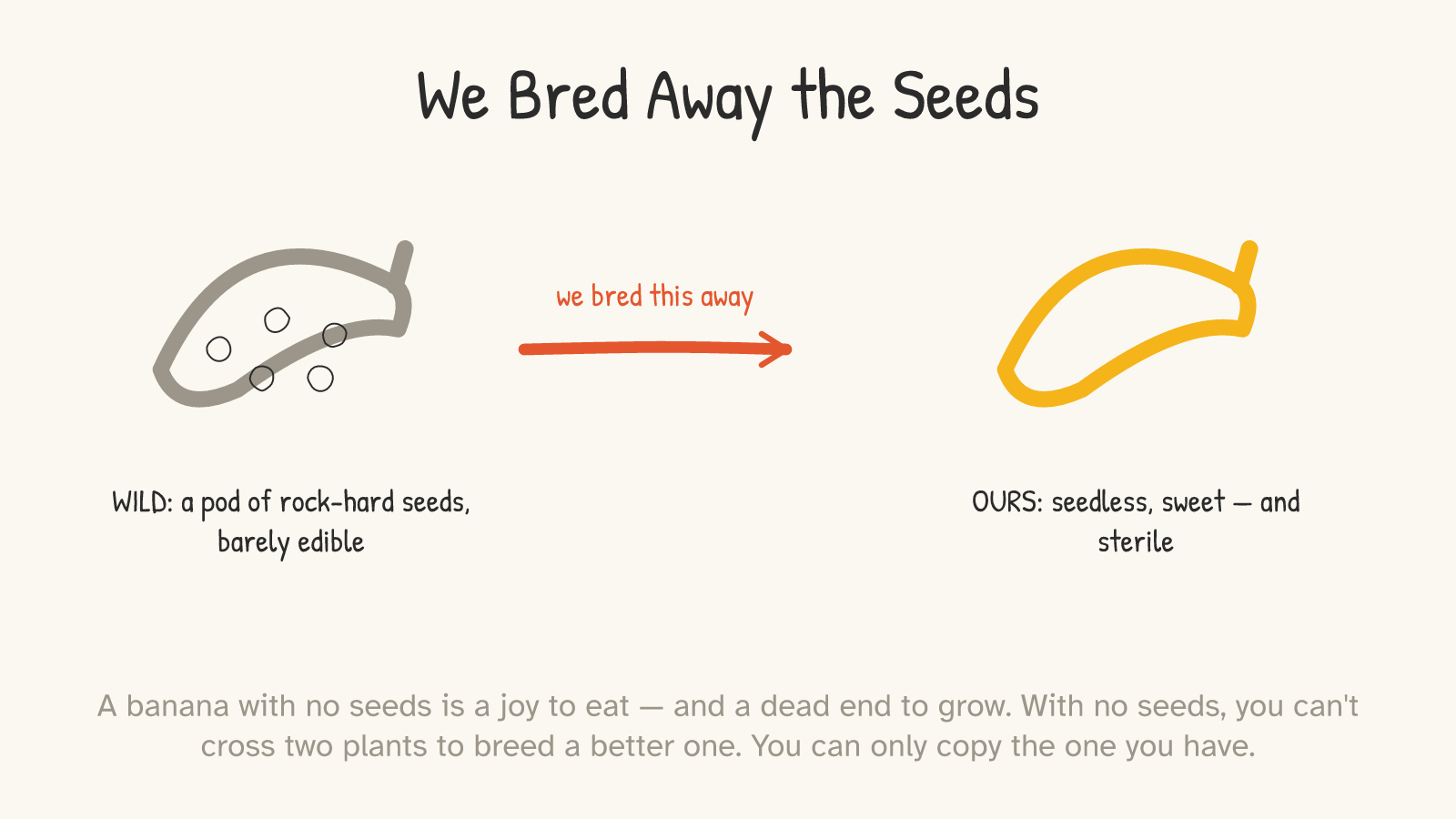
So the very thing that makes the banana pleasant — no seeds — is the thing that makes it nearly impossible to fix when something goes wrong. Hold onto that. It's the whole problem.
A clone is a sitting duck
Now stack that sterility up to global scale. The banana you buy is the Cavendish, and Cavendish plants are clones of each other — not similar, identical. Roughly half the bananas grown in the world are Cavendish — somewhere in the 40–50% range — but among the ones that actually get boxed up and shipped across oceans, it's more than nine in ten.5 The international banana trade is, functionally, one plant, grown across whole continents.
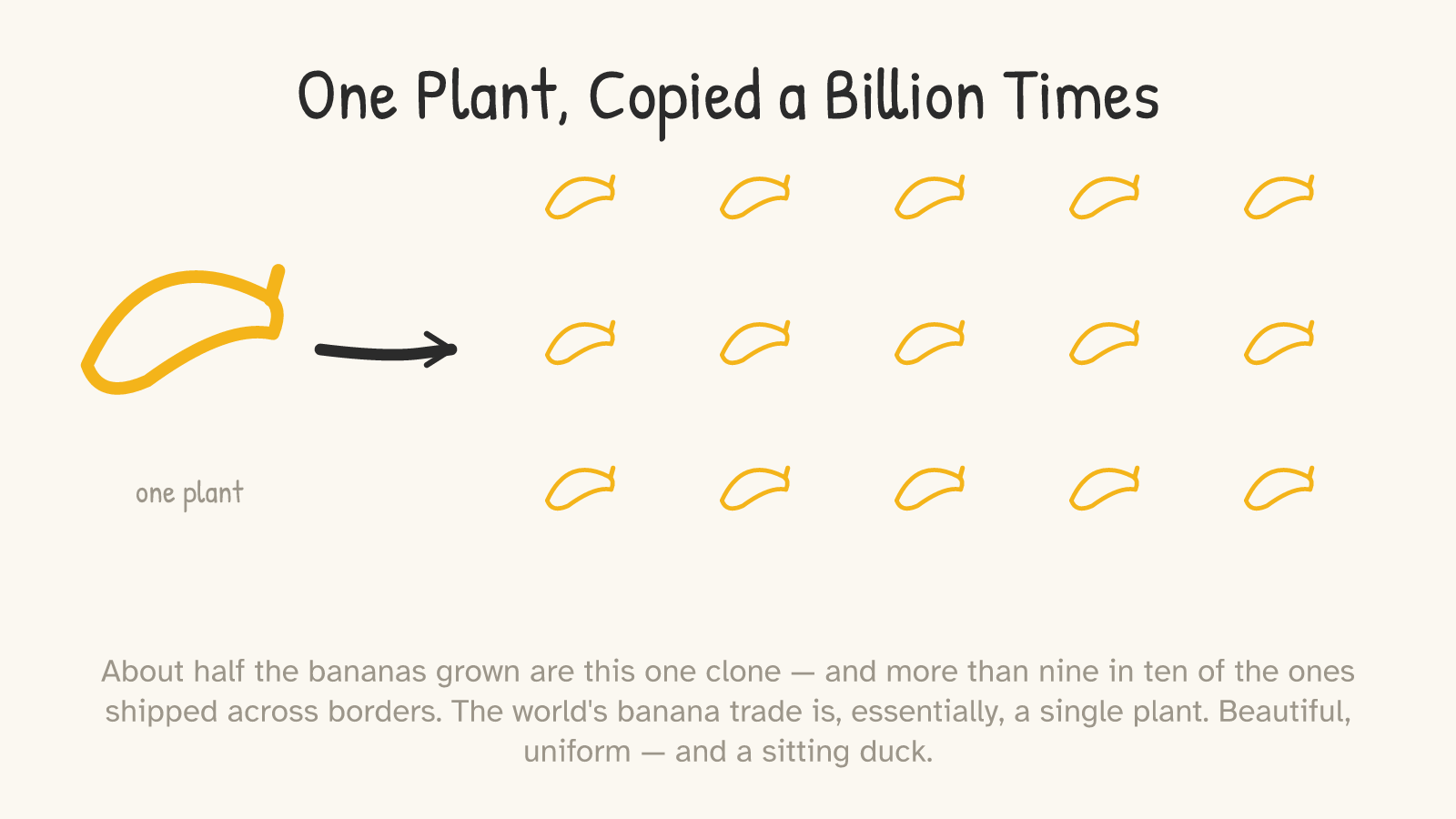
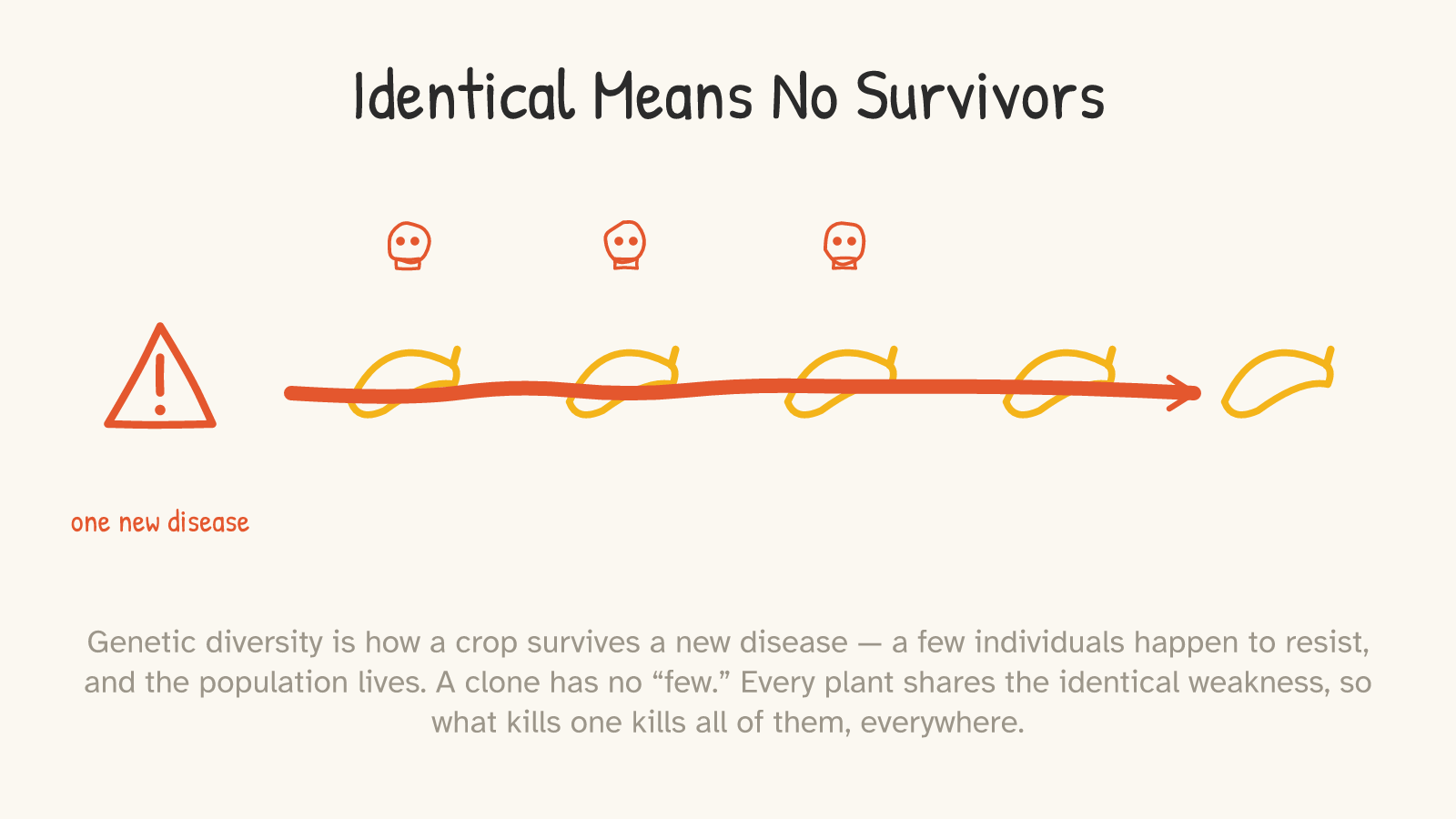
Here is why that's dangerous, and it's the most important idea in the piece. In a normal, genetically varied population, when a brand-new disease shows up, some individuals happen to carry a quirk that lets them resist it. They survive, they reproduce, and the species grinds on. Genetic diversity is a portfolio: you don't need every plant to win, just a few.
A clone has no "few." Every single plant carries the identical strengths and the identical weaknesses. So a disease that can kill one Cavendish can kill every Cavendish — in every plantation, on every continent, all at once. There is no survivor with a lucky gene, because there are no different genes.
This isn't a hypothetical worry. We have run this exact experiment before — and we lost.
This already happened
The banana your grandparents ate was not the Cavendish. It was a different clone called the Gros Michel, and by most accounts it was bigger and tastier. From the late 1800s until the early 1960s it was the banana — the one in the crates, the one in the ads.6
Then a soil-borne fungus — a strain of Fusarium — found it, causing what growers called Panama disease. It lives in the dirt and chokes the plant from the roots up, and there's no spray that cures it. Because every Gros Michel was identical, the disease tore through plantation after plantation across Latin America, and by the early 1960s the Gros Michel was finished as a commercial crop.6
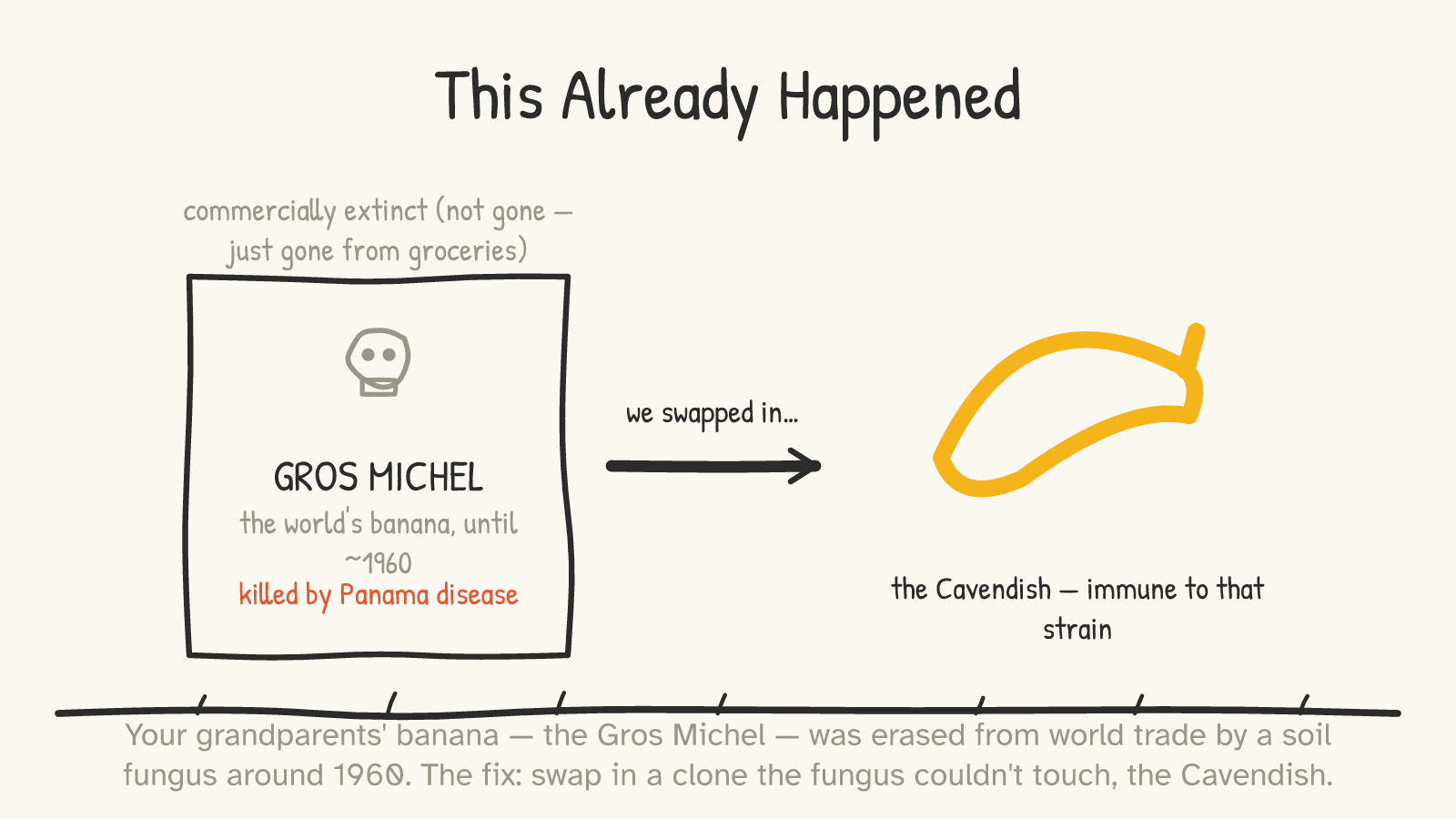
The industry didn't fix the Gros Michel — you can't fix a sterile clone. It replaced it, with another clone that happened to shrug off that particular fungus: the Cavendish. (Worth a footnote: the Gros Michel isn't truly extinct — it's still grown in home gardens and local markets across Central America and Southeast Asia. It's commercially extinct — gone from the global trade, not from the world, which is the only kind of extinct a banana like this can really be.6)
“And isn't 'fake banana flavor' based on the Gros Michel? That's why banana candy tastes wrong, right?”
It's a great story, and as far as anyone has measured, it's mostly false — worth clearing up because it's everywhere. Artificial banana flavor is a single chemical, isoamyl acetate, and it was being used in candy before the switch to Cavendish, not reverse-engineered from a lost fruit. When chemists actually measured it, both the Gros Michel and the Cavendish contain that compound at similar, low levels, and neither tastes much like the candy.7 The honest version is duller but truer: banana candy is over-concentrated on one note that real bananas only whisper. It's not the ghost of the Gros Michel.
And now it's happening again
You can probably see where this is going. A new strain of that same fungus — Tropical Race 4, or TR4 — threatens the Cavendish the same way Panama disease destroyed the Gros Michel: the same kind of incurable soil rot, the same fatal uniformity. The Cavendish was chosen because it shrugged off the old strain. It has no resistance to this one.8
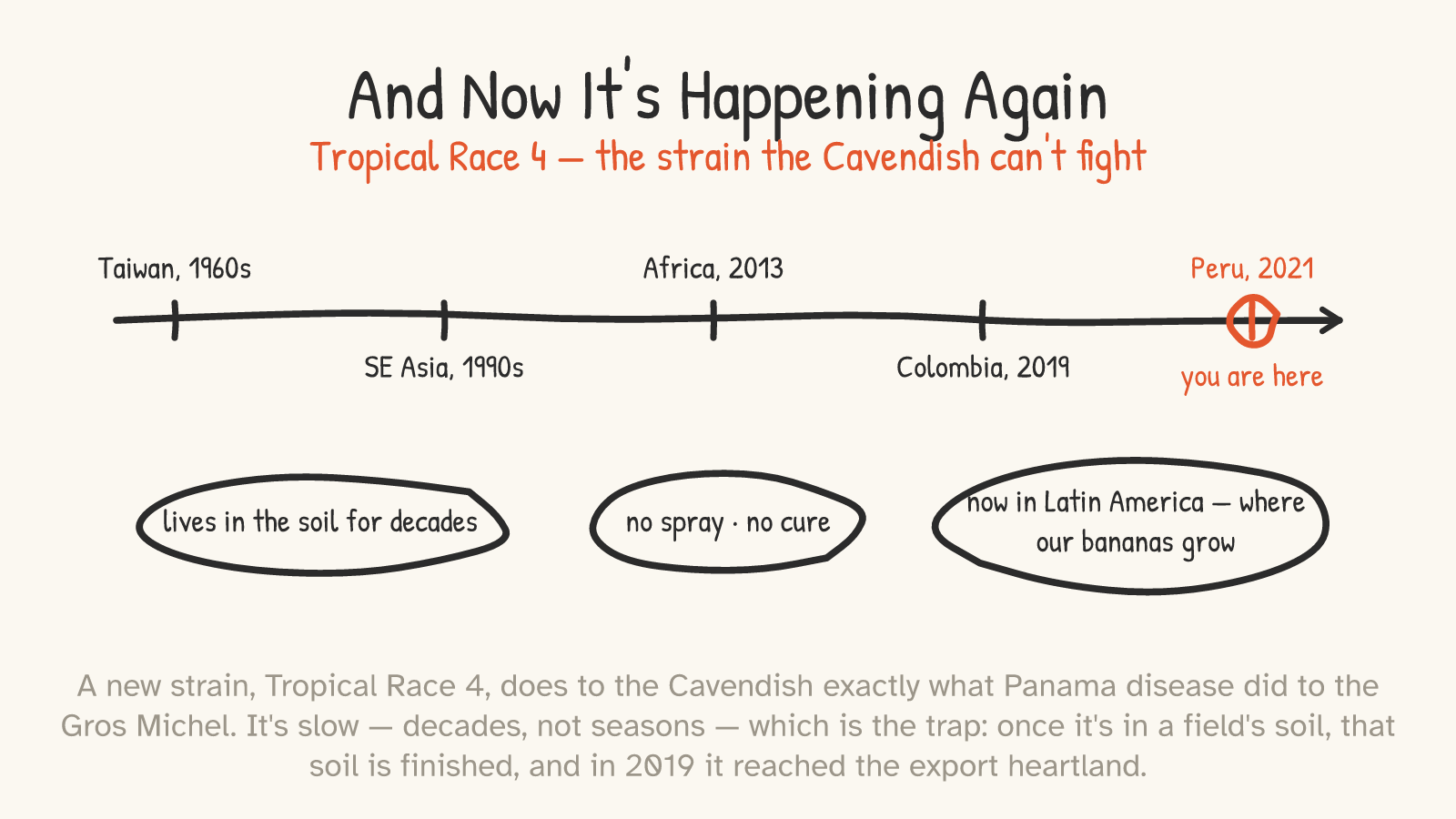
TR4 is a patient killer. It was first spotted on Cavendish in Taiwan back in the 1960s,8 and it has been creeping outward ever since — through Southeast Asia, into Australia, reaching Africa in 2013, and then, most alarmingly, jumping to Latin America: confirmed in Colombia in 2019 and Peru in 2021.8 That matters because Latin America is where almost all of the world's export bananas are grown.
Now, a fair objection: TR4 has been creeping along for over half a century, and the world's banana supply hasn't collapsed — so isn't the alarm overblown? There's real truth in that. The slowness does buy time, and growers fight back with strict quarantine and biosecurity — scrubbing boots, vehicles, and tools, restricting the movement of soil and plants — which genuinely slows the spread.9
But containment is not a cure, and that's the catch. Quarantine can keep the fungus out of a clean region; nothing gets it out of a field once it's in. It settles into the soil as tough resting spores and survives there for decades with no host, and no chemical brings that ground back.9 So the slowness isn't reassurance — it's the trap. By the time a region clearly has a problem, the soil is already lost, and all anyone can do is try to keep the fungus from reaching the next clean field.
So why can't we just make a new one?
Last time, we got lucky: a replacement clone — the Cavendish — was already sitting on the shelf, immune and ready. "So we'll just switch again," you might say — and breeders have made TR4-tolerant hybrids through heroic, decades-long work (the FHIA varieties, the cheerfully named "Goldfinger"). The trouble is that none has displaced the Cavendish, because the Cavendish never won on taste. It won on logistics: it ships hard and green halfway around the planet, ripens on a predictable schedule once it's gassed, and bruises less than the rivals. A banana that tastes lovely but turns to mush in a six-week container voyage doesn't save the trade. And remember the trap from the very beginning: because the banana is seedless, you can't simply breed the resistance into the Cavendish itself.
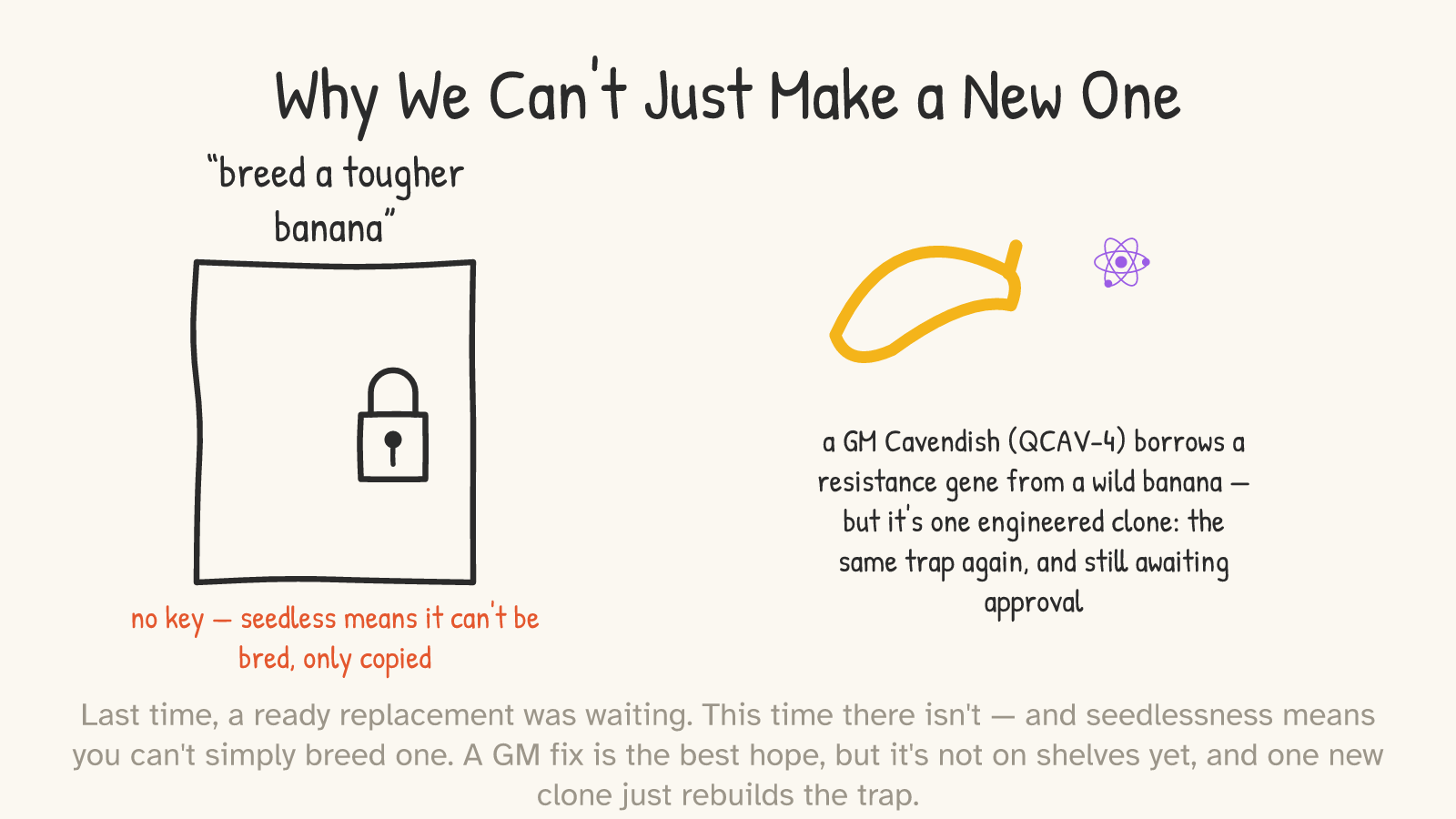
There is real hope, and it's worth being fair about it. Scientists in Australia took a Cavendish and inserted a resistance gene borrowed from a wild, seedy banana; the resulting plant, called QCAV-4, shrugged off TR4 in field trials.10 It's the most promising fix going. But it's genetically modified, which runs straight into years of regulatory review and Europe's strict legal limits on GM crops — rules that have kept most of them off European shelves for two decades. As of 2023 it had been submitted for approval in Australia and New Zealand and was still awaiting a verdict — not on any shelf.10 And notice the deeper problem it doesn't solve: if we save the banana by copying one engineered Cavendish across the world, we've just rebuilt the exact same monoculture, and started the clock on whatever comes after TR4. As the UN's own agriculture agency puts it, the fungus is really just a symptom; the underlying disease is the lack of diversity itself.11
Who this really hurts
Now the honest scope, because the headline is a bit of a cheat. The banana is not going extinct — not the plant, not the genus. There are over a thousand kinds of banana in the world and wild ones full of seeds in the forests of Asia; Musa will be fine. What's dying is the one export clone and the global trade built on it. "Extinct (again)" means commercially extinct, the way the Gros Michel went.
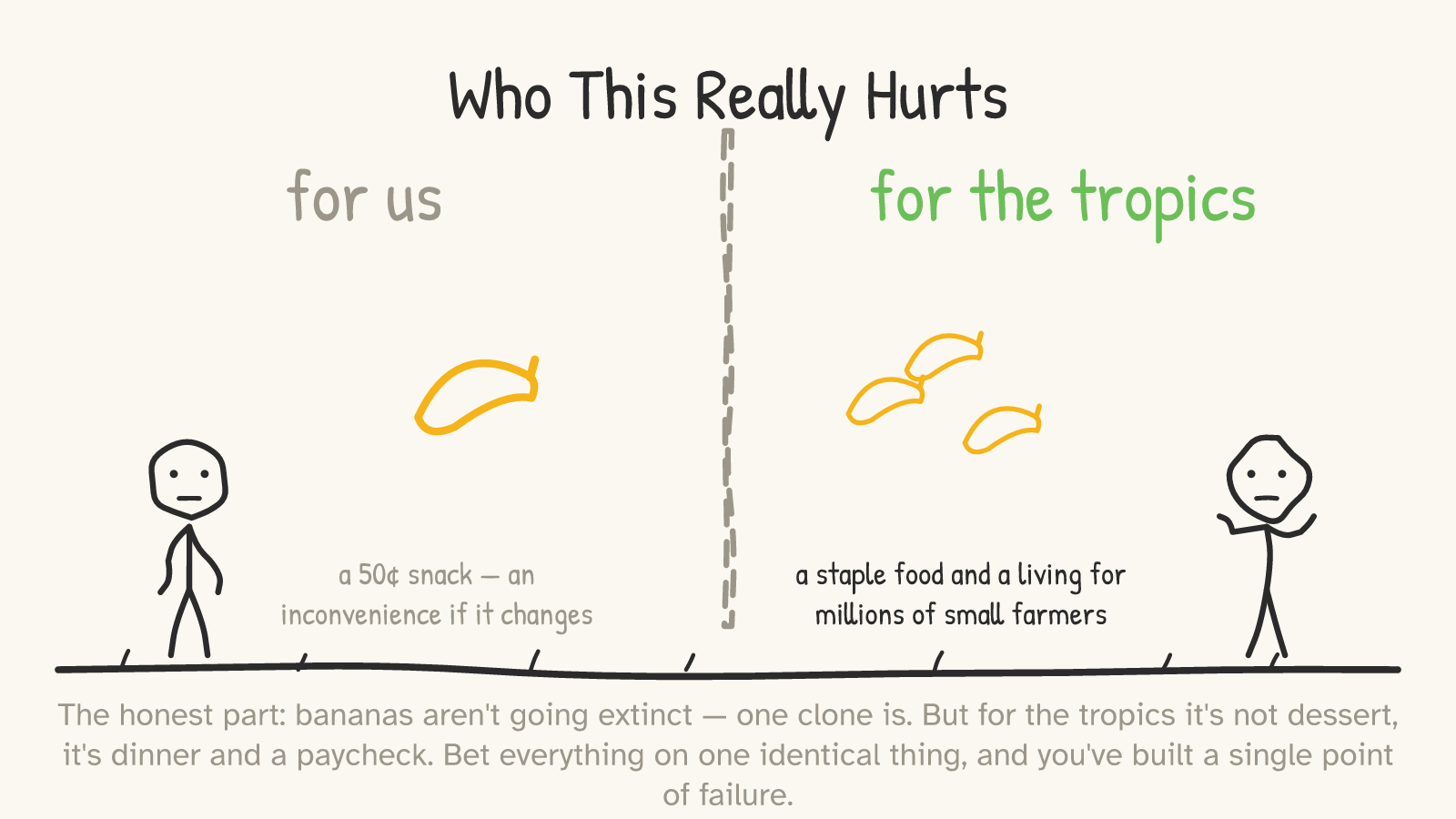
And here's the thing worth sitting with. If the Cavendish vanished from a Western supermarket, it would be a mild annoyance — a smoothie ingredient swapped for something else. But across much of the tropics, bananas and plantains aren't dessert. They're a staple — a major source of calories and the livelihood of millions of smallholder farmers.12 TR4 doesn't just threaten the fruit bowl in a rich country; it threatens dinner and a paycheck in a poor one.
So the banana turns out to be a perfect little parable, and the lesson is much older than fruit. We took something wonderful — sweet, seedless, cheap, identical — and made it all the same, because sameness is efficient. And a system made entirely of one thing has exactly one way to fail, completely. The fix is the opposite of what made the banana so cheap in the first place: not a better clone, but more difference.
The banana has died before. It will probably survive this too — re-engineered, or replaced, or quietly diversified. But it will stay one disease away from disaster for exactly as long as any replacement is planted the way this one was: as a single clone, the same banana everywhere.
Footnotes & receipts
- The black specks aren't seeds. They're immature, aborted ovules — the fruit develops without fertilization (parthenocarpy) and sets essentially no seed. Heslop-Harrison & Schwarzacher, "Banana Cytogenetics" (Univ. of Leicester); Bhatt & Bhatt (2005), Scientia Horticulturae. ↩
- Grown from cuttings, not seeds. Commercial bananas are propagated vegetatively (from suckers or tissue culture), so a plantation is a clone with near-zero genetic diversity. Heslop-Harrison & Schwarzacher (2007). ↩
- Wild bananas have hard seeds. The wild ancestors (Musa acuminata, Musa balbisiana) produce seeded, barely-edible fruit; edible bananas arose from sterile, seedless mutants that people selected and propagated. Heslop-Harrison & Schwarzacher (2007). ↩
- Sterile triploid. The Cavendish is triploid (three chromosome sets, AAA), which makes meiosis fail and yields almost no viable gametes — so it sets virtually no seed and is extremely difficult to cross-breed. Shepherd (1987), Acta Horticulturae; Heslop-Harrison & Schwarzacher (2007). ↩
- ~half of production, but >90% of exports. The Cavendish is roughly 40–50% of total world banana production but dominates the international export trade at over 90%, because cooking bananas and plantains are mostly eaten locally. FAO Markets & Trade; Heslop-Harrison (2002), Annals of Botany ("accounts for nearly all the export trade in banana"). The distinction matters — the monoculture is in the trade. ↩
- The Gros Michel collapse. The Gros Michel was the dominant export banana until the 1950s–60s, when Panama disease (Fusarium wilt, Fusarium oxysporum f. sp. cubense Race 1) destroyed it commercially and the industry switched to the Race-1-resistant Cavendish in the early 1960s. It is "commercially extinct," not biologically extinct — it survives in small plantings. Established in the peer-reviewed literature (Heslop-Harrison & Schwarzacher 2007) and banana history (Koeppel, Banana). ↩
- The artificial-flavor myth. Banana candy is flavored with isoamyl acetate, which was in use before the Cavendish switchover and was not formulated from the Gros Michel. Chemical (GC-MS) analysis finds Gros Michel and Cavendish have similar, low levels of the compound, and neither closely matches the candy — which is simply far more concentrated in that one note. Reported via Inverse (2022) and a Utica University GC-MS analysis. Verdict: largely a myth. ↩
- Tropical Race 4 (TR4). Fusarium oxysporum f. sp. cubense Tropical Race 4 (recently reclassified Fusarium odoratissimum) infects the Cavendish, which the old Race 1 could not. First observed on Cavendish in Taiwan in the 1960s (genetically typed as TR4 by 1989); spread through SE Asia (1990s), Australia, the Philippines, then Mozambique (2013, first in Africa), and into Latin America — Colombia (2019) and Peru (2021). ProMusa (Bioversity/CGIAR); FAO TR4 Global Network; Maryani et al. (2019). ↩
- Why it's unstoppable. TR4 is soil-borne, persists in soil for several decades as resting spores, has no effective fungicide or cure, spreads via soil/water/equipment, and can cause total (100%) yield loss in infected fields; FAO estimates over 80% of global banana production is based on TR4-susceptible varieties. FAO TR4 Global Network; ProMusa. ↩
- QCAV-4. A genetically modified (transgenic) Cavendish from Queensland University of Technology (James Dale's team) carrying the RGA2 resistance gene from the wild Musa acuminata subsp. malaccensis; it showed strong TR4 resistance in field trials. As of the latest confirmed status it was submitted for Australian/New Zealand regulatory review (2023) and is not yet commercially approved or grown. Dale et al. (2017), Nature Communications; QUT. ↩
- Monoculture is the root cause. The FAO frames TR4 as "a symptom of the systemic problem of lack of diversity" — the fungus is the trigger, the monoculture is the vulnerability. FAO TR4 Global Network. ↩
- The real stakes. The FAO describes bananas as "among the most important food crops for the livelihoods of millions of smallholder farmers in the tropics"; banana and plantain are a dietary staple for tens of millions of people in East/Central/West Africa and parts of Asia, and rank among the most important crops in developing countries. FAO; Heslop-Harrison (2002), Annals of Botany. (A widely-shared "400 million people" figure traces to a 2025 NGO advocacy report and is not confirmed by FAO or peer-reviewed sources, so it isn't used here.) ↩