At some point in the last two years, someone made you feel bad about typing.
Maybe it was the headline that said every ChatGPT email drinks a bottle of water. Maybe it was a chart with a chatbot next to a melting glacier. Either way, a very specific kind of guilt was born: the feeling that somewhere, every time you ask a machine to fix your cover letter, a data center tips a 500 mL bottle of clean drinking water into the void.
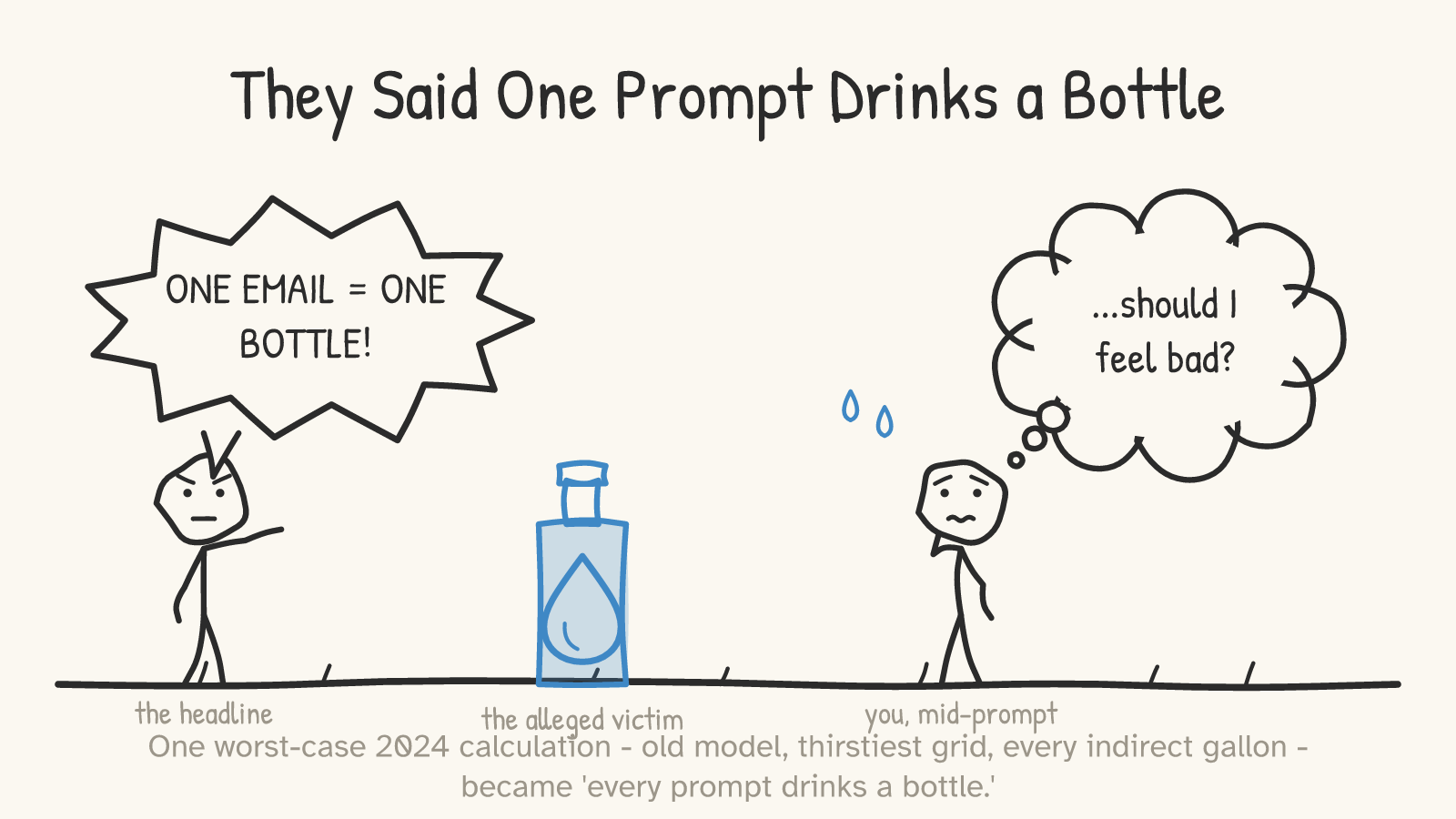
Here's the strange part: that number wasn't a lie. It was a real calculation, done by real researchers.1 It just had every dial turned to maximum — a 2023-era model, the longest email in the study, the thirstiest power grid in America, and the water used to generate the electricity stacked on top of the water that cools the servers. The researcher behind it has since published a much lower per-prompt estimate, about 15 mL — and it's worth being precise about why: the new number reflects newer models on cleaner infrastructure, not an arithmetic error in the old one. GPT-4-era inference on a coal-heavy grid really was that thirsty. The bottle kept going viral anyway, because "three teaspoons" doesn't make a good headline.
So let's do the thing the headline didn't: look at every number anyone has published, put them on one axis, and then keep zooming out until we can see what actually matters.
Part 1Nobody agrees on the number
Here is every serious per-prompt estimate we could find, drawn to true scale:
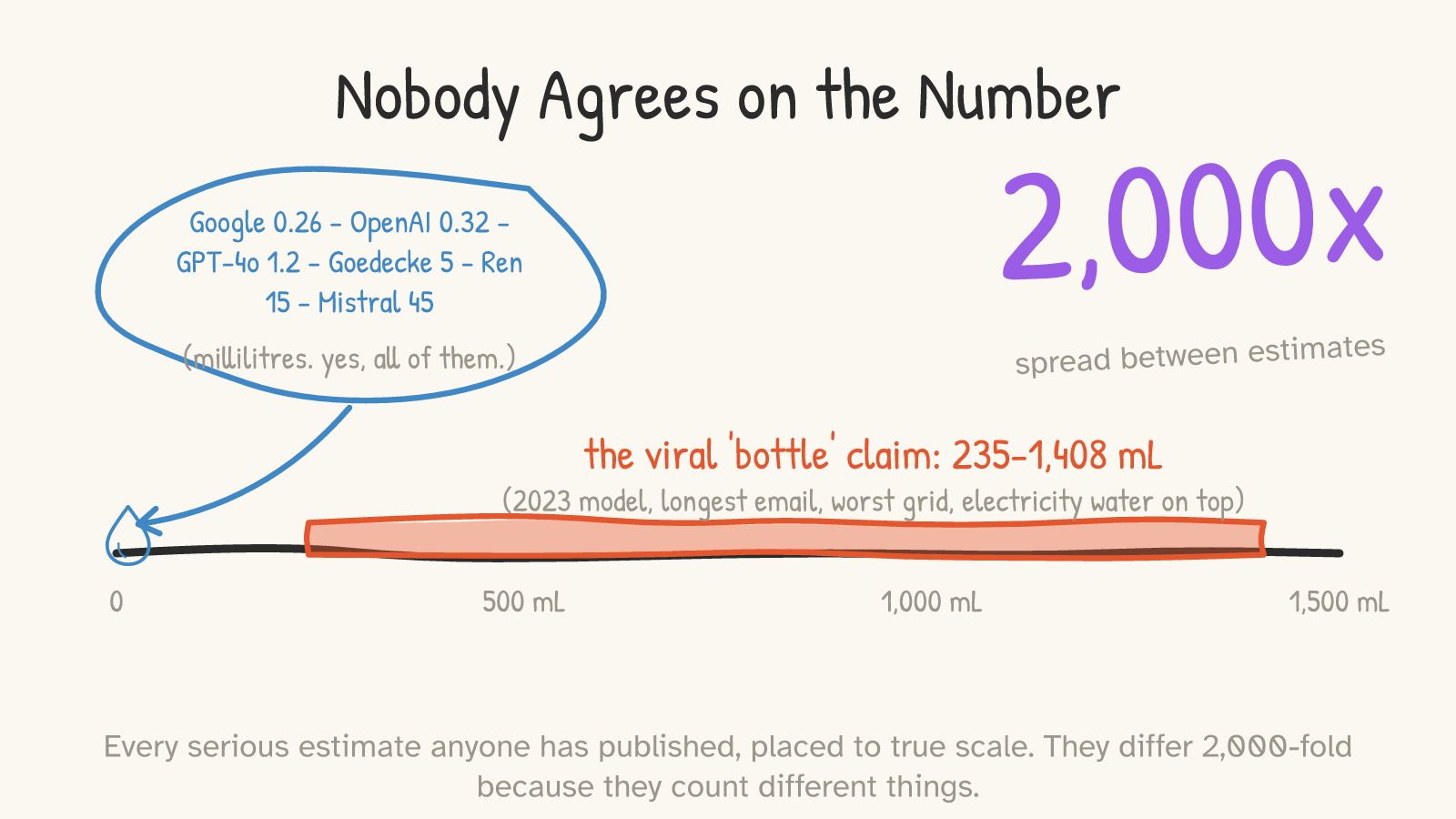
Google says a median Gemini prompt costs 0.26 mL of water — about five drops.2 OpenAI says 0.32 mL.3 Independent researchers who count the off-site water (the power plant's cooling, not just the data center's) land between 1.2 and 15 mL.4 Mistral did a full cradle-to-grave lifecycle assessment — training, hardware, everything — and got 45 mL, of which 91% is the one-time training cost spread across every future prompt.5 And the famous worst case runs 235–1,408 mL.1
That's a 2,000-fold disagreement, and it's worth being honest about why: these numbers count different things. Cooling only? Cooling plus electricity? Plus training? Plus the chip fab? Each boundary is defensible; none of them is "the" number.
Three fair concessions before we go on, because they're real. The lowest figures are company-reported and not independently audited — useful datapoints, not water bills.6 These are typical text prompts — a long reasoning chain, a million-token context, or a generated video can cost tens to hundreds of times more compute per output, and the workload mix is shifting toward exactly those heavier jobs.16 Multiply the harshest modern text estimate by 100 and you get about 1.5 litres — a number to keep in your pocket for the next section. And the spread matters for some claims, so let's scope ours now: for the food comparisons coming up, you can pick any estimate on the chart — including the 1,408 mL worst case — and the conclusion survives. For the finer-grained household math, we'll use 15 mL, the harshest modern independent figure, and we'll show what happens at 45 mL too. No number-shopping; you'll see every step.
Part 2Meet one almond
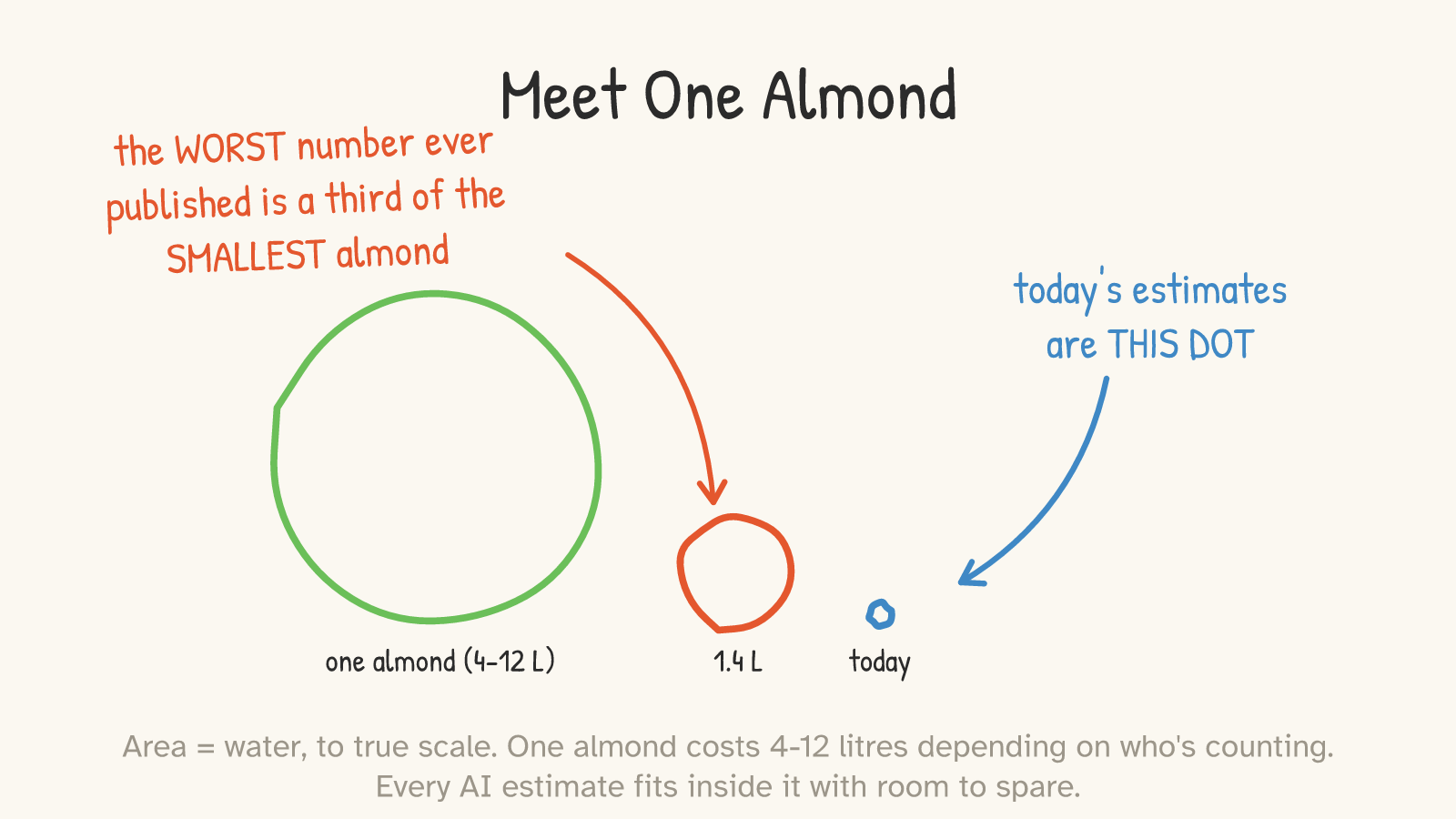
A single California almond costs 4 to 12 litres of water, depending on whose methodology you like.7 (Yes, the almond's number is fuzzy too. Everything's number is fuzzy. Welcome to water accounting.)
Take the scariest AI figure ever published — the full 1.4-litre worst case, the one the headlines were built on. It is a third of the smallest estimate for one almond. Take that 100×-heavier video-generation pocket number from Part 1 — about 1.5 litres — and it's still inside one almond. Take today's central estimates and the comparison stops being a comparison: 15 mL doesn't register against an almond. It's a rounding error on a rounding error.
And the almond is the small food.
Part 3"But burgers drink rain" — the best objection, taken seriously
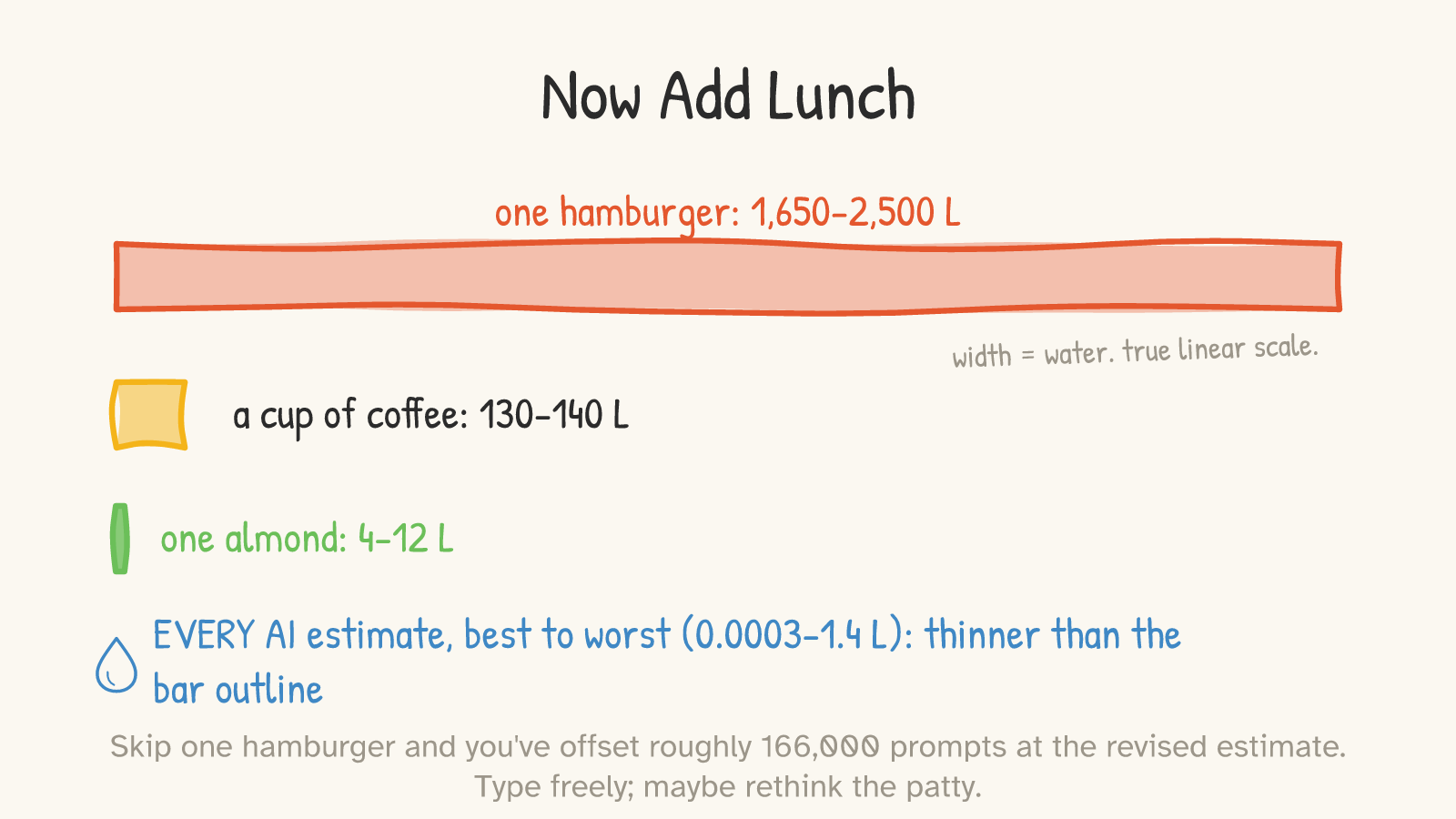
A hamburger costs somewhere between 1,650 and 2,500 litres of water.8 Put it on the chart and the entire AI controversy — best estimate to worst, every methodology, every vendor — compresses into a line thinner than the burger bar's outline.
Objection: "Those aren't the same kind of water. Burger water is mostly rain on pasture — green water. Data centers drink treated municipal blue water, in a specific town, from a specific pipe."
This is the strongest argument on the other side, so it gets three answers, in order of bluntness.
First — run the burger on blue water only, and it still wins by miles. The Water Footprint Network's own green/blue decomposition puts an average patty's blue water — irrigation withdrawals, not rainfall — at roughly 60 litres; an industry analysis of a fast-food double burger that priced every ingredient by blue-water intensity got about 930 litres.9 The honest range is wide, so take the bottom of it: 60 litres of blue water is still ~4,000 prompts at the 15 mL estimate. The almond is an even cleaner case: California almonds are irrigated — their 4 litres is nearly all blue water from the same overdrawn aquifers everyone worries about. The category error barely changes the answer.
Second — fine, drop food entirely. Compare municipal water to municipal water. Your toilet uses about 6 litres of treated drinking water per flush — the same kind of water from the same kind of pipe as the data center.
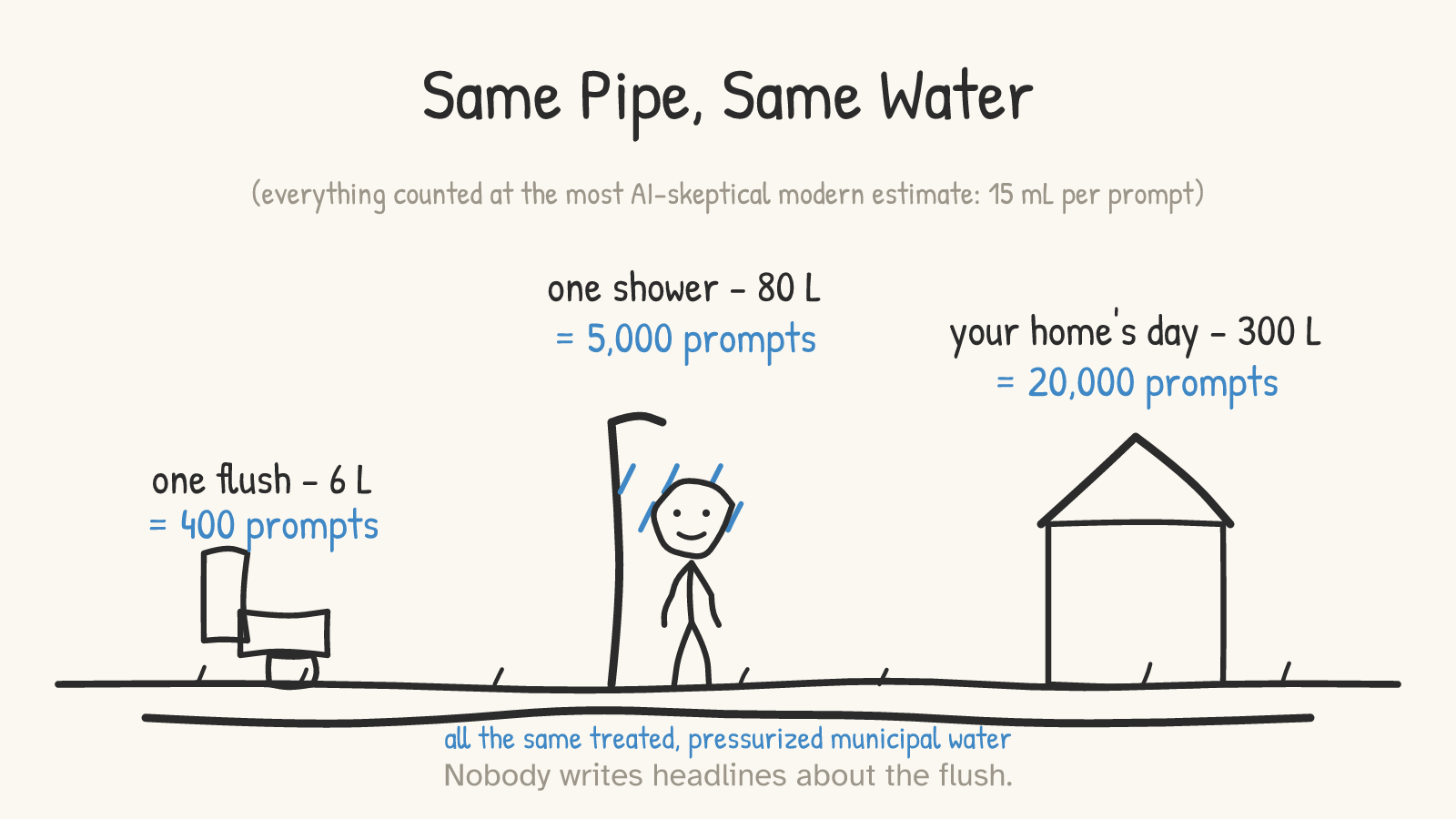
At the 15 mL estimate, that's ~400 prompts per flush. An eight-minute shower at a standard 9.5 L/min head — about 75 litres — is roughly 5,000 prompts. An average household's ~300 litres of daily indoor water is on the order of 20,000 prompts — every day, forever, without a single headline. Prefer Mistral's 45 mL full-lifecycle figure instead? Divide everything by three: ~130 prompts per flush, ~1,700 per shower, ~6,700 per household-day. The ratios shrink; the conclusion doesn't move. (Only the discarded 1,408 mL worst case — a 2023 model on the dirtiest grid — gets the flush down to ~4 prompts, and nobody, including its author, defends that as a current number.1)
Third — the "year of guilt" math, at honest usage levels. One prompt a day for a year is 117 mL at OpenAI's figure, or about 5.5 litres — half of one almond — at the 15 mL estimate. But let's not lowball the user: a power user firing 100 prompts a day runs about 550 litres a year at 15 mL. That's one year of intensive AI use ≈ one fast-food meal's worth of blue water. There is no other line item in your life where 550 litres a year would make the morality pages.
Part 4"Comparison isn't permission"
Second objection, also worth taking seriously — actually it's three objections wearing one coat, so let's take them one at a time.
Objection: "Whataboutism. Burgers being thirsty doesn't make data centers virtuous. Two things can be bad."
Correct — and that's not the argument. The argument is about what guilt is for. Moral attention is a budget. When a person decides to "use AI less to save water" while eating lunch, watering a lawn, and flushing a toilet, they've spent their entire water-conscience on the smallest line item in their life by four orders of magnitude. That's not ethics doing its job; that's well-intentioned attention aimed where the headlines pointed instead of where the water went.
Objection: "Food is survival; AI is discretionary. You're comparing a calorie to a convenience."
This is the deepest version, and it deserves a precise answer: this essay argues miscalibration, not moral equivalence. We take no position on whether your cover-letter prompt "deserves" water the way a calorie does. The claim is narrower: if the discretionary-water bar is where you've set it, then coffee (130+ litres, fully discretionary), lawns (2 trillion gallons, fully discretionary), and golf (547 billion gallons, extremely discretionary) all cleared it by orders of magnitude without acquiring a guilt industry — and the chatbot underneath all of them did. A standard applied only to the smallest user isn't a standard; it's a mood.
Objection: "Aggregation of small users is how every big water problem works. Your logic is 'my vote doesn't matter.'"
Individual conservation campaigns genuinely work — low-flow toilets, drought-season lawn rules — when the per-unit contribution is a meaningful share of total use and the behavior scales. Per-prompt abstinence fails both tests at once: the per-unit number is four orders of magnitude below your other daily water choices, and skipping prompts doesn't slow the buildout, because the infrastructure is sited and financed on aggregate demand forecasts, not on your restraint. Which points at the real lever — and there is one. You cannot govern a watershed from your keyboard; you can govern it at a zoning meeting.
Part 5Zoom all the way out
"Okay, but it's not about my prompt — it's about all of them, growing fast."
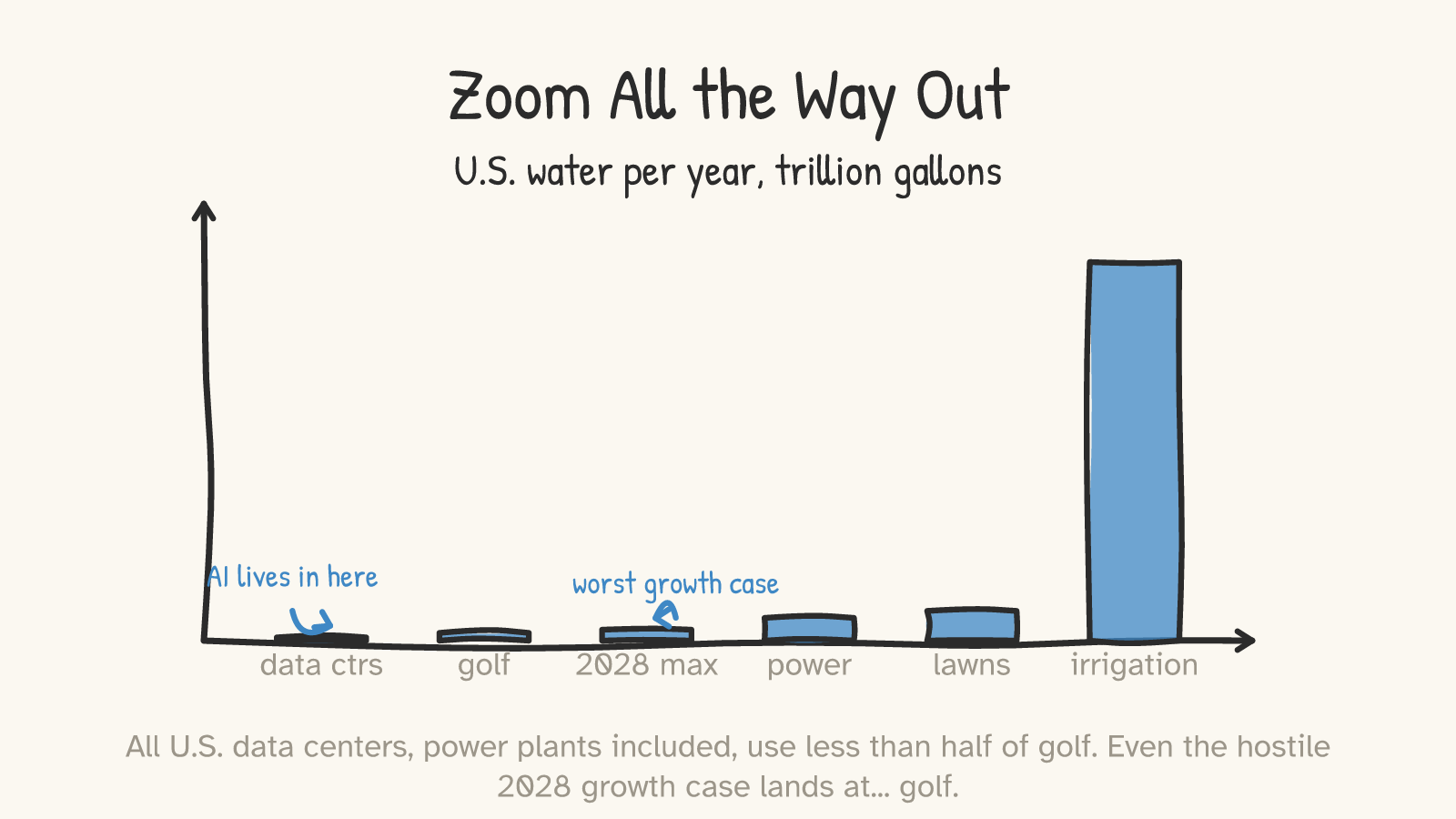
Good. Real numbers, then. U.S. data centers directly consumed about 17 billion gallons in 2023. Count the water consumed generating their electricity and it's about 229 billion gallons.10 Build a deliberately pessimistic 2028 case — the high end of LBNL's electricity projections, site cooling water on top, and a grid whose water intensity doesn't improve at all — and you get 430–773 billion gallons a year: a 14–28% compound annual growth rate from 2023.10 That is real, fast growth, and pretending otherwise would be spin.
It is also still small water. U.S. golf courses use about 547 billion gallons a year. Lawns: over 2 trillion. Irrigation: about 26.7 trillion.11 And to keep the accounting honest in the body text, not a footnote: those category figures are mostly withdrawals, while the data-center figures are consumption — on a consumption-only basis golf and irrigation shrink substantially, and the gap narrows from "absurd" to merely "several orders of magnitude." The pessimistic 2028 case for the entire AI-and-cloud industry still lands at roughly golf.
Two more things this zoom-out owes you. The horizon: this analysis stops at 2028 because that's where LBNL's projections stop. Extend the high-end growth rate past 2028 and the golf comparison eventually erodes — which is an argument for the governance below, not against it; Part 6 gets more urgent the further out you look, not less. The boundary: none of these U.S. figures count semiconductor fabrication — chip fabs in Taiwan, South Korea, and increasingly Arizona are their own concentrated water story, and this essay doesn't cover it.16
Notice also where the 229B actually lives: more than nine-tenths of it is the power plants, not the server racks. "AI's water problem" is mostly electricity's water problem wearing a trench coat. That ratio will shift as grids decarbonize and as more data centers move to dry cooling — and hyperscalers are big enough electricity buyers that their procurement choices are part of the water story, not separate from it. But the direction is the same either way: the fix lives in grids and cooling design, not in prompt rationing.
Part 6The part that's true
Now the steelman gets its full turn, because buried under the bottle memes is a real issue, and dismissing it would make everything above propaganda.
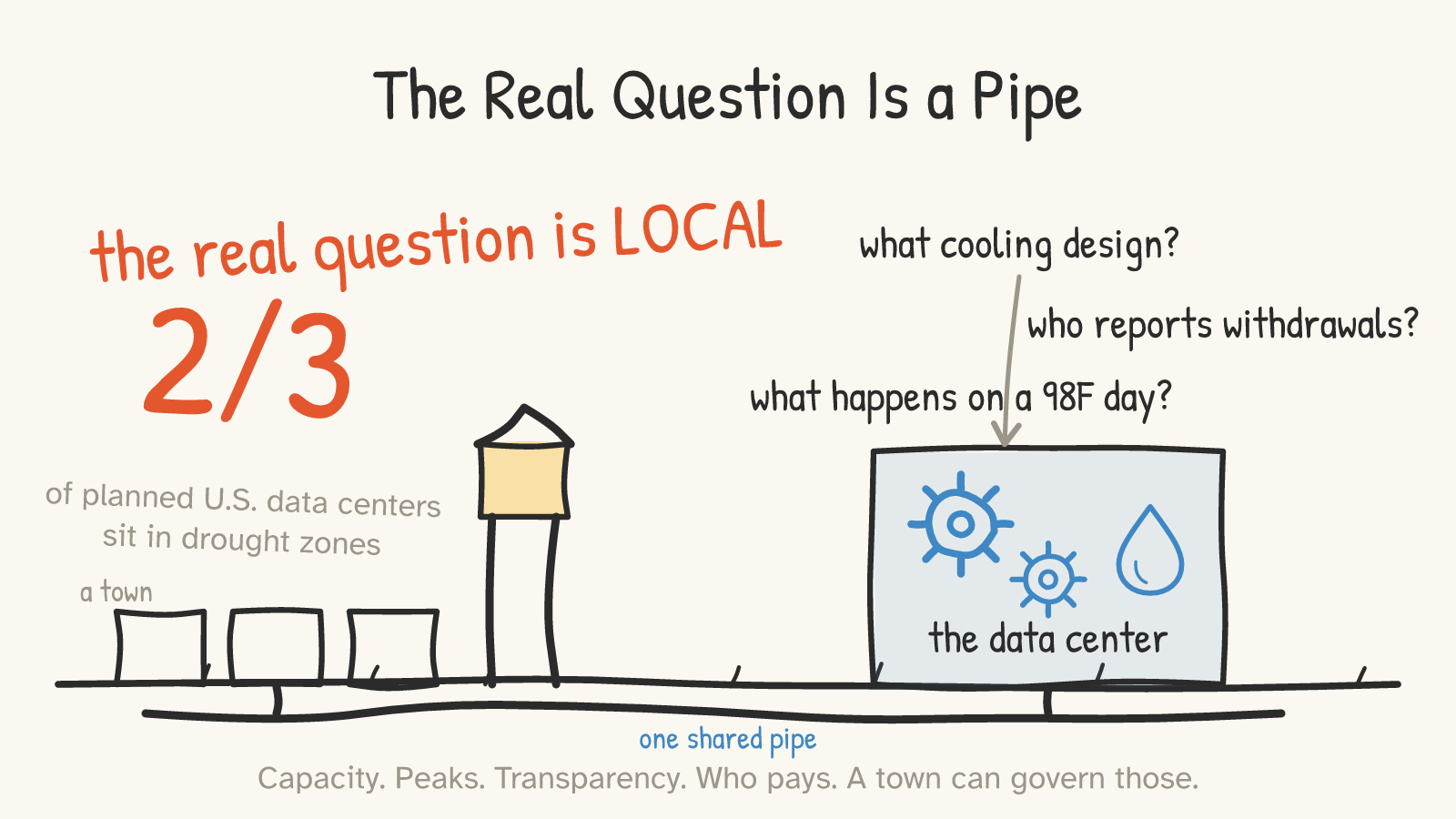
Data centers are physical infrastructure in specific places, and the places are being chosen badly. One 2026 survey of planning data found roughly two-thirds of 809 new U.S. data centers planned or under construction sited in drought-prone areas — the exact share depends on how "drought-prone" is defined, but independent analyses point the same direction: MSCI finds about a quarter of existing facilities worldwide, and a third of those under construction, face intensifying water stress.1213 A typical facility uses ~300,000 gallons a day; a large one, up to 5 million — and what breaks a small utility isn't the annual average, it's the hot-day peak, when the data center's evaporative cooling and everyone's air conditioning spike together.14 Researchers who think AI's per-prompt water cost is wildly overstated still argue U.S. data centers could need substantial new public-water capacity by 2030 — "small bottle, big pipe."15 Take that finding at full strength: it means real capital costs and real water-stress consequences for host communities, not hypothetical ones. That's an argument for planning and governance rather than panic — but it is an argument, and it's the strongest one in this debate.
And the efficiency story has a catch worth naming: the rebound effect. As inference gets cheaper per query, usage grows to fill and exceed the gains — efficiency is partly why the buildout is accelerating. Whether structural fixes (siting rules, dry cooling, cleaner grids) can outpace demand growth is a genuinely open empirical question. That uncertainty is one more reason the governance has to be real rather than vibes-based.
The disclosure problem cuts both ways, so cut it both ways. Companies resisting audited disclosure invites the suspicion that the numbers are bad — and skeptics reasonably ask: if it's so small, why hide it? But notice what the same companies volunteer: per-prompt figures like 0.26 mL, which they'd never publish if per-prompt were the embarrassing part. The likeliest reading is the one this whole essay has been drawing: per-prompt numbers are genuinely small, aggregate buildout numbers are genuinely large — small bottle, big pipe. The fix is mandatory, audited, aggregate disclosure. Per-prompt headlines are the decoy.
So the honest questions are boring, local, and answerable: What cooling design — evaporative, closed-loop (up to ~70% less freshwater), or dry? What happens at peak? Who reports withdrawals, publicly, audited? Who pays for the new pipes — the hyperscaler or the ratepayers? Should this be built here, in a basin that's already short? Communities are allowed to drive hard bargains on all of that. Loudoun County's ~$900 million a year in data-center tax revenue shows what a hard bargain looks like in a water-rich region14 — in a dry one, the bargain has to include water-rights limits and dry-cooling requirements, not just a tax rate.
None of those questions is answered by you typing less. All of them are answered in zoning meetings, utility filings, and disclosure rules.
CodaThe whole argument, in one breath
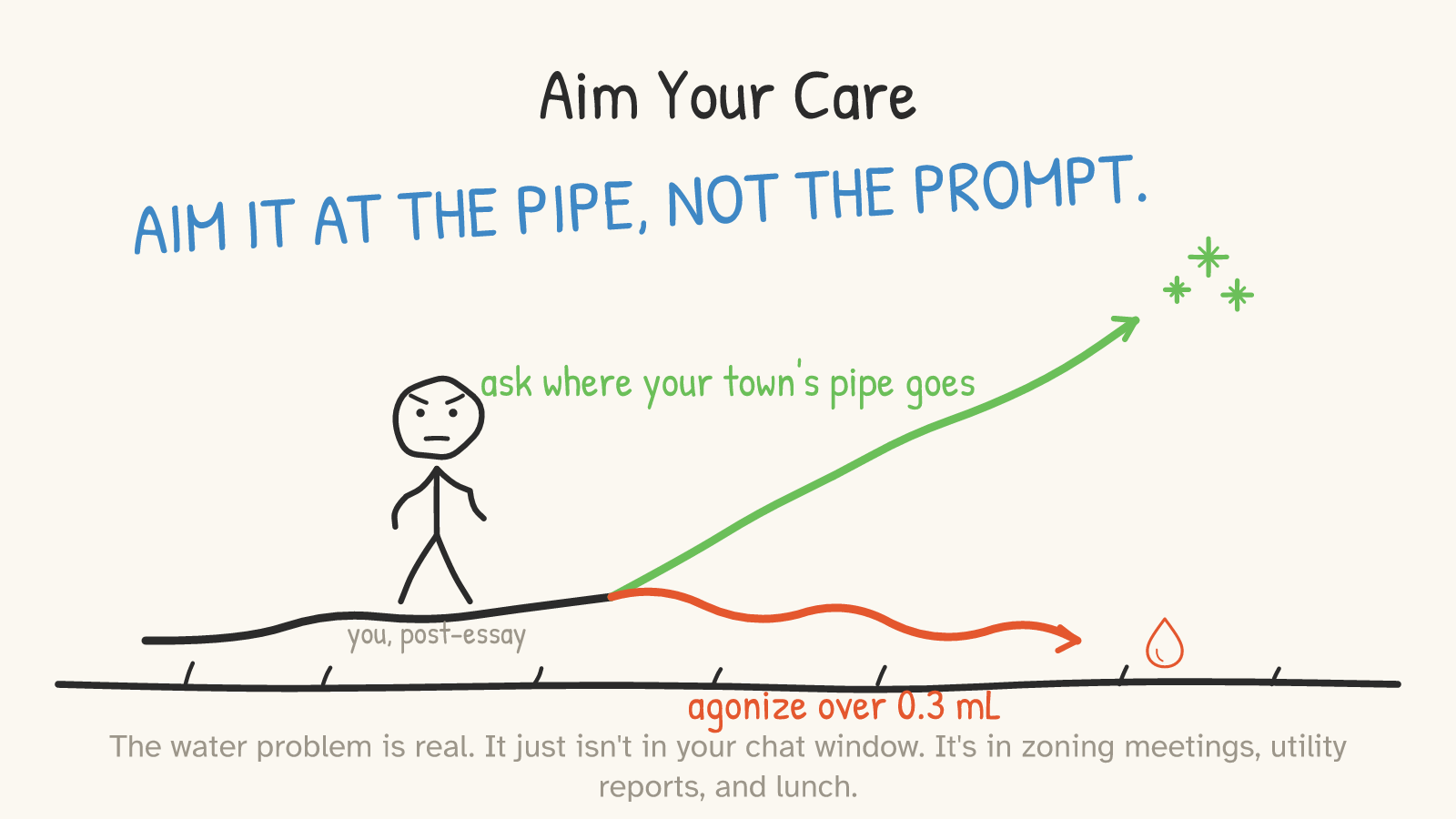
The per-prompt number is somewhere between five drops and three teaspoons. Run the comparison in blue water or municipal water and it gets worse for the panic, not better. And the parts of the story that are real and getting realer are answered in zoning meetings, utility filings, and disclosure rules — not in your chat window.
Care about water. Care a lot. Aim it at the pipe, not the prompt.
Footnotes & receipts
- Washington Post / Shaolei Ren (UC Riverside), Sept 2024: ~519 mL per 100-word GPT-4 email, 235–1,408 mL across grids — 2023-era model, worst-case grid, electricity-generation water included. Ren's 2025 per-prompt estimate, ~15 mL including off-site water, reflects newer models on cleaner infrastructure rather than a correction of the original arithmetic. ↩
- Google, "Measuring the environmental impact of AI inference," Aug 2025: median Gemini text prompt ≈ 0.24 Wh, 0.26 mL water. Company-reported, point-in-time, not independently verified. ↩
- Sam Altman, "The Gentle Singularity," June 2025: ≈ 0.000085 gal (≈ 0.32 mL) per average ChatGPT query. Same caveats as above. ↩
- Jegham et al. 2025 (arXiv:2505.09598): ≈ 1.2 mL per short GPT-4o query, infrastructure-aware. Sean Goedecke, 2025: ≈ 5 mL all-in. Li, Yang, Islam & Ren 2023 (arXiv:2304.03271): 10–25 mL per GPT-3 query — the paper most early coverage drew on. ↩
- Mistral AI with Carbone 4 and ADEME, 2025: ≈ 45 mL per 400-token prompt, full lifecycle, ~91% of it amortized training; includes an amortized hardware-manufacturing component. ↩
- See Andy Masley, "The AI water issue is fake," for both the case against per-prompt panic and the documentation of how far company figures and viral claims diverge — including a published claim about one data center's water use that overstated reality by roughly 4,500×. ↩
- Low end ≈ 4 L: California-specific, Fulton et al. / Almond Board 2018. High end ≈ 12 L: global average, Mekonnen & Hoekstra 2011. The gap is method and region, not error. ↩
- Water Footprint Network / Mekonnen & Hoekstra 2012: ≈ 1,650 L for a quarter-pound patty's footprint up to the widely cited ≈ 2,500 L ("660 gallons") figure; beef varies ~10,000–30,000+ L/kg by production system. ↩
- Blue-water burger range: Mekonnen & Hoekstra's decomposition puts global-average beef blue water around ~550 L/kg, i.e. roughly 60 L for a quarter-pound patty — the conservative figure used in the body. The ~930 L (~245 gal) figure is SemiAnalysis's 2025 ingredient-level analysis of a fast-food double burger (an industry newsletter, not peer-reviewed; ~95% of its total is the beef). We quote the range and argue from its bottom end. ↩
- Lawrence Berkeley National Laboratory, "2024 United States Data Center Energy Usage Report": ≈ 66 B L (17.4 B gal) direct consumption 2023; ≈ 800 B L (211 B gal) indirect via electricity. The 2028 case combines LBNL's 325–580 TWh electricity range with site cooling water (WUE 0.45–0.48 L/kWh, a site-level figure) plus electricity-generation water at today's grid intensity held constant — direct and indirect water computed separately and summed. 430–773 B gal vs. 229 B gal in 2023 is a 14–28% compound annual growth rate. ↩
- Golf ≈ 547 B gal/yr (GCSAA 2020, via Lincoln Institute "Data Drain"); lawns > 2 T gal/yr (Lincoln Institute); USGS 2015: irrigation ≈ 26.7 T gal/yr. These are predominantly withdrawal or total-use figures while data-center numbers are consumption; consumption-only versions of golf/irrigation are substantially smaller but remain orders of magnitude above data-center totals. ↩
- Tom's Hardware / EnviroLink, June 2026, reporting on planning data: roughly two-thirds of 809 planned or under-construction U.S. data centers in drought-prone areas. The drought classification methodology behind the survey is not fully public; treat the fraction as directional, corroborated by note 13. ↩
- MSCI, "When AI Meets Water Scarcity," 2025–26: global data-center water use ≈ 560 B L/yr now, projected ≈ 1.2 T L by 2030; ~¼ of existing facilities and ~⅓ of those under construction face intensifying water stress. ↩
- Brookings, "AI, data centers, and water": typical facility ≈ 300,000 gal/day, large ≈ 5 M gal/day; cooling water demand could grow ~870%; argues for regional water-utility/economic-development coordination. Loudoun County data-center tax revenue ≈ $900 M/yr. ↩
- Han, Li, Wierman & Ren, "Small Bottle, Big Pipe," 2026 (arXiv:2603.02705): per-prompt water is small, and aggregate data-center growth could require substantial new public-water capacity through 2030, concentrated in host communities. Both halves of this essay's thesis, in one paper title. ↩
- Workload heterogeneity and fabs: no per-query water measurements have been published for long-horizon reasoning or video-generation workloads; the "tens to hundreds of times" range reflects their relative compute intensity versus short text inference. Semiconductor fabrication water (TSMC's Taiwan operations alone use on the order of tens of millions of tonnes per year) is geographically concentrated in Taiwan, South Korea, and Arizona, and is outside this essay's U.S. data-center accounting. ↩